
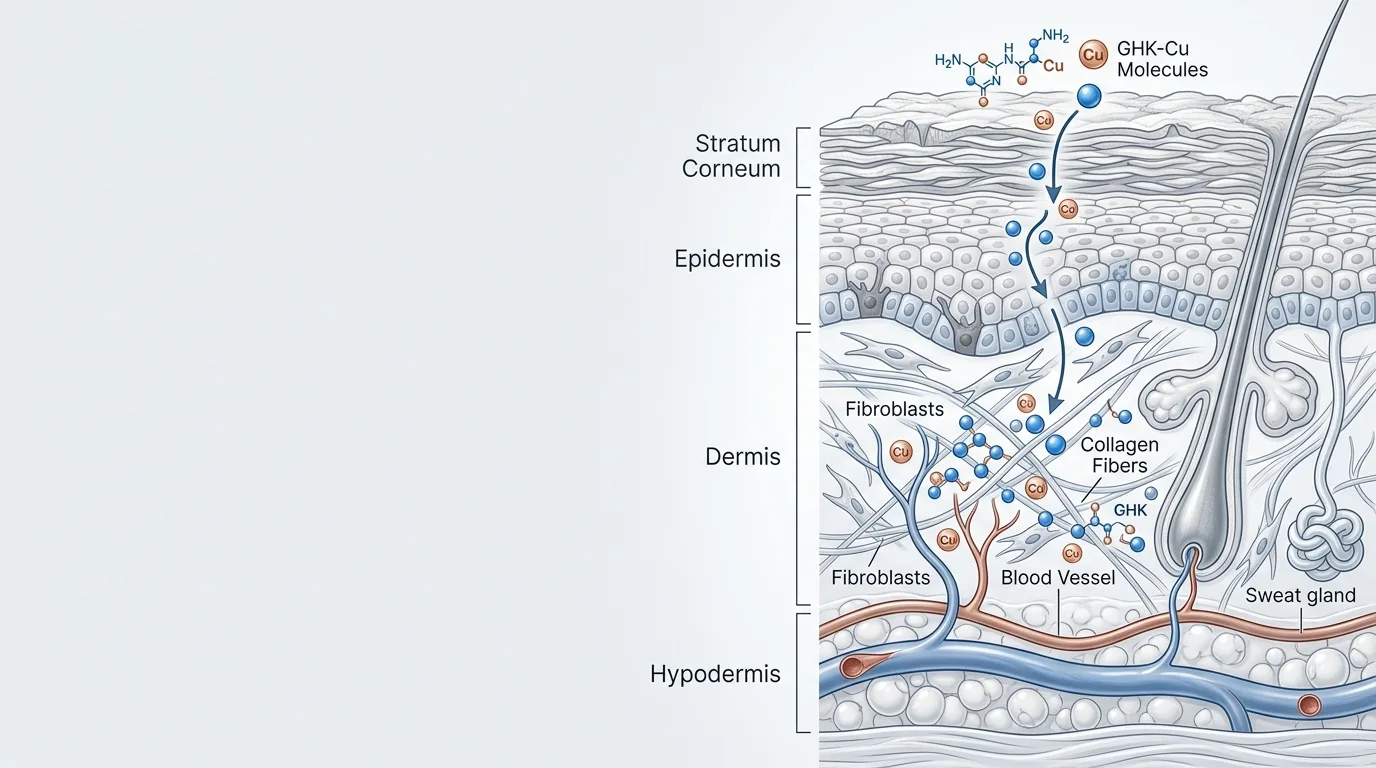
GHK-Cu appears in the ingredient lists of serums, creams, and injectable peptide protocols with growing frequency, accompanied by claims that range from credible to extravagant. The science underlying those claims is genuinely compelling. Yet the practical question that most marketing materials carefully sidestep is this: does topically applied GHK-Cu actually reach its target tissues at concentrations sufficient to trigger the biology everyone is excited about? The answer depends almost entirely on physical chemistry that most product pages never mention.
GHK-Cu is a naturally occurring tripeptide, glycyl-L-histidyl-L-lysine, first isolated by Loren Pickart from human albumin fractions in 1973. It binds copper(II) with unusual affinity and accumulates in skin, plasma, and saliva at concentrations that decline measurably with age. Understanding GHK-Cu topical vs injectable bioavailability is not a niche concern for researchers. It is the foundational question that determines whether any product built around this molecule can deliver on its promises. This article maps the pharmacokinetic realities, explains the delivery science, and gives you the tools to evaluate claims with appropriate skepticism.
What Is GHK-Cu and Why Does Delivery Matter?
Loren Pickart's original 1973 work in Nature New Biology identified GHK as a fragment associated with albumin that stimulated liver tissue regeneration in vitro. The copper-binding properties came into focus later, and the full significance of the copper coordination geometry took decades to establish. What emerged is a picture of a tripeptide that acts less like a simple growth signal and more like a regulatory conductor, modulating dozens of biological pathways simultaneously.
Plasma concentrations tell part of the aging story. At ages 20 to 25, circulating GHK sits at approximately 200 ng/mL. By age 60, that figure drops to roughly 80 ng/mL, a decline of around 60 percent. Researchers hypothesize this reduction contributes to slower tissue repair and elevated baseline inflammation in older adults. The concentration data across age groups illustrates why interest in supplementing GHK-Cu externally has grown.
The copper-bound form is the active form. GHK binds Cu(II) with a log K of approximately 16.4, an affinity that substantially exceeds most endogenous copper-chelating agents. This tight coordination allows GHK-Cu to donate copper to cuproenzymes and activate downstream signaling cascades that the free peptide alone cannot fully replicate. Studies by Maquart and colleagues confirmed that GHK without copper retains some activity on fibroblast migration and TGF-beta modulation, but GHK-Cu is consistently more potent across assays.
The downstream effects are substantial. GHK-Cu upregulates over 31 genes associated with wound healing and tissue repair in fibroblast cultures, including collagen I, collagen III, fibronectin, and decorin, while simultaneously suppressing TNF-alpha and IL-6 pro-inflammatory pathways. None of this biology is accessible, however, unless the peptide reaches the target cells. Delivery route is not a secondary consideration. It is the primary determinant of whether any of this documented science translates to a measurable outcome.
The 500 Da Rule and GHK-Cu Topical vs Injectable Bioavailability Permeation Challenge
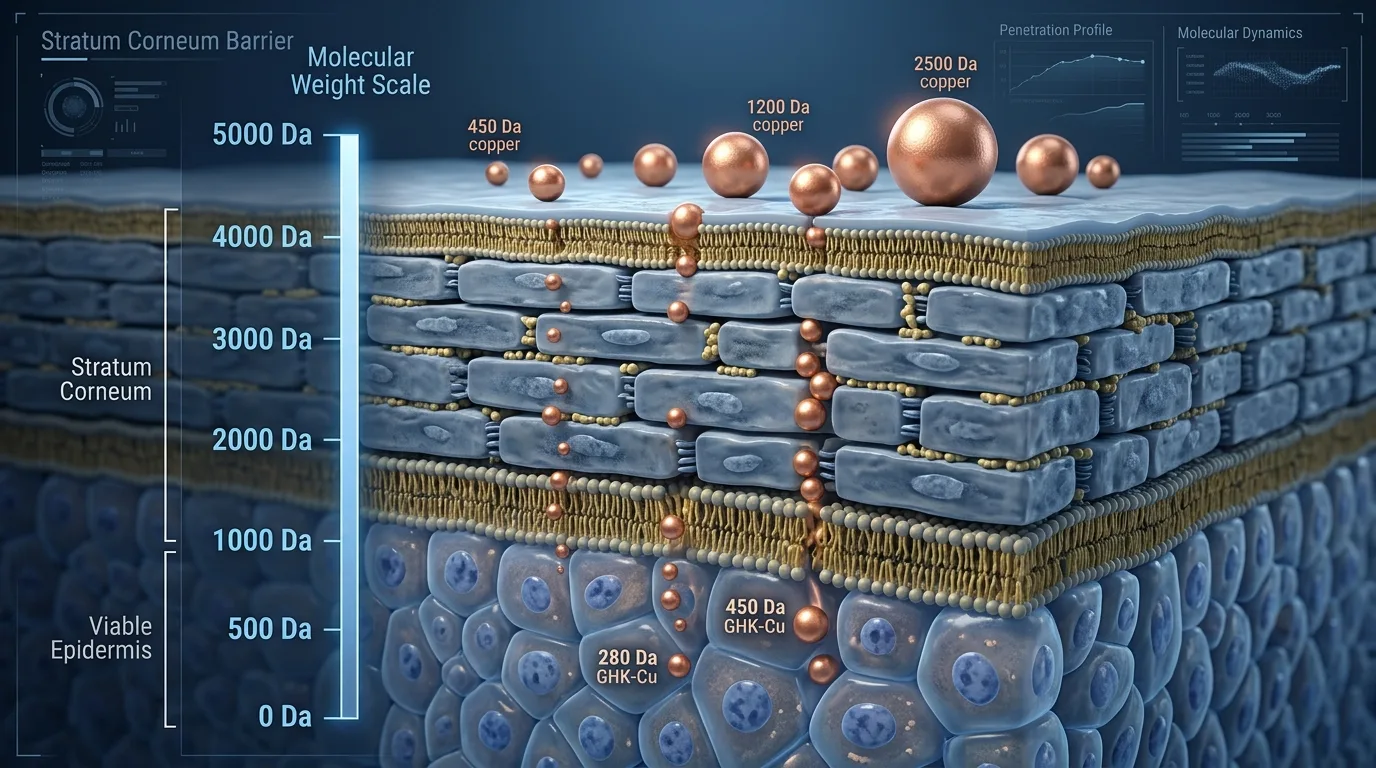
Dermatopharmacology uses a practical heuristic derived from adaptations of Lipinski's rules: molecules with molecular weights above approximately 500 Da face severe barriers to passive transdermal penetration. The stratum corneum, the outermost layer of skin comprising densely packed corneocytes and lamellar lipid bilayers, is the primary gatekeeper. GHK-Cu as a copper complex has a molecular weight of approximately 403.9 Da, placing it below the cutoff on paper. The reality is more complicated.
Molecular weight is a necessary but insufficient predictor of skin penetration. The second critical parameter is logP, the partition coefficient measuring a molecule's relative affinity for lipid versus water phases. GHK-Cu is highly hydrophilic, carrying a low logP that reflects its preference for aqueous environments. The dominant passive route through the stratum corneum is the intercellular lipid pathway, where molecules partition into and diffuse through the lipid-rich lamellar structures between corneocytes. A molecule that resists lipid partitioning is poorly suited to this route regardless of its molecular weight.
Skin permeation pathways divide into three categories. The transcellular route passes directly through corneocytes, requiring molecules to repeatedly partition between lipid and aqueous phases. The intercellular lipid route winds between cells through a continuous lipid matrix. The appendageal route uses hair follicles and sweat glands to bypass the stratum corneum partially. GHK-Cu's physicochemical profile makes all three challenging. Its charge state at physiological pH, the hydrogen bond donors and acceptors distributed across the glycine, histidine, and lysine residues, and its hydration shell collectively compound what the molecular weight alone would suggest.
To put this concretely, an ideal passive transdermal molecule would have a molecular weight below 500 Da, a logP between 1 and 3, fewer than five hydrogen bond donors, and minimal charge at skin surface pH. GHK-Cu satisfies only the molecular weight criterion. This is not a disqualifying failure; it is a design constraint that shifts the burden onto formulation technology. The comparison between GHK-Cu's actual properties and ideal transdermal properties clarifies exactly where the permeation gap lies. These numbers highlight why aqueous formulations without carrier systems face the steepest uphill challenge.
What Delivery Strategies Actually Improve Skin Penetration?
The gap between GHK-Cu's documented biology and its topical bioavailability is real, but it is not fixed. Formulation science offers several strategies that meaningfully alter the penetration equation, and the differences between them are large enough to matter when evaluating products.
Liposomal encapsulation represents the most studied enhancement approach. Preclinical data show that liposomal GHK-Cu achieves up to 4-fold improvement in skin penetration compared to equivalent aqueous solution formulations. The mechanism involves lipid bilayer fusion with stratum corneum lipids, allowing the liposome to locally disrupt the lipid organization and deposit its payload closer to viable epidermis. A 4-fold improvement in relative delivery efficiency is a clinically meaningful number, not a marginal gain. The relative penetration improvement by formulation type illustrates why carrier selection is the most important variable a consumer or researcher can evaluate.
Solid lipid nanoparticles represent an active and promising area. Unlike basic emulsion carriers, solid lipid nanoparticles provide a semi-crystalline lipid matrix that controls release kinetics and improves partitioning into lipid-rich skin layers. The sustained release profile may also reduce concentration-dependent degradation at the skin surface. These systems are more complex and expensive to manufacture, which is why their presence in a product formulation is a credible technical signal.
Chemical penetration enhancers, including ethanol, propylene glycol, and oleic acid, work by transiently disrupting the organized lipid structure of the stratum corneum. Ethanol extracts lipids from the intercellular spaces, increasing fluidity. Oleic acid inserts into lipid bilayers and creates disordered phases that allow larger, more hydrophilic molecules to penetrate. The trade-off is irritation potential at higher concentrations and the transient nature of the effect. These enhancers are widely used because they are cost-effective and well-characterized, but they offer a more modest permeation improvement than liposomal or nanoparticle systems.
Evaluating a product's delivery claims requires looking past ingredient lists to formulation architecture. Aqueous serums listing GHK-Cu without any carrier technology represent the weakest case for dermal delivery. Credible formulation indicators include liposome or nanoparticle encapsulation explicitly stated in technical documentation, a logically constructed vehicle pH near 7.4, and absence of known destabilizing ingredients at concentrations that would compromise the copper complex. Red flags include vitamin C or AHA concentrations high enough to acidify the formulation significantly, claims of "deep penetration" without any described delivery mechanism, and no discussion of GHK-Cu stability in the product context.
What Does the Clinical Evidence Actually Show for Topical GHK-Cu?
The most important human clinical trial for topical GHK-Cu remains a 2001 double-blind, placebo-controlled RCT published by Leyden and colleagues in the Archives of Dermatology. The study demonstrated statistically significant improvements in skin laxity, density, and thickness after 12 weeks of use compared to placebo. This is one of the few genuine randomized controlled human trials this peptide has, and its existence matters. It provides controlled evidence that a topical GHK-Cu formulation can produce measurable skin structure improvements under rigorous conditions.
The GAG-stimulating mechanism adds a distinct dimension to the clinical picture. GHK-Cu stimulates dermal fibroblasts to produce glycosaminoglycans including hyaluronic acid and dermatan sulfate, contributing to improved skin hydration and extracellular matrix integrity. This effect is mechanistically separate from collagen stimulation and likely additive to it, meaning that even partial penetration to viable epidermis could produce hydration-related improvements at lower concentrations than those required for full collagen remodeling effects.
Honest analysis of the evidence landscape requires acknowledging the gap between the volume of scientific interest and the volume of human clinical data. The mechanistic case for GHK-Cu is built primarily on in vitro fibroblast cultures and murine models, both of which involve direct peptide application to target cells without a skin barrier in the way. Human RCT data, specifically placebo-controlled trials examining dermal remodeling, remain sparse relative to the marketing activity surrounding this ingredient.
Evidence quality varies substantially by claim type. Clinical evidence for surface-level outcomes like skin hydration and perceived texture improvement is relatively stronger, supported by the Leyden trial and consistent with the GAG mechanism. Evidence for claims about deep tissue remodeling, particularly wound healing or anti-fibrotic effects via topical application, is considerably weaker because these mechanisms require the peptide to reach dermal depths where formulation delivery limitations are most pronounced. The breakdown across claim categories illustrates why applying uniform confidence to all GHK-Cu marketing claims is scientifically unjustified.
Is GHK-Cu Safe to Inject Subcutaneously?
Subcutaneous injection bypasses the skin barrier entirely. The peptide enters systemic circulation at a defined dose, and the pharmacokinetics are no longer constrained by logP or stratum corneum architecture. From a purely bioavailability perspective, injection solves the penetration problem that limits topical application. The practical considerations, however, introduce a different set of concerns that deserve honest treatment.
The regulatory position is clear. Injectable GHK-Cu sits in drug territory in the United States and European Union. It has not completed the clinical trial pathway required for pharmaceutical approval as an injectable therapeutic. The research peptide and biohacking markets operate in the legal gray area created by research-use exemptions and the absence of active enforcement against non-clinical sales, but this does not create regulatory legitimacy. It creates regulatory ambiguity, which is a meaningfully different thing.
Quality assurance is the most pressing practical issue. Pharmaceutical-grade injectable preparations require sterility testing, endotoxin levels below 0.1 EU/mL, and mass spectrometry-verified identity. Cosmetic-grade and research peptide market materials frequently lack these assurances. A material listed as 95 percent pure by HPLC may contain endotoxin levels sufficient to cause systemic inflammatory responses when injected, even if the peptide itself is chemically authentic. This is not a hypothetical risk; it is a routine quality gap in unregulated markets.
Current human safety data for subcutaneous GHK-Cu are limited. What exists is generally favorable at low doses, consistent with the peptide's endogenous origin and its presence in human plasma. This does not, however, constitute a safety profile adequate for clinical recommendation. The absence of reported adverse events in informal biohacking communities reflects reporting gaps as much as genuine safety, and it provides no information about dose-response relationships, long-term exposure effects, or interactions with individual health conditions.
Why Do Some GHK-Cu Products Turn Blue or Green?
The characteristic blue-green color of GHK-Cu solutions is not a contaminant or a formulation error. It is a direct optical signature of Cu(II) d-d electronic transitions within the copper coordination complex. The square-planar coordination geometry, with binding sites provided by the terminal amine of glycine, the imidazole nitrogen of histidine, and two deprotonated backbone amide nitrogens, creates an electronic environment that absorbs light in the red-orange range and transmits blue-green wavelengths. This is the same fundamental chemistry that gives copper sulfate solution its familiar color.
Color change from blue-green toward colorless or pale yellow is a practical signal worth paying attention to. It indicates copper dissociation from the peptide, pH shifts that disrupt the coordination geometry, or peptide degradation. None of these changes are desirable. A product that was once visibly blue-green and has become colorless has likely lost a meaningful fraction of its active copper complex. This makes color stability a useful, if imperfect, visual quality proxy.
pH is the most important stability variable. Optimal copper complexation occurs near physiological pH of 7.4. Many skincare formulations are buffered to pH 4.0 to 5.5, both to match skin surface pH and to stabilize co-ingredients like vitamin C and AHAs. At these acidic pH values, copper dissociation is thermodynamically favored, and the blue-green color diminishes accordingly. Co-formulating GHK-Cu with strongly acidic ingredients is a meaningful compatibility concern, not just a stability footnote.
Practical storage guidance follows directly from the chemistry. Light exposure accelerates photoreduction of Cu(II), heat increases dissociation rates, and acidic co-ingredients compete for copper coordination. Opaque packaging, refrigerated storage, and formulation separation from low-pH actives are all grounded in the underlying chemistry. Color stability confirms that the complex is intact but does not verify purity, concentration, or biological activity, so it should inform but not replace proper quality documentation.
Topical vs. Injectable GHK-Cu: A Practical Comparison
Comparing these two delivery routes across the dimensions that matter most for scientifically literate evaluation requires resisting the temptation to declare a clear winner. The honest picture is that both routes have distinct profiles of strength and limitation, and the appropriate choice depends heavily on context, purpose, and quality assurance access.
Across five key dimensions, the profiles diverge sharply. Bioavailability certainty favors injectable delivery, which bypasses the skin barrier and delivers peptide systemically at definable concentrations. Topical bioavailability is highly formulation-dependent and, at best, delivers a fraction of applied dose to the viable dermis. Evidence quality currently favors topical application, paradoxically, because the 2001 Leyden RCT and supporting in vitro work provide a more complete clinical picture than any human trial data for injectable use. Regulatory status clearly favors topical, which is broadly permitted as a cosmetic ingredient, versus injectable, which operates without regulatory clearance in most jurisdictions. Safety profile is nuanced: topical GHK-Cu has an established record of tolerability, while injectable use carries quality-assurance risks that are not resolved by the peptide's endogenous origin. Practical accessibility strongly favors topical, which is commercially available in regulated cosmetic channels with at least some product quality oversight.
A scientifically literate evaluator approaching either route should ask specific questions. For topical products: what delivery system is used, what is the formulation pH, and has the manufacturer documented GHK-Cu stability in the final product? For injectable use: what quality documentation is available, how were endotoxin levels tested, and what is the source's track record for identity verification by mass spectrometry? These questions do not guarantee good answers, but asking them distinguishes evidence-based evaluation from label reading.
The comparison between routes underscores a broader principle: GHK-Cu topical vs injectable bioavailability is not simply a question of which route delivers more peptide. It is a question of which route delivers verified, active peptide safely to the intended target tissue, and the answers to those questions are currently more favorable for well-formulated topical products than they are for unregulated injectable preparations.
GHK-Cu's documented biology remains among the most compelling profiles of any cosmetic tripeptide under active investigation. The age-related plasma decline, the 31-plus wound-healing gene upregulation, the glycosaminoglycan stimulation, and the anti-inflammatory pathway modulation collectively represent a mechanistic case that is difficult to dismiss. What the physical chemistry also makes clear is that this biology is not automatically accessible through every product that lists GHK-Cu on its label.
The 4-fold penetration improvement from liposomal delivery and the positive findings from the Leyden 2001 RCT together represent the strongest available evidence that well-formulated topical products can produce measurable outcomes. These findings do not validate all topical products equally, and they do not provide a basis for extrapolating to claims about deep tissue remodeling that the current evidence base does not yet support. Injectable GHK-Cu solves the penetration problem but replaces it with regulatory and quality-assurance challenges that are not yet resolved.
The framework for evaluation is straightforward: molecular weight and logP determine the baseline penetration challenge, carrier technology determines how much of that challenge is overcome, formulation pH determines whether the active complex remains intact, and citation quality determines whether efficacy claims have any empirical grounding. Applying this framework consistently is more valuable than any single study or product recommendation. GHK-Cu is one of the most scientifically interesting tripeptides known, and the field's willingness to engage honestly with its limitations is itself a sign of scientific maturity worth emulating.
Sources
- formblends.com — formblends.com
- deltapeptides.com — deltapeptides.com
- curology.com — curology.com
- nih.gov — pmc.ncbi.nlm.nih.gov
- nih.gov — pmc.ncbi.nlm.nih.gov
- bocsci.com — liposomes.bocsci.com
- nih.gov — pmc.ncbi.nlm.nih.gov
- nih.gov — pmc.ncbi.nlm.nih.gov
- plasticsurgerykey.com — plasticsurgerykey.com