

IGF-1 LR3 occupies a distinct category among research peptides. Its extended half-life, reduced binding protein affinity, and potent receptor activity make it one of the most pharmacologically aggressive tools available for studying anabolic and tissue-repair signaling. Pairing it with a growth hormone secretagogue like CJC-1295 seems, on the surface, like a logical amplification strategy. Both compounds act on the GH/IGF-1 axis. Both ultimately increase IGF-1 receptor stimulation. The theoretical logic writes itself.
The problem is that shared pathway is precisely what makes the IGF-1 LR3 and CJC-1295 combination uniquely hazardous rather than uniquely powerful. When CJC-1295 drives sustained endogenous IGF-1 production through the hepatic GH receptor axis, and exogenous IGF-1 LR3 floods IGF-1 receptors simultaneously, the result is not signal amplification. It is system saturation. Two inputs converging on the same receptor do not double the output; they compete for occupancy and, past a threshold, trigger the biological penalties that receptor biology consistently delivers under chronic co-stimulation.
This article evaluates the IGF-1 LR3 and CJC-1295 combination risks across three specific domains: hypoglycemia risk from compounded free IGF-1 activity, IGF-1 receptor downregulation from dual-source chronic stimulation, and the timing window problem that arises from CJC-1295's pharmacokinetic architecture. The goal is a data-driven framework that helps researchers assess whether this stack offers genuine additive benefit or simply compounds risk without proportionate reward.
Understanding the Dual IGF-1 Signal Problem
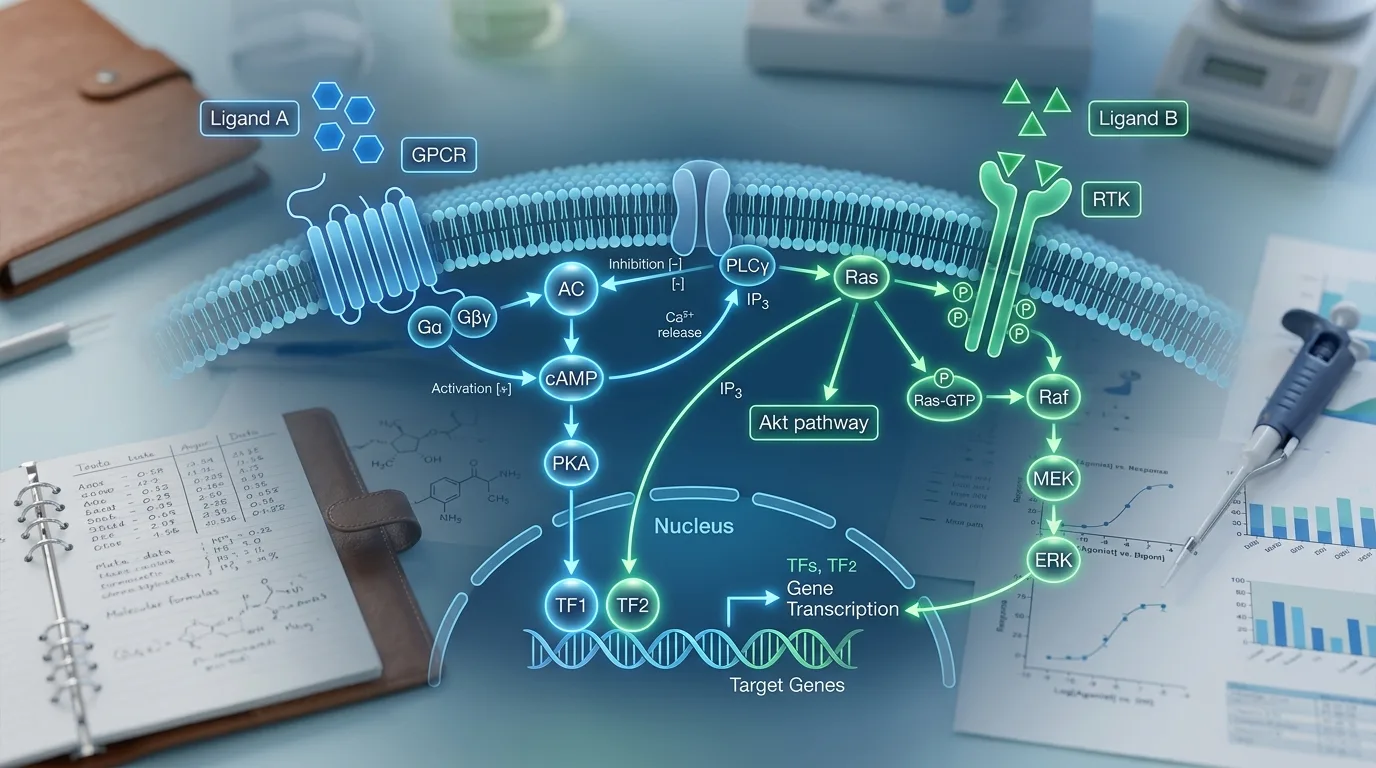
CJC-1295 stimulates the pituitary to secrete growth hormone, which then travels to the liver and binds hepatic GH receptors, triggering endogenous IGF-1 synthesis and secretion. In a landmark 2006 clinical trial, a single subcutaneous dose of CJC-1295 produced IGF-1 elevations of 1.5 to 3-fold above baseline that persisted for six days post-dose. This is not a brief pulse. It is a sustained, days-long elevation of endogenous IGF-1 that remains active in circulation long after the initial administration.
IGF-1 LR3 introduces a second, independent source of IGF-1 receptor stimulation on top of that endogenous elevation. Its pharmacokinetic profile is markedly different from native IGF-1, which has a plasma half-life of five to six hours. IGF-1 LR3's half-life runs approximately 20 to 30 hours, extended through its N-terminal 13-amino acid modification and arginine substitution at position 3. Critically, this structural modification also reduces its binding affinity for IGF-1 binding protein 3 (IGFBP-3), meaning a substantially higher fraction of circulating IGF-1 LR3 remains free and receptor-active compared to native IGF-1.
When these two sources overlap, both CJC-1295-driven endogenous IGF-1 and exogenous IGF-1 LR3 compete for the same IGF-1 receptor population across muscle, adipose, and other target tissues. The convergence is not theoretical; it is a direct consequence of the pharmacokinetic overlap given CJC-1295's six-day IGF-1 elevation and IGF-1 LR3's 20 to 30 hour persistence. The cumulative ligand concentration at the receptor approaches saturation kinetics. Beyond that point, adding more ligand does not proportionally increase receptor activation. It increases receptor occupancy toward a ceiling while simultaneously triggering internalization and downregulation responses.
These numbers highlight a fundamental mechanistic ceiling that makes the additive benefit case considerably harder to sustain than the intuitive rationale suggests.
CJC-1295 Pharmacokinetics and the GH Pulse Architecture
CJC-1295 with DAC achieves its prolonged activity through covalent albumin binding via a lysine residue modification, creating receptor occupancy that lasts six to eight days. This fundamentally changes how it interacts with the GH axis. Physiological GH secretion is pulsatile, characterized by discrete surges separated by troughs during which receptor sensitivity is maintained and restored. CJC-1295 with DAC does not mimic this architecture. It produces a continuous background elevation of GH stimulation, which is why the standard pharmacodynamic rationale for pairing it with a short-acting GHRP is to generate pulses atop that background, preserving some pulsatile character.
In the 2006 clinical trial, CJC-1295 produced dose-dependent mean GH concentration increases of 2 to 10-fold above baseline, with peptide half-lives of 5.8 to 8.1 days for the modified compound. That GH elevation drives a sustained hepatic IGF-1 production response. Under these conditions, CJC-1295 alone already removes much of the GH axis trough that receptor sensitivity depends upon. Layering IGF-1 LR3 on top eliminates the remaining recovery window for IGF-1 receptor sensitivity.
The quantitative picture matters here. CJC-1295 alone drives IGF-1 1.5 to 3-fold above baseline for six days. IGF-1 LR3 at research-relevant doses adds an independent, free-IGF-1-enriched signal persisting 20 to 30 hours per administration. Across a seven-day window, a researcher using both compounds is maintaining near-continuous supra-physiological IGF-1 receptor stimulation from two independent sources. The breakdown illustrates how cumulative IGF-1 receptor exposure in this stack far exceeds what either compound would produce independently.
Hypoglycemia Risk in the IGF-1 LR3 and CJC-1295 Combination Risks
The hypoglycemia risk mechanism in this combination is direct and quantifiable. IGF-1 receptors are expressed in hepatic tissue and peripheral muscle, and their activation suppresses hepatic glucose output while enhancing peripheral glucose uptake through mechanisms that parallel insulin signaling. IGF-1 LR3's reduced IGFBP-3 binding means a larger free fraction is receptor-active compared to native IGF-1 at equivalent total plasma concentrations. When CJC-1295 is simultaneously driving endogenous IGF-1 production, total free IGF-1 activity across both sources creates a theoretical additive risk of hypoglycemia, rather than simple additive suppression.
The critical risk differentiator between standalone IGF-1 LR3 use and the stacked protocol is predictability. With IGF-1 LR3 alone, hypoglycemia risk is dose-dependent and manageable through careful titration and glucose monitoring. In a CJC-1295 stack, the endogenous IGF-1 contribution is variable. It depends on the individual's pituitary responsiveness, hepatic GH receptor sensitivity, and baseline IGF-1 status. That variability makes the combined free IGF-1 activity difficult to titrate with precision, creating an unpredictable additive glucose suppression profile.
Consider the estimated free IGF-1 activity gradient across three conditions. IGF-1 LR3 alone at standard research doses produces a moderately elevated free IGF-1 activity index. CJC-1295 alone elevates endogenous IGF-1 1.5 to 3-fold above baseline, with normal IGFBP-3 binding partially buffering free fractions. The combined protocol produces both elevated total IGF-1 from endogenous production and an additional high-free-fraction exogenous signal, creating the highest cumulative free IGF-1 activity of the three conditions. These numbers highlight a risk gradient that is not linear: the combined condition represents a qualitatively different risk profile, not simply an additive one.
Timing IGF-1 LR3 post-workout partially mitigates this risk. Exercise-induced glucose uptake in skeletal muscle reduces the net glucose-lowering impact of IGF-1 receptor activation during the post-exercise window. This is a real but incomplete mitigation strategy; it reduces the hypoglycemia risk window without eliminating the underlying pharmacodynamic mechanism.
IGF-1 Receptor Downregulation and Diminishing Returns
Sustained receptor stimulation from a dual-source IGF-1 signal does not produce sustained proportional signaling output. IGF-1 receptors, like all G protein-coupled and tyrosine kinase receptors under chronic high-ligand conditions, undergo internalization and surface expression reduction. Under dual-source stimulation, this downregulation can manifest within 48 to 72 hours, establishing a practical ceiling on how long the stack can deliver meaningful receptor activation.
This timeline parallels a well-documented phenomenon elsewhere on the GH axis. GHS-R1a, the ghrelin receptor targeted by GHRPs, undergoes measurable desensitization within 48 to 72 hours under continuous non-pulsatile administration. Receptor biology does not distinguish between receptor types in this penalty. Across the GH/IGF-1 axis, chronic co-stimulation from converging ligands consistently produces diminished receptor surface expression and reduced downstream signaling amplitude. The IGF-1 receptor is not an exception.
The practical consequence is significant for protocol design. A researcher constructing this stack in pursuit of synergistic anabolic or tissue-repair signaling may achieve the opposite outcome after the first 48 to 72 hours: a net reduction in IGF-1 receptor responsiveness that persists beyond the administration window. The anabolic endpoint the stack was designed to achieve becomes pharmacologically unavailable precisely because the receptor population has been chronically oversaturated. Every researcher evaluating this protocol should ask whether the target tissue expresses sufficient receptor reserve to sustain dual-signal stimulation, or whether the stack design is actively defeating its own purpose.
Timing IGF-1 LR3 Relative to GH Pulse Windows
Understanding the GH pulse-to-IGF-1 conversion timeline is central to evaluating when the convergence risk in this stack peaks. Following a GH pulse, whether natural or secretagogue-driven, hepatic IGF-1 production rises over approximately four to six hours and remains elevated for several hours thereafter. This post-pulse window represents the period of highest endogenous IGF-1 activity. Administering exogenous IGF-1 LR3 during or immediately following this window creates the greatest peak-on-peak convergence at the IGF-1 receptor.
The optimal offset strategy, to the extent one exists within this stack, involves administering IGF-1 LR3 during the trough between GH pulses, not coincident with them. This reduces the peak IGF-1 receptor load while still achieving exogenous receptor engagement. Given IGF-1 LR3's 20 to 30 hour half-life, however, true separation between exogenous and endogenous IGF-1 activity is difficult to achieve in practice. The compound's persistence means that even well-timed administration will overlap with subsequent GH pulses driven by CJC-1295.
Hepatocyte GH receptor expression follows circadian variation, peaking in early morning hours in both rodent and human models. Evening administration of CJC-1295 is specifically designed to exploit the pre-sleep pulsatile GH surge, when pituitary GH secretion naturally amplifies. This means IGF-1 LR3 timing must be deliberately offset from this evening-to-early-morning high-activity window to minimize peak-on-peak IGF-1 receptor stimulation. A 24-hour GH pulse map overlaid with IGF-1 LR3's plasma concentration curve would show narrow windows where convergence risk is minimized, with the evening through early morning period representing the highest-risk zone for simultaneous peak activity. The breakdown illustrates that the timing challenge in this stack is not incidental but structural.
AOD-9604 provides a useful contrast for researchers seeking an alternative stacking partner. As a modified fragment of hGH targeting adipocyte beta-3 adrenergic receptors for lipolysis, AOD-9604 does not activate the full GH receptor and does not raise IGF-1. It adds an independent lipolytic mechanism without any contribution to IGF-1 receptor convergence, making it mechanistically safe within a GH secretagogue stack and avoiding the timing problem entirely.
Does This Stack Offer Genuine Additive Benefit?
The theoretical rationale for combining IGF-1 LR3 with CJC-1295 rests on achieving supra-physiological IGF-1 receptor stimulation for anabolic or tissue-repair endpoints. The mechanistic logic is coherent at a surface level: more IGF-1 receptor activation should drive greater downstream signaling through PI3K/Akt/mTOR pathways associated with protein synthesis and cellular repair. The problem emerges when that theoretical rationale is weighed against the documented risk domains and the receptor kinetics that govern real-world outcomes.
The honest and necessary disclosure here is that no peer-reviewed clinical data directly evaluates the IGF-1 LR3 and CJC-1295 combination. Every risk projection in this analysis is a mechanistic inference derived from individual peptide pharmacology. That is not a reason to dismiss the analysis; mechanistic inference is the appropriate scientific tool when direct combination data does not exist. It is, however, a limitation that must be stated clearly in any responsible protocol assessment, particularly one involving compounds with hypoglycemic potential.
Narrow conditions under which additive benefit is theoretically plausible do exist. Short-duration IGF-1 LR3 administration, not chronic use, limits the receptor downregulation window. Careful timing offsets from GH pulses reduce but do not eliminate peak convergence. Reducing CJC-1295 dosing to lower the endogenous IGF-1 baseline creates more headroom before receptor saturation. Active glucose monitoring converts an unmanaged risk into a tracked variable. None of these mitigations eliminate the core mechanistic conflicts; they reduce their magnitude.
Evaluating the risk distribution across the three primary domains yields a clear picture. Hypoglycemia risk in the combined protocol is high, driven by unpredictable additive free IGF-1 activity. IGF-1 receptor saturation risk is high, given the dual-source chronic stimulation and the 48 to 72 hour downregulation timeline. Pharmacokinetic conflict risk is moderate to high, given the structural mismatch between CJC-1295's six-to-eight day activity window and IGF-1 LR3's 20 to 30 hour half-life. The breakdown illustrates that no single risk domain is negligible, and all three are present simultaneously in this combination.
Practical Framework for Researchers Evaluating This Stack
Before combining IGF-1 LR3 with any GH secretagogue stack, four questions frame the minimum responsible evaluation. First, what is the subject's baseline IGF-1 level? CJC-1295 will elevate this further; knowing the starting point determines how much additional IGF-1 receptor load exogenous IGF-1 LR3 actually introduces. Second, is active glucose monitoring in place? Given the unpredictable additive glucose suppression mechanism, glucose response must function as a primary safety biomarker, not an afterthought. Third, what is the precise administration timing protocol relative to GH pulses? Coincident timing with the evening GH pulse window maximizes convergence risk. Fourth, what is the planned duration of concurrent administration? Even theoretically plausible short-duration benefit degrades rapidly past the 48 to 72 hour receptor downregulation threshold.
If the decision to proceed is made, several compatibility principles reduce risk at the margin. Using CJC-1295 without DAC rather than the DAC version shortens its activity window, which slightly reduces the sustained endogenous IGF-1 burden. Administering IGF-1 LR3 during the GH trough window, not coincident with pulses, reduces peak receptor convergence. Limiting concurrent administration to the shortest effective research window avoids crossing the receptor downregulation threshold. Treating glucose response as a primary outcome biomarker rather than a secondary safety note converts the most acute risk into a measurable variable.
Documentation is not optional in this protocol context. Given the complete absence of human clinical trial data on this specific combination, rigorous outcome tracking is the only available substitute for direct evidence. At minimum, researchers should record baseline and serial IGF-1 levels, fasting and post-administration glucose readings, administration timing relative to GH pulse windows, and any subjective or objective indicators of receptor sensitivity changes over time.
Researchers seeking complementary anabolic and repair signaling without IGF-1 convergence risk have cleaner architectural options. A CJC-1295 plus ipamorelin combination preserves pulsatile GH dynamics through complementary receptor targeting at the GHRH receptor and GHS-R1a. Adding BPC-157 to that foundation introduces pleiotropic tissue-repair activity through GH receptor upregulation, nitric oxide pathways, and VEGF signaling, all mechanistically orthogonal to the GH axis without compounding IGF-1 receptor load. AOD-9604 adds lipolytic activity through a completely independent adipocyte mechanism. These combinations achieve broad anabolic, repair, and metabolic endpoints without the dual IGF-1 signal convergence that defines the core risk of the IGF-1 LR3 and CJC-1295 combination.
Combining IGF-1 LR3 with CJC-1295 or related GH secretagogues is not pharmacologically irrational. The theoretical rationale is coherent, and narrow conditions of short duration, careful timing, reduced CJC-1295 dosing, and active glucose monitoring create a version of this stack that is less dangerous than its unconstrained form. But the core finding stands: the shared convergence on IGF-1 receptor signaling from two independent sources creates compounded risks across hypoglycemia, receptor downregulation, and pulsatility disruption that are not offset by any existing clinical evidence of superior outcomes over better-designed alternatives.
The timing-offset principle remains the most actionable mitigation available within this combination. Administering IGF-1 LR3 during GH troughs rather than coincident with CJC-1295-driven IGF-1 peaks does not resolve the dual-signal problem structurally, but it reduces the magnitude of peak receptor convergence in a way that is practically implementable. It is a harm-reduction measure, not a solution to the underlying mechanistic conflict.
Molecule Notes is committed to providing mechanistic clarity for researchers navigating exactly these kinds of protocol questions, where the intuitive logic and the underlying receptor biology point in different directions. If you want to go deeper on peptide compatibility frameworks, receptor kinetics across the GH axis, or the evidence base for alternative stack architectures, the related content below and the Molecule Notes newsletter offer ongoing synthesis of the primary literature as it develops. The goal is always to give researchers the tools to evaluate protocols on evidence, not on anecdote or surface-level rationale.
Sources
- substack.com — thepeptidelist.substack.com
- focalpointvitality.com — focalpointvitality.com
- edrubinmd.com — edrubinmd.com
- swolverine.com — swolverine.com
- youtube.com — youtube.com
- orthoandwellness.com — orthoandwellness.com
- fda.gov — fda.gov
- fda.gov — fda.gov
- nih.gov — pmc.ncbi.nlm.nih.gov
- endocrine-abstracts.org — endocrine-abstracts.org
- swolverine.com — swolverine.com
- harvard.edu — health.harvard.edu
- nih.gov — pubmed.ncbi.nlm.nih.gov
- medsafe.govt.nz — medsafe.govt.nz
- dopinglinkki.fi — dopinglinkki.fi
- nih.gov — pubmed.ncbi.nlm.nih.gov
- diatribe.org — diatribe.org