
In the early 1990s, a gastroenterology laboratory at the University of Zagreb School of Medicine was investigating one of the more fundamental questions in digestive biology: why does the stomach not digest itself? The gastric environment is chemically hostile, and yet the mucosal lining survives. Professor Dijalma Sikiric and his group reasoned that the answer might be encoded in the stomach's own chemistry, specifically in the proteins present in human gastric juice.
From that inquiry, the group isolated a partial amino acid sequence from a gastric juice protein they designated BPC, for Body Protection Compound. They synthesized a stable 15-amino-acid version and called it BPC-157. The question they started with was narrow. What followed was not.
Over the next three decades, the Zagreb laboratory published roughly 150 peer-reviewed papers on this single compound, documenting observations in rodent models spanning gastric ulcers, tendon injuries, ligament tears, nerve damage, corneal wounds, and skin repair. BPC-157 became one of the most widely discussed peptides in biohacking and bodybuilding communities while never completing a Phase II clinical trial. That gap between the lab bench and the popular market is not a minor detail. It is the central fact of this compound's story.
Everything that follows is observed in animal models, primarily rodents, conducted almost entirely by one research group in one country. That context belongs at the front of any honest account of the BPC-157 mechanism of action nitric oxide and related pathways.
What Is BPC-157 and Where Did It Come From
BPC-157 is a synthetic pentadecapeptide, meaning a chain of exactly 15 amino acids. Its sequence is Gly-Glu-Pro-Pro-Pro-Gly-Lys-Pro-Ala-Asp-Asp-Ala-Gly-Leu-Val. That precise sequence does not occur freely in nature; it was designed and stabilized by Sikiric's group at the University of Zagreb School of Medicine, derived from a longer gastric juice protein.
The original research hypothesis was specific: endogenous gastric proteins might encode peptide subsequences with intrinsic cytoprotective activity. Cytoprotective, for those outside biochemistry, refers to the capacity of a compound to shield cells from injury or death under conditions of stress, inflammation, or chemical insult. The stomach, in that framing, might carry its own chemical defense system within its proteins.
One property that drew early pharmacological interest was stability. BPC-157 is described in Zagreb group publications as resistant to enzymatic degradation and stable in human gastric juice. Most therapeutic peptides are fragile. They break apart in the digestive environment and require chemical modification, through processes such as PEGylation, which attaches polyethylene glycol chains to extend half-life, or cyclization, which loops the peptide into a ring structure to resist enzyme attack. BPC-157 reportedly did not require these interventions, which made it an unusual candidate for oral administration research and attracted early attention from gastroenterology-focused investigators.
The Zagreb Lab and the 30-Year Publication Arc
The scope of the Zagreb group's output is difficult to overstate in the context of a single institutional research program. Approximately 150 peer-reviewed publications emerged from or directly citing this group, documenting rodent model observations across gastric ulcers, duodenal ulcers, inflammatory bowel disease, tendon-to-bone healing, ligament repair, peripheral nerve regeneration, corneal injury, and dermal wound healing. For a single laboratory, that breadth is unusual.
The structural limitation is equally clear. The near-totality of this evidence base originates from one institution, with Croatian Ministry of Science grant funding acknowledged across publications. Peer commentators reviewing the BPC-157 literature have identified this insularity as a recognized methodological concern. Independent replication, the standard mechanism by which scientific findings earn broader credibility, has been limited relative to the total paper count.
The breadth-of-effect profile itself raises a scientific flag. A compound that appears to accelerate repair across a dozen tissue types in rodents is scientifically interesting, but also warrants scrutiny. Biology rarely produces a single molecule with no meaningful specificity. When animal models show effects this broad, the question of whether those effects are robust or are artifacts of particular experimental conditions becomes critical.
The clinical translation gap is the sharpest part of this picture. No Phase II or Phase III trial has published results in a peer-reviewed journal. One Phase II trial for inflammatory bowel disease was initiated, but results have not appeared in the published literature. After 30 years, the entire evidence base remains at the preclinical level. To put this numerically: approximately 150 animal-model papers exist, and zero completed human trials have published findings. The breakdown illustrates the scale of the translational gap in a way that prose alone cannot fully convey.
How BPC-157 Is Proposed to Work: An Overview
BPC-157 does not appear to function as a conventional drug in the pharmacological sense. Most small-molecule drugs and therapeutic peptides work by binding to a specific receptor with measurable affinity and triggering a defined downstream response. BPC-157 does not fit that model cleanly. Researchers characterize it as a pleiotropic modulator, meaning a compound that influences multiple biological pathways simultaneously rather than acting on a single molecular target.
Three primary proposed mechanisms have emerged from the Zagreb group's publications. The first is modulation of the nitric oxide system. The second is upregulation of VEGF, vascular endothelial growth factor, a protein that instructs cells to construct new blood vessels. The third is interaction with the FAK-paxillin signaling axis, a molecular relay that governs how cells physically move and attach to surrounding tissue.
Plain-language versions: nitric oxide is a short-lived signaling gas produced by cells lining blood vessels; VEGF is essentially a construction signal for new vasculature; FAK-paxillin is a relay system that tells cells where to go and how to anchor when tissue needs to be rebuilt. Each of these pathways is biologically legitimate and well-characterized in the broader scientific literature independent of BPC-157 research.
Whether all three mechanisms operate together, whether one drives the others, or whether they represent three loosely connected observations from a single research program is an open question. The published literature has not resolved it.
BPC-157 Mechanism of Action and Nitric Oxide Modulation
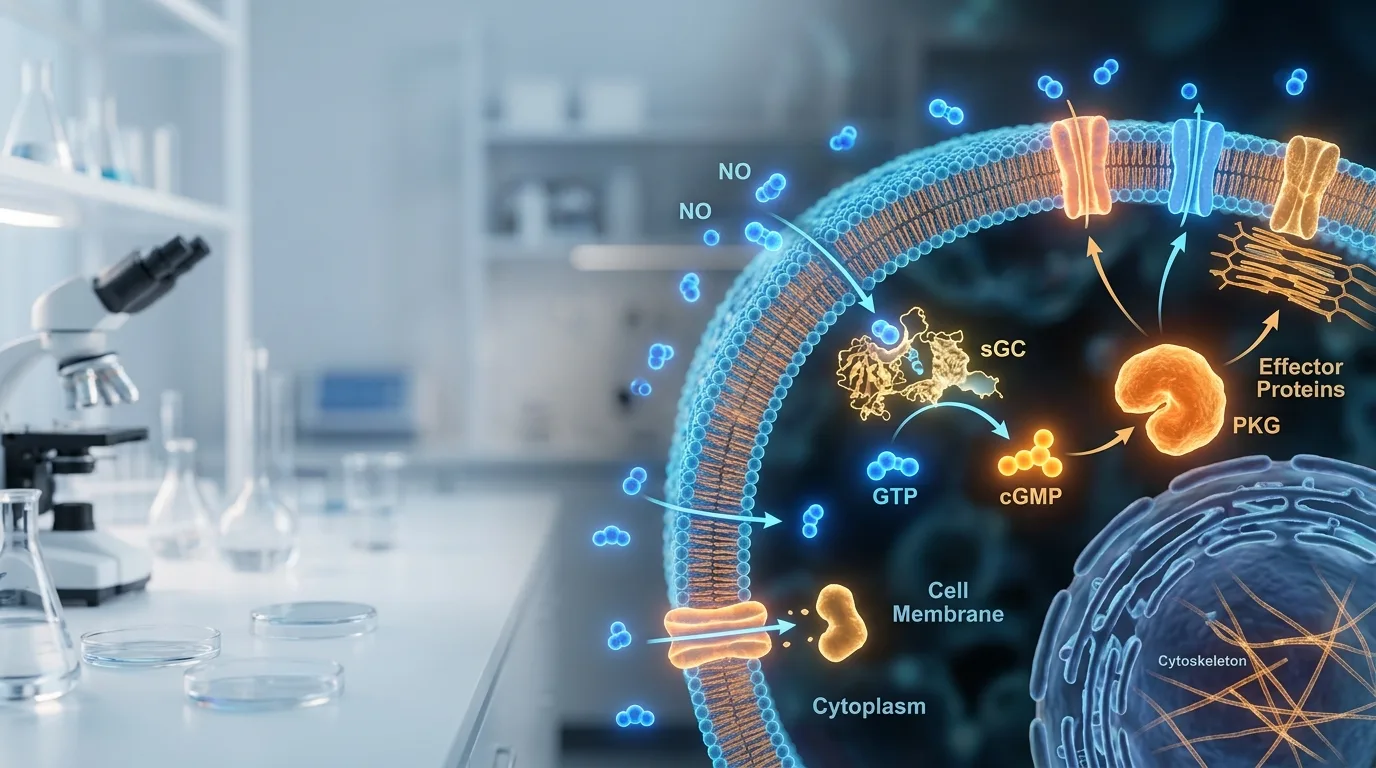
Nitric oxide is produced primarily by endothelial cells, the cells that line the interior of blood vessels. It acts as a short-lived signaling molecule that regulates vessel dilation, moderates inflammatory responses, and coordinates communication between cells. Its role in tissue biology is well-established and spans cardiovascular, neurological, and gastrointestinal systems.
Zagreb group studies observed that BPC-157 appeared to interact with the nitric oxide system in a modulatory rather than straightforwardly stimulatory way. In some tissue contexts, rodent model observations were consistent with NO pathway upregulation. In others, researchers observed effects consistent with attenuation. This context-dependent modulation is a recurring characteristic in the published descriptions of the BPC-157 mechanism of action nitric oxide relationship.
That complexity creates a pharmacological problem. If a compound simply activates a pathway, it can be characterized through standard methods: a binding assay measures how strongly it attaches to a receptor, a dose-response curve describes what happens as concentration increases. A compound that modulates a pathway differently depending on tissue context is considerably harder to characterize. This may partly explain why the nitric oxide mechanism remains incompletely described after 30 years of publication.
Whether NO modulation is the primary driver of observed cytoprotective effects in rodent models, or a downstream consequence of another mechanism acting upstream, has not been resolved in the published literature. That is not a minor gap. It means the central proposed mechanism of the compound lacks a confirmed causal account.
VEGF and New Blood Vessel Formation
Angiogenesis is the process by which new blood vessels grow from existing ones. Damaged tissue requires new blood supply to receive oxygen and the cellular materials needed for repair. Without angiogenesis, wound healing stalls. VEGF is one of the primary molecular signals that initiates this process, instructing endothelial cells to proliferate and form new capillary networks.
Rodent model observations from the Zagreb group showed that BPC-157 treatment was associated with increased VEGF expression in wound and tendon tissue. Researchers observed elevated capillary density in treated animals compared to controls. Treated animals showed measurably higher vessel density; control animals showed lower density under the same injury conditions. These numbers highlight what the animal model data consistently suggested about the compound's association with new vessel formation.
This VEGF connection offers a partial explanation for the breadth-of-effect problem. Angiogenesis is relevant to nearly every tissue repair process. A compound that reliably promotes new blood vessel formation in animal models would, by that mechanism alone, plausibly show effects across gastric tissue, tendons, nerves, and skin. The scope of the Zagreb group's publication record is, in that reading, internally consistent with a VEGF-centered mechanism.
The limitation is direct: VEGF pathway involvement has been characterized in rodent tissue. Whether analogous upregulation occurs in human tissue, at what magnitude, and through what upstream molecular event BPC-157 triggers this response are questions that have not been characterized in human biological systems.
The FAK-Paxillin Pathway and Cell Movement
Focal adhesion kinase, abbreviated FAK, and paxillin are components of a molecular relay system that governs cell migration. Focal adhesions are the physical attachment points between a cell and the extracellular matrix, the structural scaffolding that surrounds cells in tissue. When a cell needs to move, the FAK-paxillin axis coordinates the anchoring, pulling, and release cycle that makes migration possible.
Cell migration is not optional for tissue repair. Survival of existing cells is insufficient; new cells must physically move into damaged areas, anchor to available scaffolding, and reorganize. FAK-paxillin signaling is one of the key systems coordinating that movement.
In cell culture and rodent models, the Zagreb group observed that BPC-157 treatment was associated with increased FAK and paxillin activity. The proposed interpretation is that this enhanced cell migration capacity partially accounts for the accelerated tendon and ligament healing observed in animal studies. Cell migration moving faster and more effectively into injury sites would produce the kind of repair timeline the Zagreb data described.
The outstanding mechanistic question is foundational. How BPC-157 initiates FAK-paxillin signaling — what upstream receptor or molecular event triggers the cascade in the first place — has not been identified in the published literature. Without that upstream identification, the FAK-paxillin observation is a correlation rather than a mechanistic account. It describes what happens in rodent tissue after BPC-157 exposure, not why it happens at the molecular level.
Independent Replication: What Outside Labs Have Found
Several research groups outside Zagreb have published animal studies with findings consistent with the original Zagreb observations, particularly in tendon healing and neuroprotective contexts. That external work provides some validation that the Zagreb group's findings are not purely artifacts of a single laboratory's methods or animal handling practices.
The proportional picture, however, requires honest accounting. Of approximately 150 published papers on BPC-157, the total volume of genuinely independent replication remains modest. No outside group has conducted a full dose-response replication study running parallel to the original Zagreb protocols. The ratio of Zagreb-affiliated or Zagreb-citing papers to fully independent replications is heavily weighted toward the former. The breakdown illustrates a literature that is broad but not yet independently verified at its core claims.
The potency profile is a specific point of scrutiny. Zagreb group studies reported dose-dependent effects at nanogram-to-microgram per kilogram ranges in rodents. Most peptide drugs require milligram-per-kilogram dosing to produce measurable effects. The claim of effectiveness at nanogram ranges is scientifically unusual and has attracted both enthusiasm in popular communities and skepticism from independent researchers. Formal independent verification of this potency profile has not been published.
The clinical translation problem closes this section plainly. Without published human pharmacokinetic data, meaning data describing how the compound moves through, is processed by, and is cleared from a human body, the translational relevance of NO modulation, VEGF upregulation, and FAK-paxillin signaling to human biology cannot be assessed. Animal pharmacokinetics and human pharmacokinetics are not the same. The assumption that they are equivalent is an assumption, not a finding.
What the Evidence Does and Does Not Show
The evidence base for BPC-157 can be summarized in tiers. Robust animal model data exists across multiple tissue types. That data comes primarily from one laboratory. Independent replication exists in specific categories, tendon healing and neuroprotection most notably, but remains modest in total volume. Zero published human trial results exist. No regulatory approval for any clinical application exists in any jurisdiction.
BPC-157 circulates widely in bodybuilding and biohacking communities as a self-administered compound, sold under a research chemical designation. This market activity occurs in the absence of established human pharmacokinetic data, any approved administration regimen, or regulatory approval anywhere. The distance between Sikiric's gastroenterology inquiry in 1990s Zagreb and the current commercial landscape is considerable, and that distance is not bridged by animal model data alone.
Responsible scientific assessment of what does BPC-157 do in the body according to animal research requires distinguishing what animal models showed from what remains unknown in human systems. Those are different categories of knowledge, and conflating them is a persistent error in popular coverage of this compound.
What independent multicenter replication studies, published human pharmacokinetic data, and at minimum a completed Phase II trial would provide is not merely regulatory paperwork. They would answer whether the three proposed mechanisms — NO modulation, VEGF-driven angiogenesis, and FAK-paxillin signaling — constitute a coherent unified pharmacology or three loosely connected observations from a single research program. The existing literature cannot answer that question. It can only document that the question remains open.
Sikiric's group set out in the early 1990s to understand how the stomach protects itself. Three decades later, their pentadecapeptide has generated a body of animal-model literature spanning almost every tissue type and a popular culture footprint that vastly outpaces the clinical evidence. The proposed mechanisms are scientifically coherent. Nitric oxide modulation, VEGF-driven angiogenesis, and FAK-paxillin cell migration signaling are legitimate biological pathways, and their involvement in rodent tissue repair has been repeatedly observed in Zagreb laboratory conditions.
What remains absent is the translational bridge. Human pharmacokinetic data has not been published. Independent full replication has not been completed. Clinical trial results have not appeared in peer-reviewed journals. That absence does not invalidate the research program. It marks where the science currently ends and where extrapolation begins. Those are not the same place, and in serious scientific assessment, the distance between them matters.
Stay current on peptide chemistry research. Molecule Notes publishes in-depth coverage of peptide synthesis, mechanism research, and the evolving clinical landscape. Subscribe to the newsletter for continuing analysis, delivered without hype or commercial agenda.
Sources
- newtropin.com — newtropin.com
- nih.gov — pmc.ncbi.nlm.nih.gov
- researchgate.net — researchgate.net
- mdpi.com — mdpi.com
- nih.gov — pmc.ncbi.nlm.nih.gov
- peptpedia.org — peptpedia.org
- nih.gov — pubmed.ncbi.nlm.nih.gov
- plos.org — journals.plos.org
- substack.com — neuroathletics.substack.com
- researchgate.net — researchgate.net
- examine.com — examine.com