

Most peptide stack guides spend considerable effort explaining which peptides to combine and almost no effort explaining when to administer them. That oversight is significant. Your body's circadian clock does not simply regulate sleep and wakefulness; it actively controls the expression of growth hormone receptors in hepatocytes, orchestrates a diurnal cortisol rhythm that directly competes with anabolic signaling, and shapes the natural pulsatility of endogenous GH release across a 24-hour cycle. Ignoring these rhythms when designing a peptide stack is analogous to optimizing a key without considering the lock it needs to open. This guide applies circadian pharmacology to the most common peptide combinations, with a focus on circadian timing peptide stack GH receptor expression as a core pharmacodynamic variable rather than an afterthought. The key concepts covered here include stacking windows, pulsatile dosing logic, and how half-life mismatches interact with biological timing to either amplify or undermine receptor-level efficacy.
Circadian Timing Peptide Stack GH Receptor Expression: How Your Circadian Clock Controls It
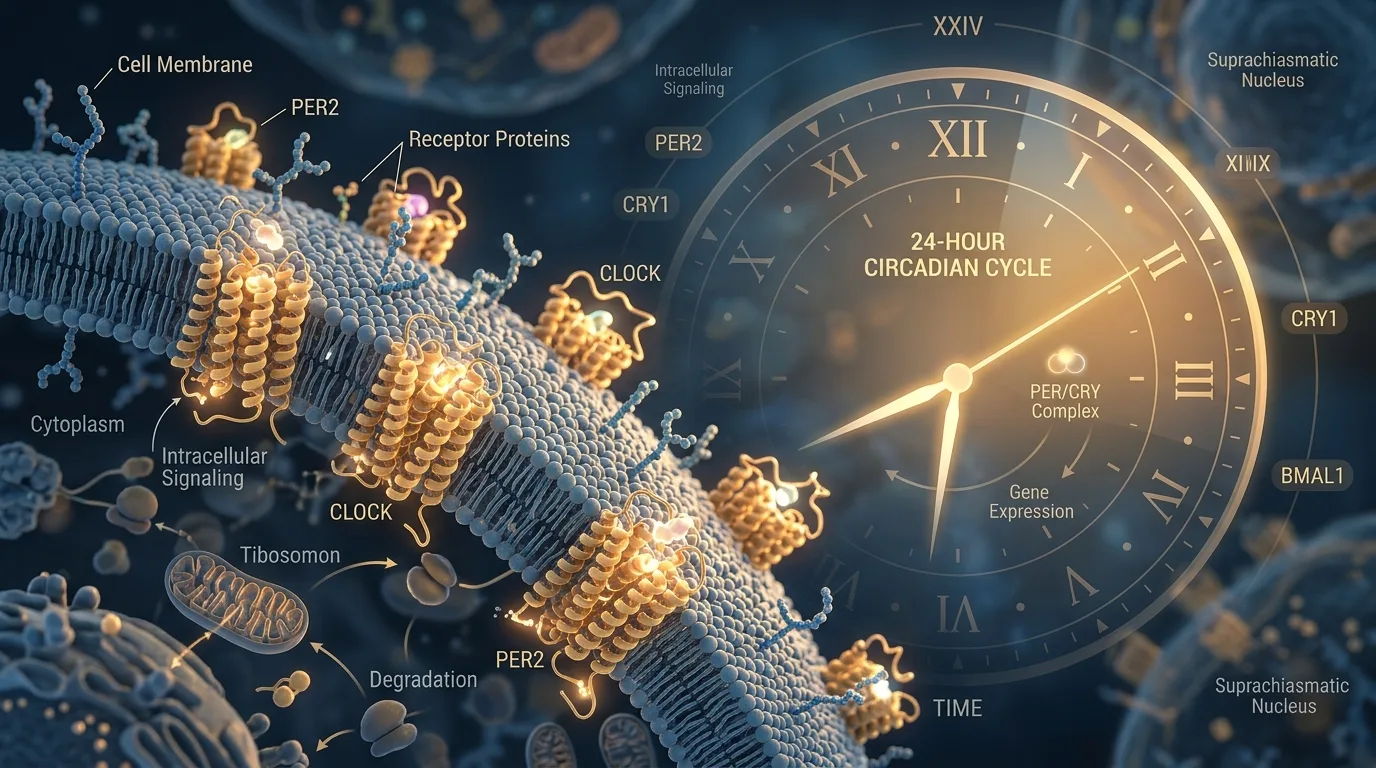
GH receptor expression in hepatocytes follows a measurable circadian rhythm. Both rodent and human models show that receptor density peaks during the early morning hours, establishing a physiological window of heightened GH sensitivity that does not remain constant across the day. This rhythm is not incidental; it is orchestrated by the suprachiasmatic nucleus (SCN), the brain's master clock, which coordinates timing signals to peripheral clocks embedded in liver and muscle tissue. These peripheral clocks gate receptor sensitivity independently of hormone secretion, meaning the liver can be primed or resistant to GH signaling regardless of how much GH is circulating at any given moment.
Cortisol complicates the picture considerably. The cortisol diurnal rhythm peaks around 8 AM as part of the cortisol awakening response, and at those elevated concentrations, cortisol upregulates suppressor of cytokine signaling (SOCS) proteins. SOCS proteins directly inhibit GH receptor signal transduction by blocking JAK2-STAT5 phosphorylation, the primary intracellular cascade through which GH exerts anabolic effects. This is the pharmacological rationale for evening dosing of GH secretagogue stacks: cortisol is near its nadir between 10 PM and 2 AM, SOCS-mediated interference is minimal, and the dominant endogenous GH pulse naturally occurs in the first few hours of sleep.
When you overlay endogenous GH pulsatility, cortisol concentrations, and GH receptor sensitivity on a single 24-hour timeline, a clear picture emerges. GH pulses cluster in the early sleep period, cortisol is suppressed during that same window, and receptor sensitivity is elevated in the early morning hours following nocturnal GH release. The practical implication is that exogenous GH secretagogues administered during the pre-sleep window are entering a hormonal environment specifically conducive to signal transduction, while the same peptides administered during the morning cortisol peak face a receptor landscape actively working against them. These numbers highlight why the timing dimension can be as consequential as the choice of peptide itself.
What Is Pulsatile Peptide Dosing and Why Does It Matter
Pulsatile dosing refers to administering peptides in discrete, timed intervals that mimic the episodic nature of endogenous hormone secretion, as opposed to continuous infusion or overlapping schedules that maintain a steady pharmacological signal. The distinction is biologically critical for GH secretagogues because their primary receptor, GHS-R1a, is a G-protein coupled receptor subject to rapid internalization and downregulation when exposed to sustained agonist stimulation.
Research data on receptor desensitization are clear. Continuous, non-pulsatile administration of ghrelin mimetics can downregulate GHS-R1a expression within 48 to 72 hours, measurably reducing net GH output compared to the same total dose delivered in spaced pulses. This means that stacking two GHRPs on an overlapping schedule does not double the GH response; it erodes the receptor capacity that makes either peptide effective in the first place.
Peptide half-lives span a range that most stack guides fail to adequately address. Native GHRH(1-44) has a plasma half-life of under 2 minutes due to rapid DPP-IV cleavage. Modified GHRH analogs like CJC-1295 without DAC extend that to roughly 30 minutes. CJC-1295 with DAC, through its covalent albumin-binding mechanism, achieves receptor occupancy lasting 6 to 8 days. Short-acting GHRPs like ipamorelin have half-lives in the range of 2 hours, while longer-duration variants extend further. The approximate half-lives for comparison are as follows: native GHRH at under 2 minutes, ipamorelin at approximately 2 hours, CJC-1295 without DAC at approximately 30 minutes, and CJC-1295 with DAC at 6 to 8 days. The breakdown illustrates how dramatically pharmacokinetic profiles diverge within a single stack, and why treating all peptides as pharmacologically equivalent at the timing level is an error with real consequences for receptor engagement.
Defining Stacking Windows: Circadian Pharmacology in Practice
A stacking window is a time-of-day period during which receptor sensitivity, the ambient hormonal environment, and peptide pharmacokinetics converge to create conditions for maximum pharmacodynamic synergy. Identifying these windows transforms a peptide stack from a list of compatible molecules into a temporally structured protocol.
The pre-sleep window, spanning approximately 10 PM to midnight, represents the most favorable window for circadian timing peptide stack GH receptor expression optimization. It coincides with the dominant endogenous GH pulse, the lowest cortisol concentrations of the 24-hour cycle, and a period of elevated GH receptor sensitivity in peripheral tissues. GHRH/GHRP combinations administered here are amplifying a physiological process rather than working against competing signals. This is where GH secretagogue stacks belong as a primary dosing window.
The post-exercise window offers a secondary opportunity. Resistance exercise transiently upregulates GH receptor expression and activates AMPK signaling in skeletal muscle, creating a brief period of enhanced metabolic responsiveness. This window is better suited to metabolic peptides like AOD-9604, which targets beta-3 adrenergic receptors in adipocytes for lipolysis independent of the IGF-1 axis, or MOTS-c, which activates AMPK and enhances insulin sensitivity through parallel metabolic pathways. Pairing these peptides with post-exercise timing capitalizes on the adrenergic and metabolic receptor upregulation that exercise induces.
The morning cortisol peak, between approximately 6 AM and 9 AM, is the least favorable window for GH secretagogue stacks due to SOCS-mediated receptor interference. However, this window is not wasted. Peptides that operate independently of GH receptor signaling, such as Thymosin alpha-1, which enhances T-cell maturation through TLR signaling pathways, or BPC-157 administered orally for gut and connective tissue repair, have timing flexibility that GH secretagogues do not. Morning administration of these peptides poses no circadian conflict and may align well with the immunological activity patterns of early wakefulness.
The GHRH Plus GHRP Stack: Timing the Synergistic Pulse
The GHRH plus GHRP combination is a popular but poorly studied and scientifically unvalidated peptide stack used mostly in non-clinical GH optimization protocols. The mechanism is dual-receptor co-activation: GHRH binds the pituitary GHRH receptor to stimulate GH synthesis and release, while a GHRP simultaneously activates GHS-R1a through a distinct intracellular pathway. The co-activation of both receptors produces GH pulses substantially larger than either peptide can generate alone, a finding validated across multiple clinical pharmacology studies. This is synergy in the strict pharmacological sense, not additive interaction.
CJC-1295 with DAC changes the architecture of this synergy. Its 6 to 8-day receptor occupancy creates a sustained background elevation of GHRH receptor stimulation, against which short-acting GHRP pulses, such as ipamorelin administered at the pre-sleep window, produce amplified GH spikes. The 2006 CJC-1295 clinical trial provides quantitative grounding for this model: a single subcutaneous dose produced mean GH concentrations 2 to 10-fold above baseline, with IGF-1 levels increasing 1.5 to 3-fold and remaining elevated for 6 days post-dose. These figures establish what the background component of the stack can sustain before a GHRP pulse is added.
The timing warning here is important. Pairing CJC-1295 with DAC with another long-duration GHRP analog on a fixed daily schedule risks converting a pulsatile protocol into continuous GHS-R1a stimulation. The pulsatility is not an inconvenience to be engineered around; it is the physiological pattern that preserves receptor sensitivity and downstream IGF-1 responsiveness. The recommended approach is deliberate asymmetry: a long-acting GHRH analog providing background receptor priming, combined with a short-acting GHRP administered at the pre-sleep window to generate a discrete, physiologically patterned pulse. GH pulse amplitude under GHRH alone, GHRP alone, and co-administration scenarios across a 24-hour window shows a clear dose-response advantage for the combined pre-sleep approach, with co-administration producing the highest amplitude pulse during the low-cortisol window. These numbers highlight the synergistic benefit of aligning both peptides with the optimal stacking window rather than distributing them arbitrarily across the day.
How Long to Wait Between Peptide Injections in a Stack
Spacing logic for peptide injections derives from two variables: the half-life of each peptide and the recovery time required for target receptors to regain sensitivity after stimulation. For GHS-R1a, research supports a minimum inter-dose interval of approximately 3 hours for short-acting GHRPs such as ipamorelin or GHRP-2. Shorter intervals risk partial receptor desensitization before the next dose, progressively attenuating each successive GH pulse.
DPP-IV competition introduces an underappreciated pharmacokinetic interaction. DPP-IV rapidly cleaves peptides that carry an alanine or proline residue at position 2, a category that includes both several GHRH analogs and GLP-1 class peptides. When two DPP-IV-sensitive peptides are administered simultaneously, they compete for the same degradative enzyme, potentially extending each other's plasma half-lives in unpredictable ways. This is not necessarily beneficial; extended half-life of a GH secretagogue outside the intended dosing window may blunt pulsatility rather than enhance it.
Route of administration provides a practical simplification in some cases. BPC-157 retains bioactivity when administered orally in animal models due to its resistance to gastric peptidase degradation. A subcutaneously administered GHRP and an orally administered BPC-157 involve no pharmacokinetic collision at the absorption site, so these can be co-timed without interaction risk. A simple decision framework for injection spacing follows. Short-acting GHRP combined with long-acting GHRH analog: same-time co-administration is acceptable because the half-life asymmetry creates natural pulse architecture. Two short-acting GHRPs: stagger by at least 3 hours to allow GHS-R1a recovery. Two long-acting analogs: avoid routine co-stacking entirely to preserve physiological pulsatility.
Circadian Timing for Repair and Metabolic Peptide Combinations
BPC-157 and TB-500 represent the most commonly paired repair peptide stack, and their compatibility is mechanistically sound. BPC-157 drives tissue repair through GH receptor upregulation in local tissues, nitric oxide pathways, and VEGF signaling, while TB-500 (Thymosin beta-4) promotes actin polymerization, cellular migration, and anti-inflammatory signaling. Preclinical rodent data show complementary, non-overlapping mechanisms with no reported antagonistic interactions at standard research intervals. These repair pathways are not circadian-gated in the same rigid way as GH receptor expression, but anti-inflammatory signaling and nocturnal growth factor release during sleep suggest that evening dosing alignment may provide incremental benefit over morning administration for connective tissue and vascular repair objectives.
AOD-9604 occupies a distinct niche in the metabolic peptide space. As a fragment of hGH targeting beta-3 adrenergic receptors in adipocytes, it stimulates lipolysis without activating the full GH receptor and without raising IGF-1. This makes it genuinely safe to layer onto a GH secretagogue stack without compounding IGF-1-driven risks. Morning or post-exercise timing aligns AOD-9604 with peak adrenergic receptor sensitivity and the catabolic hormonal environment that supports lipolysis.
Epithalon presents an interesting case for evening timing. Its proposed mechanisms, telomerase activation and cortisol normalization, suggest alignment with the nocturnal cortisol trough rather than the morning peak. Evening Epithalon dosing may complement the pre-sleep GH secretagogue window without creating receptor or pathway overlap. IGF-1 LR3 warrants a specific caution when stacked with GH secretagogues. Its 20 to 30-hour plasma half-life, compared to native IGF-1's 5 to 6 hours, means it sustains IGF-1 receptor activation well beyond any single dosing event. Timing IGF-1 LR3 to peak action simultaneously with a GH secretagogue-driven endogenous IGF-1 surge creates a dual IGF-1 signal with hypoglycemia risk that deliberate timing offset can substantially mitigate.
Practical Circadian Stack Protocols: Morning, Evening, and Post-Exercise
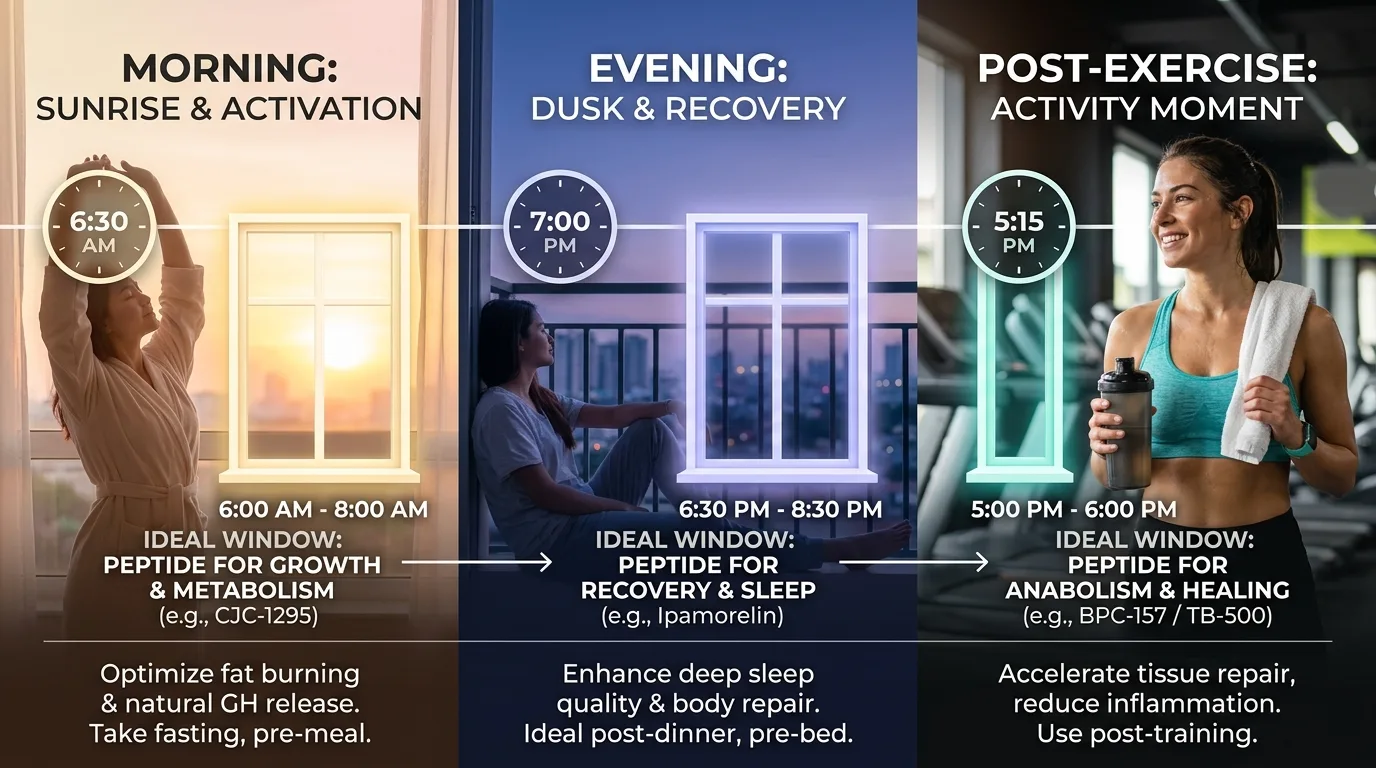
Three structured timing templates translate the circadian pharmacology principles above into actionable protocols. Each template aligns peptide categories with their optimal biological windows based on receptor sensitivity, cortisol dynamics, and pharmacokinetic profiles.
The Pre-Sleep Protocol, timed between approximately 10 PM and midnight, is anchored by the GHRP injection leveraging the CJC-1295 with DAC background for pulse amplification. BPC-157 and TB-500 administered in this window align repair signaling with nocturnal growth factor release. Epithalon fits naturally here given its cortisol-modulating properties and compatibility with the low-cortisol nocturnal environment.
The Post-Exercise Protocol captures the transient receptor upregulation and AMPK activation that follow resistance training. AOD-9604 and MOTS-c are the primary candidates for this window. An optional short-acting GHRP can be included in the post-exercise window provided it is separated by at least 3 hours from the next scheduled pre-sleep GHRP dose.
The Morning Protocol reserves the high-cortisol window for peptides that operate independently of GH receptor signaling. Thymosin alpha-1 for immune support, oral BPC-157 for GI and systemic repair, and cognitive peptides such as Semax (which elevates BDNF and modulates dopaminergic pathways) or Selank (which acts on GABAergic and serotonergic systems) all fit this window without circadian conflict. The proportional distribution of these three protocol windows across a 24-hour cycle, with GH secretagogues occupying the pre-sleep segment, metabolic peptides occupying the post-exercise segment, and immune and cognitive peptides occupying the morning segment, provides a clear visual structure for designing a complete daily protocol. A word of caution applies to all three templates: chronotype varies meaningfully between individuals, and a person with a strongly delayed circadian phase may need to shift these windows by 1 to 2 hours. These protocols represent research-derived frameworks from preclinical and early clinical data; personal calibration remains essential.
Putting It All Together
Circadian biology is not a peripheral consideration for peptide stacks. GH receptor expression, cortisol competition, and GHS-R1a sensitivity all fluctuate on predictable 24-hour cycles, and peptide stacks designed without accounting for these rhythms leave measurable efficacy on the table at the receptor level. The circadian timing peptide stack GH receptor expression relationship is a pharmacodynamic variable as consequential as dose selection or peptide choice.
Three practical principles summarize the evidence covered here. First, align GH secretagogue pulses with the pre-sleep, low-cortisol window to maximize receptor signal transduction and exploit the dominant endogenous GH pulse. Second, respect receptor recovery intervals to prevent GHS-R1a desensitization, observing a minimum 3-hour spacing for short-acting GHRPs and avoiding dual long-acting analog co-stacking. Third, treat the half-life mismatch between long-acting and short-acting analogs as a deliberate design feature, using the background elevation plus pulse architecture to create physiologically patterned GH release rather than continuous stimulation.
For deeper exploration of peptide half-life compatibility and receptor selectivity principles, the companion content at Molecule Notes covers these topics in structured detail. Subscribe to the Molecule Notes newsletter to receive protocol updates as the clinical data on circadian peptide pharmacology continues to develop; the field is moving quickly, and timing-aware protocols represent one of the most underutilized dimensions of evidence-based stack design.
Sources
- frontiersin.org — frontiersin.org
- nih.gov — pmc.ncbi.nlm.nih.gov
- mdpi.com — mdpi.com
- nih.gov — pmc.ncbi.nlm.nih.gov
- nih.gov — pubmed.ncbi.nlm.nih.gov
- kaneorthopedicinstitute.com — kaneorthopedicinstitute.com
- oup.com — academic.oup.com
- nih.gov — pubmed.ncbi.nlm.nih.gov
- oup.com — academic.oup.com
- contemporaryhealthcenter.com — contemporaryhealthcenter.com
- gamedaymenshealth.com — gamedaymenshealth.com
- nationalgeographic.com — nationalgeographic.com
- meto.co — meto.co
- iipseries.org — iipseries.org
- nih.gov — pubmed.ncbi.nlm.nih.gov