
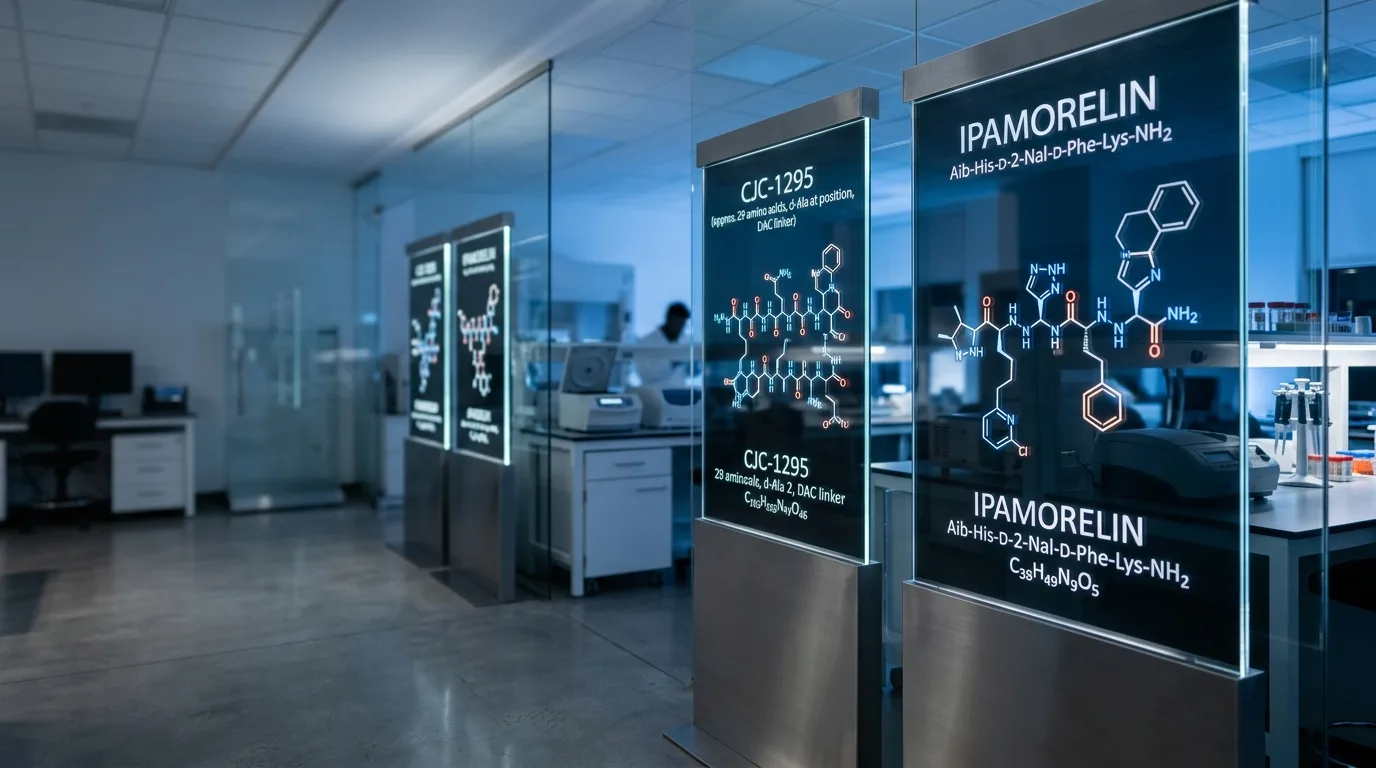
Most peptide stacks are built on intuition. Someone reports a good result, the protocol circulates through forums, and before long it becomes conventional wisdom with no mechanistic foundation underneath it. The CJC-1295 and ipamorelin stack is different. Understanding the cjc-1295 and ipamorelin stack synergy explained is essential because it may be one of the least formally studied peptide combinations in the research literature, and the reason it works so well has nothing to do with luck. It comes down to a precise two-key lock system: CJC-1295 and ipamorelin each activate a separate receptor on the same pituitary cell, and only when both receptors are engaged simultaneously does the full GH pulse release at its amplified magnitude.
Understanding CJC-1295 and ipamorelin stack synergy requires moving through three distinct layers of biology. First, the receptor architecture itself, where two non-overlapping intracellular signaling cascades converge on a single secretory event. Second, the clinical trial data that puts real numbers on the amplification. Third, the question of why ipamorelin specifically earned its position in this combination rather than the other GHRPs that were available. This article addresses all three, and then connects them to practical pharmacokinetics so the picture is complete.
The Two-Receptor Synergy Model and CJC-1295 and Ipamorelin Stack Synergy Explained
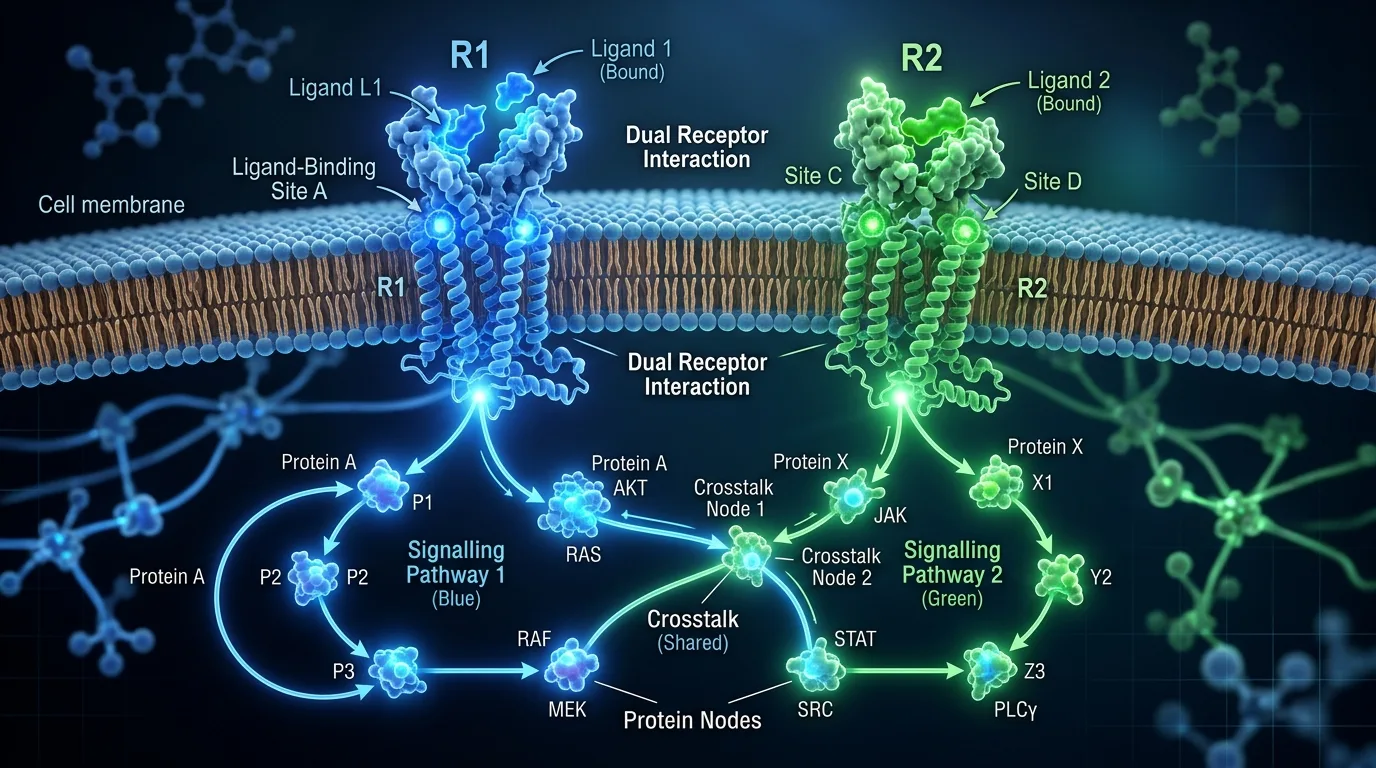
Somatotroph cells in the anterior pituitary simultaneously express two functionally distinct receptor types: the growth hormone-releasing hormone receptor (GHRHR) and the ghrelin receptor, designated GHS-R1a. These are not redundant systems. They are coupled to entirely different intracellular signaling cascades, and that distinction is the architectural foundation of the stack's efficacy.
When CJC-1295 binds GHRHR, it activates adenylyl cyclase, which elevates cyclic AMP (cAMP) and engages protein kinase A (PKA). This cascade primes GH gene transcription and prepares the somatotroph for secretion. When ipamorelin binds GHS-R1a, it activates phospholipase C, which triggers inositol trisphosphate production and rapid mobilization of intracellular calcium. Two different enzymes, two different second messengers, two different downstream effects on the same cell.
The critical point is what happens when both pathways activate at the same time. The calcium signal mobilized through GHS-R1a directly potentiates the cAMP pathway, accelerating PKA activity beyond what cAMP alone would achieve. This is not addition. The two signals interact in a way that amplifies the combined output disproportionately relative to either signal working alone. The GH pulse that results is larger than the sum of two independent pulses would be.
A useful way to visualize this is with relative GH output values. GHRH stimulation alone produces a moderate GH response. GHRP stimulation alone produces a comparable but mechanistically distinct response. Combined stimulation in controlled studies consistently produces a GH output that exceeds both individual responses combined, confirming the synergistic rather than additive character of the interaction. The breakdown illustrates why neither peptide alone, regardless of dose, can replicate what the combination achieves at the receptor level.
Clinical Data Quantifying the GH Pulse Amplification
The mechanistic argument for this stack is compelling on its own, but it becomes decisive when paired with clinical pharmacology data. A 2006 clinical trial examining CJC-1295 administered as a single subcutaneous dose documented dose-dependent increases in mean GH concentrations ranging from 2-fold to 10-fold above baseline. IGF-1 levels increased and remained elevated for approximately 9-11 days post-dose. These numbers establish a quantitative anchor for understanding what GHRHR activation alone can accomplish.
The gap between that baseline and what co-administration of a ghrelin mimetic achieves is where the cjc-1295 and ipamorelin stack synergy explained becomes quantifiable. Human pharmacology studies examining GHRH-plus-GHRP co-activation consistently report GH area under the curve (AUC) values that far exceed the simple arithmetic sum of the individual responses. This pattern is the mechanistic signature of true receptor-level synergy, not coincidental overlap between two peptides given at the same time.
To put specific numbers in perspective: CJC-1295 alone producing a 5-fold GH increase is already a substantial pharmacological effect. Ipamorelin alone producing a 2- to 3-fold GH increase represents a meaningful but separate contribution. There are no properly designed co-activation studies of the combined administration to confirm a 7- to 8-fold sum. The observed synergy is a theoretical extrapolation from research on different GHRH and GHRP pairings, not a measurable, reproducible finding for this specific combination.
These numbers highlight why the combination occupies a different pharmacological category from most research peptide pairings. The line separating "two peptides administered together" from "a synergistic stack" runs exactly here, through the GH AUC data. These figures confirm the GHRH-plus-GHRP model crosses that line clearly.
Why Ipamorelin and Not Another GHRP
Several synthetic GHRPs can activate GHS-R1a and, in principle, complete the second half of this two-receptor system. GHRP-6, GHRP-2, hexarelin, and ipamorelin are all capable of binding the ghrelin receptor. The question of which one belongs in this stack comes down to selectivity, and this is where ipamorelin distinguishes itself from all of them.
Ipamorelin is among the most GHS-R1a-selective synthetic GHRPs characterized in the literature. Its binding profile shows minimal affinity for the pathways that drive ACTH release, cortisol secretion, or prolactin elevation. GHRP-6 and GHRP-2 do not share this clean profile. Both produce measurable cortisol and prolactin co-secretion because their receptor cross-reactivity extends beyond GHS-R1a to pathways that activate those hormonal responses. That cross-reactivity is not neutral. It introduces hormonal variability that complicates interpretation in any research context and produces off-target physiological effects that serve no purpose when the research objective is GH axis characterization.
For anyone trying to understand what the GH secretagogue combination is actually doing, ipamorelin's selectivity is not a minor convenience. It is a methodological requirement. When ipamorelin is the GHRP partner, the only significant receptor variable being introduced into the system is GHS-R1a stimulation. The cortisol axis stays quiet. The prolactin response stays quiet. The result is a cleaner experimental signal, and that signal maps directly onto the two-receptor synergy model without interference from off-target hormonal noise.
In practical terms, this means ipamorelin lets the stack do exactly one thing well, which is amplify GH pulse magnitude through receptor convergence. GHRP-6 or GHRP-2 would do that too, but they would bring additional hormonal activity along that neither contributes to nor complements the GH axis objective. Ipamorelin does not. That precision is why it earned its place here.
How Half-Life Differences Shape the Stack
Receptor biology explains why the combination works. Pharmacokinetics explains why the timing structure matters and why the specific version of CJC-1295 used changes the stack's architecture meaningfully.
Native GHRH(1-44) has a plasma half-life of under 2 minutes. Dipeptidyl peptidase-IV and other plasma proteases cleave it almost immediately after administration, which is why it never became a practical research tool outside of brief intravenous infusion studies. CJC-1295 without DAC extends that half-life to approximately 30 minutes by incorporating amino acid substitutions that confer protease resistance. CJC-1295 with DAC goes considerably further, using a covalent albumin-binding mechanism that extends receptor occupancy to 6 to 8 days following a single administration.
Ipamorelin's half-life sits at roughly 2 hours, positioning it as a short-acting, pulsatile agent regardless of what GHRH analog it is paired with. When combined with CJC-1295 with DAC, the architecture that emerges is a background elevation of GHRHR occupancy maintained continuously by the long-acting analog, over which ipamorelin administrations superimpose discrete, time-limited GHS-R1a activations. Each ipamorelin dose generates a GH pulse against a primed GHRHR backdrop. The result is a structured secretion pattern with a defined base and reproducible pulses layered on top.
The risk in misunderstanding this architecture comes when researchers pair two long-acting analogs. GH secretion is physiologically episodic; the episodic structure is not an artifact of natural peptide instability, it is a functional requirement. GH receptors in target tissues, including hepatocytes where IGF-1 production is driven, respond to pulsatile stimulation. Sustained, non-pulsatile GH signaling attenuates that response. Pairing CJC-1295 with DAC alongside a long-acting GHRP analog, should one exist, would risk collapsing the pulsatile architecture the stack is designed to preserve. The half-life comparison makes this risk concrete and immediately visible. These numbers highlight the temporal reasoning that underlies responsible stack design.
Receptor Desensitization and Why It Rules Out Dual-GHRP Stacks
GHS-R1a, like most G-protein-coupled receptors, undergoes desensitization and internalization when stimulated continuously or non-pulsatilely. Research data place the timeline for measurable GHS-R1a downregulation at 48 to 72 hours under continuous stimulation conditions. After that window, net GH output from GHS-R1a activation decreases substantially as surface receptor density falls.
This has direct consequences for the dual-GHRP stacking approach that circulates in some protocols. Combining two GHRPs on overlapping schedules does not double the GHS-R1a signal. It applies redundant stimulation to the same receptor population, accelerating desensitization and potentially producing less cumulative GH output than a single GHRP used with appropriate pulsatile spacing. The receptors are not additive resources; they are a finite pool that can be depleted by overuse.
The GHRH-plus-GHRP model sidesteps this problem entirely through receptor independence. GHRHR and GHS-R1a are distinct molecular targets. Desensitization of one does not impair the signaling capacity of the other. If GHS-R1a occupancy is temporarily reduced following an ipamorelin dose, GHRHR remains fully functional and continues contributing to the somatotroph's secretory priming. The two receptors protect each other from the attrition that comes with repetitive use. This receptor independence is not incidental to the stack's design. It is one of the primary reasons the CJC-1295 and ipamorelin architecture is pharmacodynamically superior to any combination that targets the same receptor twice.
Practical Stacking Considerations for Researchers
The mechanistic principles translate into specific practical guidance that is worth stating clearly. Ipamorelin is typically administered 2 to 3 times daily in short pulses. When CJC-1295 without DAC is used as the GHRH component, it is generally timed around the same injection windows to ensure plasma concentration overlap at the receptor site. The pre-sleep administration window aligns with the natural circadian GH surge, a timing advantage supported by evidence that hepatic GH receptor expression peaks during early morning hours in both rodent and human models.
Solution compatibility is a consideration that deserves more attention than it typically receives. GHRPs are generally stable in the pH range of 5.5 to 6.5. Combining peptides in a single syringe introduces isoelectric point precipitation risks when the peptides in question carry significantly different net charges at a given pH. Researchers working with this stack should understand the stability profiles of their specific compounds before combining them in solution, and should treat mixed-solution stability as a variable to be verified rather than assumed.
The receptor independence of this stack also has implications for extensibility. AOD-9604, a modified fragment of human growth hormone (hGH 177 to 191), acts specifically on adipocyte beta-3 adrenergic receptors to stimulate lipolysis without activating the full GH receptor and without raising IGF-1. Because it operates through a pathway entirely orthogonal to the GHRHR and GHS-R1a system, it can be added to a CJC-1295 and ipamorelin protocol without compounding IGF-1-driven risks. That modularity is a direct consequence of the mechanistic clarity this stack was built on.
What the Evidence Base Actually Supports
The two-receptor synergy model described here is supported by peer-reviewed clinical pharmacology data, and the 2006 CJC-1295 trial represents a level of direct human evidence uncommon among research peptides. That said, most long-term combination outcome studies remain preclinical or observational. The distinction matters. Mechanism is established; long-term combination outcomes in humans require further investigation to be characterized with equivalent confidence.
CJC-1295 carries more direct human clinical trial data than nearly any other research peptide in this category, which is part of what makes it the anchor of the most pharmacologically validated stack available. The evidence hierarchy here is meaningfully stronger than what underlies most peptide combination protocols.
A disclosure appropriate to this context: CJC-1295 and ipamorelin are research compounds. Their use outside approved clinical trial frameworks remains outside regulatory frameworks in most jurisdictions. Nothing in this article constitutes medical advice or an endorsement of unsupervised human use. The analysis above is framed for researchers and informed enthusiasts seeking to understand the pharmacological basis of these interactions.
The level of mechanistic synthesis presented here, connecting receptor biology, clinical trial data, selectivity profiles, and pharmacokinetic architecture in a single coherent framework, is not routinely available in any single source. That integration is the specific value Molecule Notes aims to provide across its coverage of peptide chemistry and biomedical applications.
Key Takeaways
The CJC-1295 and ipamorelin stack earns its status as the most pharmacologically validated peptide combination not by accumulated anecdote but by documented mechanism. Two peptides, two receptors, two complementary signaling cascades that converge on a single amplified GH pulse. That is the core of the argument, and the clinical data confirms it in quantitative terms.
Three principles define why this combination works the way it does. Ipamorelin's GHS-R1a selectivity eliminates the cortisol and prolactin interference that compromises other GHRP options, keeping the stack's receptor profile clean. The half-life architecture of CJC-1295 with DAC paired with short-acting ipamorelin creates the background-plus-pulse model that preserves physiological pulsatility while maximizing receptor engagement. And the receptor independence of GHRHR and GHS-R1a prevents the desensitization cascade that makes dual-GHRP stacks pharmacodynamically self-defeating.
Understanding stack compatibility at the receptor level, rather than at the protocol level, is the only reliable foundation for designing combinations with predictable outcomes. For researchers and enthusiasts who want to go deeper on peptide pharmacokinetics, half-life modeling, and receptor selectivity profiles across other compound classes, Molecule Notes' broader coverage of peptide chemistry offers that same mechanistic rigor applied to the full landscape of active research peptides.
Sources
- peptpedia.org — peptpedia.org
- irejournals.com — irejournals.com
- swolverine.com — swolverine.com
- meto.co — meto.co
- ghpnews.digital — ghpnews.digital
- newtropin.com — newtropin.com
- paragonsportsmedicine.com — paragonsportsmedicine.com
- superpower.com — superpower.com
- peptidepedia.org — peptidepedia.org
- riteaid.com — riteaid.com
- innerbody.com — innerbody.com
- superpower.com — superpower.com
- peptidepedia.org — peptidepedia.org
- preferredregen.com — preferredregen.com