
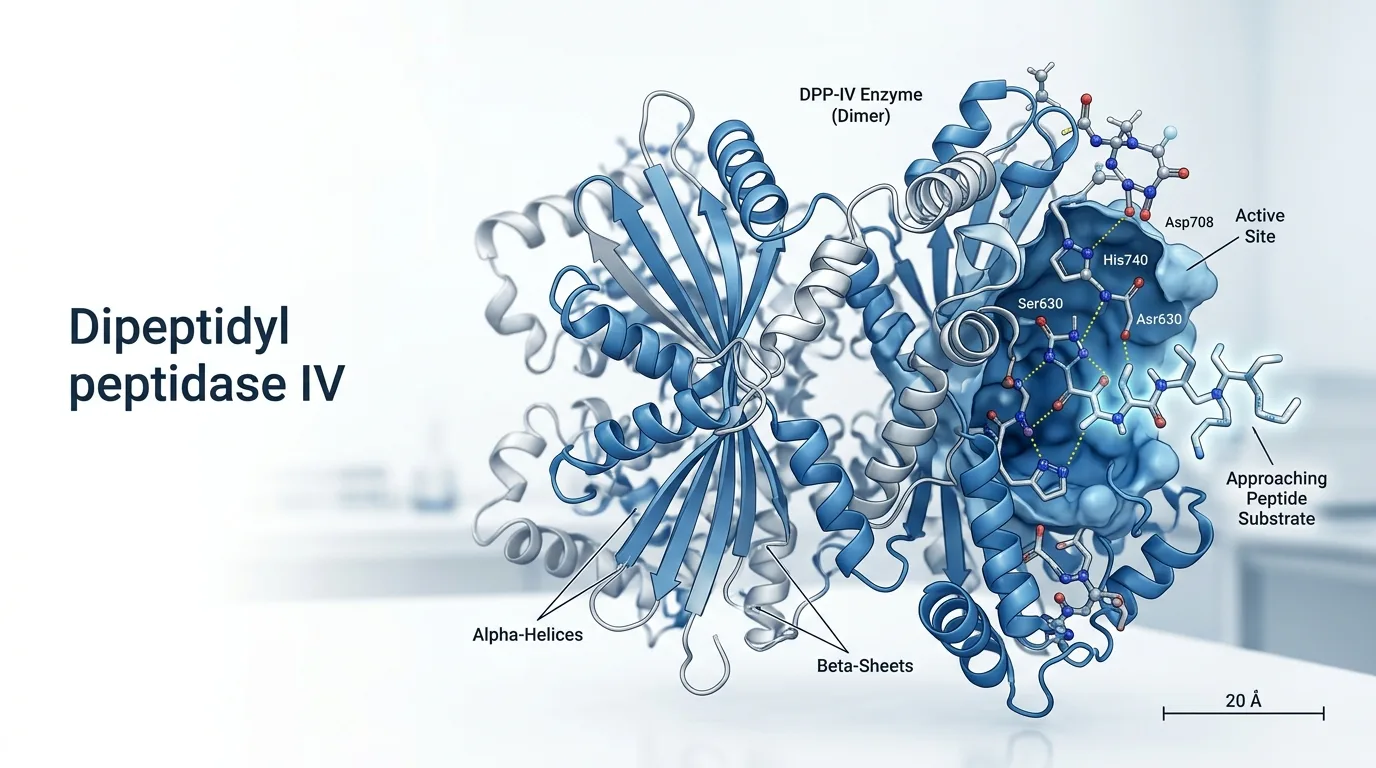
Most researchers and biohackers approach peptide stacking as a receptor-level puzzle. The logic seems straightforward: identify two peptides with complementary targets, combine them, and expect the sum of their individual effects. What this framework misses entirely is the enzymatic layer sitting between administration and receptor binding. Combine two peptides that share a degradation pathway, and you are not simply adding pharmacological effects. You may be fundamentally reshaping how long each compound survives in plasma. The enzyme at the center of this overlooked interaction is DPP-IV, dipeptidyl peptidase-IV, a serine protease that quietly governs the fate of a surprisingly broad library of research peptides.
The central problem with DPP-IV sensitive peptides co-administration interaction is that it is invisible at the design stage. Researchers select peptides for receptor synergy, verify that their targets do not overlap in ways that cause desensitization, and consider half-life in isolation for each compound. What they rarely ask is whether two peptides in the same stack will compete for the same degradative enzyme, extending each other's half-lives in ways that were never intended. This article examines the mechanism behind that competition, identifies the peptide pairs most vulnerable to it, and provides a practical framework for either exploiting or avoiding the interaction.
What Is DPP-IV and How Does It Cleave Peptides
DPP-IV, also catalogued as the cell surface marker CD26, is a serine protease expressed broadly across immune cells, endothelial surfaces, and circulating plasma. Its substrate specificity is precise but consequential. The enzyme preferentially cleaves dipeptides from the N-terminus of a peptide chain when position 2 carries an alanine or proline residue. This X-Ala or X-Pro recognition motif at positions 1 and 2 triggers the enzyme to remove the entire N-terminal dipeptide, a modification that renders most target peptides biologically inactive by disrupting the pharmacophore responsible for receptor binding.
The clinical prominence of DPP-IV comes largely from its role in degrading GLP-1, the incretin hormone central to blood glucose regulation. This is why pharmaceutical DPP-IV inhibitors such as sitagliptin became a major drug class. However, framing DPP-IV purely as a metabolic enzyme undersells its reach considerably. The enzyme processes a wide substrate library that includes GHRH analogs, certain neuropeptides, and immune-related peptides. Any research peptide carrying a position-2 alanine or proline is a potential DPP-IV substrate, making this enzyme relevant to peptide research well beyond the metabolic or endocrine domains.
For researchers evaluating stacking compatibility, the practical implication is this: the N-terminal motif of each peptide in a stack is a structural flag worth examining before any co-administration protocol is designed. A simple survey of position-2 residues across commonly used research peptides reveals that this vulnerability is more widespread than most users appreciate.
Why Half-Life Determines Stack Compatibility and DPP-IV Sensitive Peptides Co-Administration Interaction Outcomes

Pharmacodynamic synergy between two peptides requires more than complementary receptor targets. It requires that both peptides reach adequate plasma concentrations at the receptor site simultaneously. A stack designed entirely around receptor-level logic can fail in practice simply because the two peptides are never meaningfully co-present at their respective targets. This temporal dimension is one of the most consistently underappreciated variables in peptide stacking discussions.
The range of half-lives across common research peptides illustrates the scale of the challenge. Native GHRH(1-44) has a plasma half-life of under 2 minutes due to DPP-IV cleavage at its position-2 alanine. Unmodified CJC-1295 achieves approximately 30 minutes to 1 hour. CJC-1295 with the DAC modification extends half-life to 6 to 8 days through covalent albumin binding. These numbers represent not a minor pharmacokinetic detail but a fundamental difference in how each compound participates in a stack. The breakdown illustrates how dramatically structural modifications can shift the pharmacokinetic profile of what is nominally the same peptide scaffold.
Temporal mismatch between a long-acting and short-acting compound is not inherently a flaw. CJC-1295 with DAC paired with ipamorelin is the canonical example of intentional mismatch exploitation. The DAC compound creates a sustained background elevation of GH secretory tone, while ipamorelin delivers acute pulsatile stimulation at the ghrelin receptor. The asymmetry is the point. Where the problem emerges is in stacks built from two short-acting DPP-IV-sensitive peptides. In this scenario, their individual half-lives do not remain independent. They become linked through their competition for the same degradative enzyme.
Competitive Enzyme Inhibition: The Hidden Pharmacokinetic Interaction

Competitive inhibition at DPP-IV operates on straightforward kinetic principles. When two substrates compete for the same enzyme active site, the presence of each one reduces the cleavage rate experienced by the other. The enzyme cannot process both simultaneously, so the effective half-life of each peptide is extended beyond what would be observed in isolation. This is not a theoretical concern. It is the pharmacological principle that entire drug classes were designed around. Sitagliptin and the other gliptins work precisely because blocking DPP-IV extends native GLP-1 half-life from under 2 minutes to a therapeutically meaningful window. Co-administering two DPP-IV-sensitive peptides produces a pharmacologically similar, if weaker and less predictable, version of this effect.
The degree of half-life extension from this competitive dynamic is not fixed. It depends on relative dosing, enzyme saturation kinetics, and route of administration. At low combined substrate loads, the competition effect is modest. As combined dosing increases toward enzyme saturation, the mutual half-life extension becomes more pronounced. For researchers relying on precise dosing windows tied to circadian GH pulsatility or pre-sleep protocols, this dose-dependent unpredictability is a meaningful risk. These numbers highlight why understanding enzymatic load matters as much as understanding receptor pharmacology when designing a DPP-IV sensitive peptides co-administration interaction.
Peptide Pairs Most Affected by DPP-IV Competition
The clearest example of redundant co-administration involves stacking a GLP-1 analog with a DPP-IV inhibitor, since GLP-1 analogs are already resistant to DPP-IV degradation. Both substrates enter the same enzymatic bottleneck simultaneously, producing mutual half-life extension that can shift the effective dosing window without any change in the doses themselves. A researcher expecting the GLP-1 analog to clear within its normal window may find its effects persisting into a period where the GHRH analog is still active, compounding effects that were never intended to overlap.
The contrast with CJC-1295 with DAC is instructive. The DAC modification does not just extend half-life by slowing clearance. It engineers the peptide out of the DPP-IV competition pool entirely. By binding covalently to albumin, CJC-1295 with DAC becomes inaccessible to the enzyme's active site. It no longer participates in competitive inhibition dynamics, which is one reason its pharmacokinetics are more predictable and its stacking profile more controllable.
GHRPs such as GHRP-6 and ipamorelin occupy an important middle ground. Their structural features confer partial DPP-IV resistance, meaning they are less susceptible to this competitive interaction when co-administered with DPP-IV-sensitive analogs. This distinction matters considerably for GHRH/GHRP stack design. Ipamorelin paired with a DPP-IV-sensitive GHRH analog creates far less enzymatic competition than two position-2 alanine peptides given together. The 2006 clinical trial data on CJC-1295 without DAC reinforces how dramatically even partial DPP-IV resistance reshapes pharmacokinetics. Single subcutaneous doses produced half-lives of 5.8 to 8.1 days for the modified peptide, compared to under 2 minutes for the unmodified native sequence.
Receptor Convergence: A Separate but Compounding Risk
The DPP-IV pharmacokinetic interaction and receptor-level convergence are distinct risks that can operate simultaneously in a poorly designed stack. Both deserve individual evaluation, and each can amplify the consequences of the other. Understanding their separation is essential before they can be managed together.
The dual-GHRP scenario illustrates receptor convergence clearly. Co-administering GHRP-6 and ipamorelin on the same schedule doubles the agonist load at GHS-R1a without accessing a second receptor pathway. Research indicates that continuous, non-pulsatile stimulation of GHS-R1a can downregulate receptor expression within 48 to 72 hours. The result is a net GH output that falls below what a single well-timed GHRP would produce. These desensitization timelines represent a concrete cost to stacking two agents at the same receptor without separation in timing or mechanism. The breakdown illustrates that more is not more when receptor biology sets a ceiling on agonist signaling.
The validated GHRH plus GHRP model demonstrates what sound stacking architecture looks like by contrast. GHRH acts at the GHRH receptor on somatotroph cells, while GHRPs act at GHS-R1a. These two distinct receptor systems interact synergistically within the same cell, producing GH pulses significantly larger than either peptide alone. The two-receptor model is the pharmacologically sound template precisely because it does not create convergence pressure at a single target.
Melanotan II and PT-141 represent a different category of redundancy. Both are melanocortin receptor agonists targeting the MC1R to MC4R family with overlapping affinity profiles. Co-administration adds side effect burden including nausea, facial flushing, and blood pressure changes without generating additive therapeutic value. Receptor redundancy without kinetic benefit is the outcome when two compounds compete for the same target without any compensating mechanism to differentiate their effects.
Exploiting vs. Avoiding DPP-IV Interactions in Practice
The competitive inhibition dynamic is not inherently harmful. In contexts where a modestly extended half-life serves the protocol's goals, deliberately co-administering a secondary DPP-IV substrate at low dose can be a rational strategy. A researcher seeking to prolong the window of GH receptor stimulation beyond what a single short-acting GHRH analog provides might find that a low-dose co-substrate extends that window predictably if doses are calibrated carefully. The key word is calibrated. Unintentional competitive inhibition operates on the same mechanism but without the dose precision needed to make it useful.
Avoidance matters most when precise timing is the protocol's foundation. Pre-sleep pulsatile GH protocols timed to circadian peaks in GH receptor expression in hepatocytes depend on a clean pulse with a defined clearance window. Unexpected half-life extension from competitive inhibition could blunt pulsatility and undermine the protocol's core logic by extending signal duration into a period when receptor sensitivity is declining.
A practical decision framework for managing DPP-IV sensitive peptides co-administration interaction begins with a simple structural audit. Identify whether each peptide in a planned stack carries an N-terminal position-2 Ala or Pro motif. If two or more do, the options are staggered administration timing, typically by at least 60 to 90 minutes to reduce competitive saturation at peak plasma concentrations, or selection of analogs with DPP-IV-resistant modifications in place of sensitive ones.
Route of administration provides a natural enzymatic separation that is underused as a management tool. BPC-157 retains oral bioactivity due to resistance to gastric peptidases. When taken orally, it does not enter the systemic DPP-IV competition pool that subcutaneous agents encounter. A protocol pairing oral BPC-157 with a subcutaneous GH secretagogue therefore involves no pharmacokinetic collision at the enzymatic level, regardless of how the receptor profiles interact. Route diversity deserves more deliberate consideration in stack design than it currently receives.
Structural Modifications That Sidestep DPP-IV Entirely
Pharmaceutical analog design has produced three main engineering strategies for conferring DPP-IV resistance. The first is N-terminal amino acid substitution, replacing the position-2 alanine with a D-amino acid or a non-standard residue that the enzyme cannot recognize. The second is C-terminal amidation, which modifies the peptide backbone to reduce overall enzymatic susceptibility. The third, most extensively developed in GH-axis research, is the albumin-binding DAC technology used in CJC-1295 with DAC. By covalently linking the peptide to circulating albumin via a modified lysine residue, this approach physically removes the compound from the DPP-IV substrate pool while simultaneously extending half-life to 6 to 8 days.
Understanding these strategies helps researchers evaluate new analogs critically rather than accepting half-life claims at face value. A compound described as a "stabilized" or "extended" version of a native sequence almost certainly incorporates one of these modifications. The nature of the modification determines not only the half-life but also how the compound participates in enzymatic competition dynamics with other stack members.
CJC-1295 with DAC's stacking profile reflects this clearly. Because it exits the DPP-IV competition pool entirely, it does not create mutual half-life extension when co-administered with other DPP-IV-sensitive peptides. Its 6 to 8 day duration makes it a background signal by design, best paired with short-acting pulsatile agents rather than other long-acting compounds. Pairing two long-acting analogs risks flattening the pulsatility pattern that physiological GH secretion depends on, which is itself a form of pharmacokinetic mismatch even when no enzymatic competition is involved.
Putting It Together
DPP-IV competitive inhibition is a pharmacokinetic variable that most peptide stacking discussions skip entirely, yet it has the genuine potential to alter the half-life of every DPP-IV-sensitive peptide in a co-administration protocol. The mechanism is not obscure. It is the same principle that drove the development of a multi-billion-dollar pharmaceutical drug class. Recognizing the N-terminal motif vulnerability in a research peptide, and knowing which analogs have been chemically engineered to avoid it, is not an advanced biochemistry exercise. It is a foundational step in designing any stack that involves GLP-1 analogs, GHRH analogs, or other position-2 Ala/Pro peptides.
Stacking compatibility is best evaluated as a three-layer question. Receptor selectivity must be confirmed to avoid convergence and desensitization risk. Half-life overlap must be assessed to ensure that pharmacodynamic synergy is actually achievable given the temporal profiles of each compound. Shared enzymatic degradation pathways, particularly DPP-IV, must be mapped to identify whether co-administration will produce unexpected kinetic interdependencies. All three layers operate simultaneously in any real protocol. Evaluating each in isolation guarantees that at least one of them will behave in ways that were never anticipated.
Molecule Notes will be expanding this analysis in upcoming content covering receptor desensitization timelines in detail and practical administration timing frameworks for common peptide stacking architectures. If the enzymatic layer of DPP-IV sensitive peptides co-administration interaction raised questions about your current protocol design, those next pieces will address the receptor and timing dimensions with the same level of mechanistic specificity applied here.
Sources
- nih.gov — pmc.ncbi.nlm.nih.gov
- nih.gov — pubmed.ncbi.nlm.nih.gov
- nih.gov — pmc.ncbi.nlm.nih.gov
- nih.gov — pmc.ncbi.nlm.nih.gov
- nih.gov — pmc.ncbi.nlm.nih.gov
- oup.com — academic.oup.com
- nih.gov — pubmed.ncbi.nlm.nih.gov
- acs.org — pubs.acs.org
- nih.gov — pmc.ncbi.nlm.nih.gov
- acs.org — pubs.acs.org
- nih.gov — pmc.ncbi.nlm.nih.gov
- oup.com — academic.oup.com
- researchgate.net — researchgate.net
- researchgate.net — researchgate.net
- nih.gov — pubmed.ncbi.nlm.nih.gov
- nih.gov — pubmed.ncbi.nlm.nih.gov
- emblemhealth.com — emblemhealth.com