
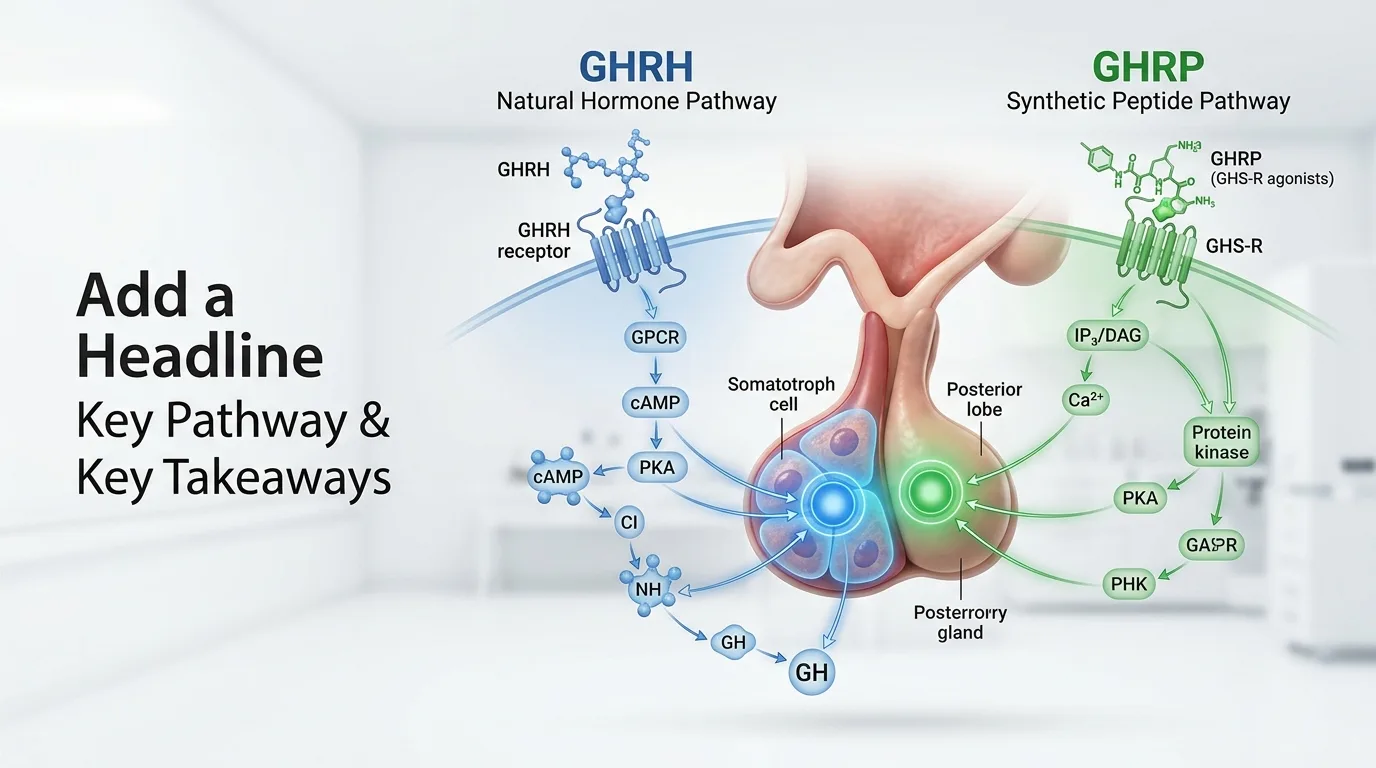
In 1982, two research groups working under Roger Guillemin and Jean Rivier isolated and characterized growth hormone-releasing hormone, the hypothalamic signal that tells the pituitary gland to release growth hormone. The discovery answered a question endocrinologists had been chasing since the 1960s. But within a few years, a separate and stranger finding emerged from laboratories screening synthetic peptide libraries: a class of small molecules, structurally unrelated to GHRH, that triggered the same pituitary cells to release the same hormone. These became known as growth hormone-releasing peptides, or GHRPs.
The compounds shared no sequence homology with GHRH. They did not bind the same receptor. Yet somatotroph cells in the anterior pituitary responded to both by releasing growth hormone. That convergence, two molecularly distinct inputs producing an identical physiological output, set off decades of research into how many "doors" exist into the same room. It also set the stage for a persistent point of confusion in peptide research: the assumption that GHRH and GHRP are interchangeable simply because they arrive at the same destination.
How GHRH and GHRP Growth Hormone Secretion Pathways Differ at the Receptor Level
Both GHRH and GHRP act on somatotroph cells, the specialized pituitary cells responsible for producing and storing growth hormone. That shared cellular target is the root of most of the conflation between the two classes. If both molecules end in the same outcome, it is easy to assume they are functionally the same category of compound.
They are not. GHRH is an endogenous hormone, synthesized in the hypothalamus and released into the hypophyseal portal system as part of normal physiological signaling. GHRPs are synthetic constructs, developed in laboratories beginning in the 1980s, that happen to mimic the action of a different endogenous hormone entirely, ghrelin, rather than GHRH itself.
Understanding the GHRH vs GHRP growth hormone secretion pathway difference requires setting aside the shared endpoint and looking instead at the separate receptors, separate signaling cascades, and separate physiological roles each molecule occupies. The next several sections unpack those distinctions in order.
The GHRH Pathway: Natural Signaling Through cAMP
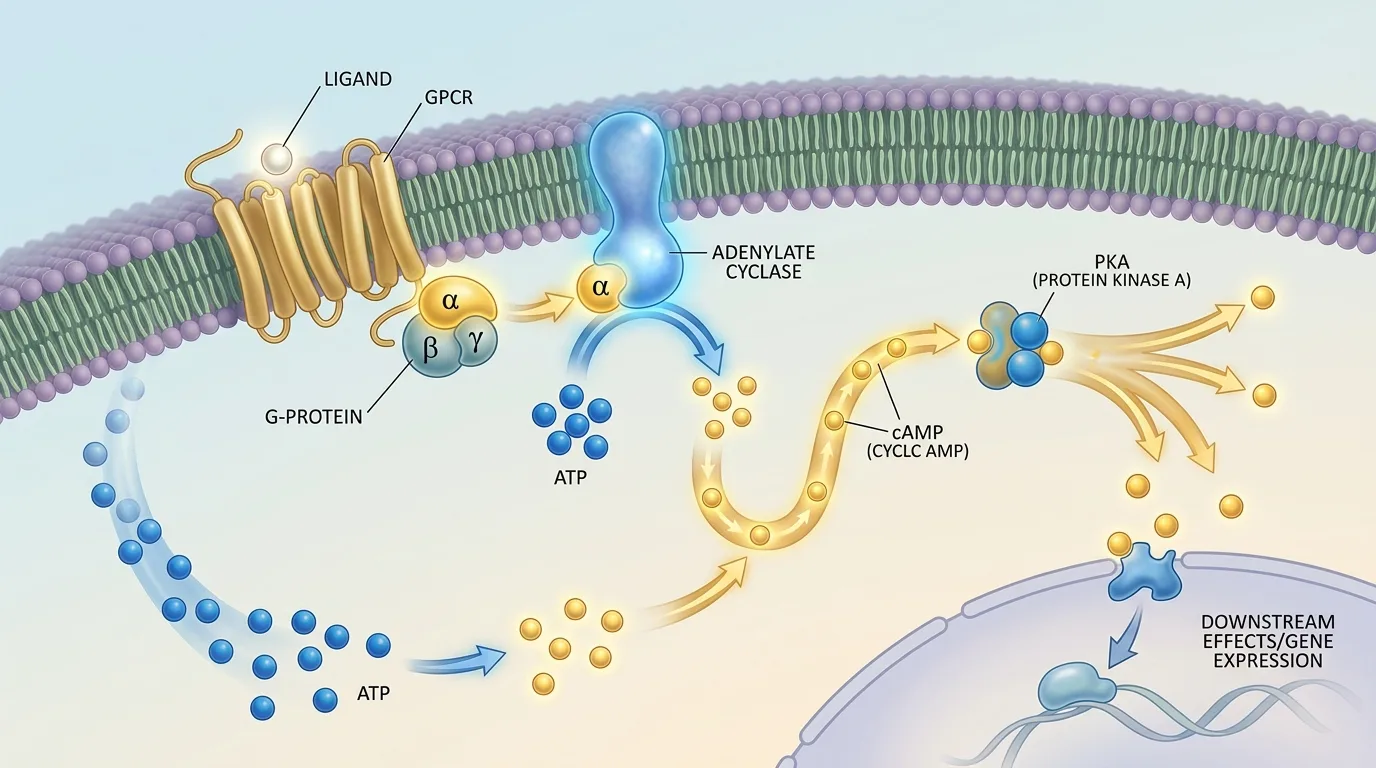
GHRH signaling begins when the hormone binds to the GHRH receptor, a G-protein-coupled receptor expressed on somatotroph cell membranes. That binding activates adenylate cyclase, an enzyme that converts ATP into cyclic AMP, raising intracellular cAMP concentrations.
The rise in cAMP activates protein kinase A, which carries out two jobs simultaneously. It triggers the transcription of the growth hormone gene, building the cell's future supply, and it stimulates the release of GH already packaged in secretory vesicles, according to findings indexed on PubMed [1]. This dual action, synthesis and release, is what makes GHRH the primary physiological driver of the body's naturally pulsatile GH secretion pattern.
GHRH's role in this system is entirely dependent on its hypothalamic origin. It is released in bursts, travels a short distance to the pituitary, and does its job quickly. That speed is also its pharmacological weakness: natural GHRH breaks down within minutes of entering circulation [2]. That short half-life becomes a central problem later in this story, one that drove much of the modification work in synthetic analogs decades later.
The GHRP Pathway: Synthetic Peptides and the Ghrelin Receptor
GHRPs take a different route entirely. Rather than binding the GHRH receptor, they act on the growth hormone secretagogue receptor, commonly abbreviated GHS-R, the same receptor that the endogenous hormone ghrelin uses [3]. This is the defining feature of GHRP secretagogue receptor signaling, and it is mechanistically distinct from GHRH's cAMP pathway from the first step.
Where GHRH signaling raises cAMP, GHS-R activation raises intracellular calcium concentrations. This calcium-based cascade is a separate biochemical route to the same somatotroph cells, converging on GH release through different intracellular machinery [3].
Research cataloged in academic literature, including work published through Oxford University Press's academic journals [3], describes GHRP action as functioning across three distinct fronts. GHRPs stimulate the pituitary directly, they amplify the hypothalamus's own GHRH release, and they inhibit somatostatin, the hormone that normally acts as the body's "off switch" for GH secretion [4]. No naturally occurring hormone performs this exact three-part function; GHRPs are entirely synthetic constructs designed to exploit a receptor system that ghrelin uses for a related but distinct physiological purpose.
Why Two Pathways Were Combined: The Synergy Rationale
The mechanistic separation between GHRH and GHRP is precisely what generated interest in combining them. Because GHRH signals through cAMP and GHRPs signal through calcium, researchers found that administering both together produced a GH release substantially greater than the sum of either compound's individual effect [5].
This is not intuitive on its face. Two molecules acting on the same cell type, through two separate second-messenger systems, do not simply add their effects together; they appear to potentiate one another. The proposed explanation is that cAMP and calcium signaling cascades intersect at points downstream of receptor activation, amplifying the overall secretory response beyond what either pathway achieves alone [5].
It is worth being precise about what this synergy describes: pituitary cell signaling behavior observed in research models, not a claim about outcomes in human physiology or performance. The distinction matters because this synergy finding is exactly what gave rise to the practice of pairing GHRH-type and GHRP-type compounds in early research settings, well before the modified analogs discussed later in this piece existed.
The Early Limitation: Short Half-Lives and Frequent Dosing
The synergy rationale ran directly into a practical wall. Both natural GHRH and first-generation GHRPs degraded within minutes of entering the bloodstream [2]. Any signaling effect, synergistic or otherwise, was necessarily brief, which meant sustaining an effect over time required repeated administration at short intervals.
This pharmacokinetic limitation constrained experimental design considerably. Researchers studying these compounds in the 1980s and 1990s were working with molecules that had a narrow window of activity, complicating both the interpretation of results and the feasibility of any sustained research application.
A second limitation compounded the first. Earlier-generation GHRPs, specifically GHRP-6 and GHRP-2, were noted in research literature to bind the GHS-R with limited selectivity. That lack of precision meant these molecules also elevated cortisol and prolactin, two hormones with their own distinct regulatory systems [3]. The combination of short duration and poor receptor selectivity defined the two central problems that later modification efforts specifically targeted.
Modified GHRH: How CJC-1295 and DAC Changed the Half-Life Problem
The response to GHRH's short half-life came in the form of a chemical modification known as Drug Affinity Complex, or DAC. CJC-1295 with DAC is a modified GHRH analog engineered to bind to albumin, the most abundant protein in blood plasma [6].
That albumin-binding property is the entire mechanism behind the extended duration. Instead of circulating freely and breaking down within minutes, the DAC-modified molecule is shielded by its albumin attachment, extending its half-life from minutes to several days according to pharmacokinetic research [6].
The physiological consequence described in the literature is a continuous, low-level GHRH signal rather than the brief, sharp signal natural GHRH produces. This sustained signaling is described as raising the baseline, or "trough," level of GH between the body's natural secretory pulses, and priming the pituitary to synthesize more growth hormone over time [1]. The comparison in duration is stark: minutes for endogenous GHRH versus multiple days for its DAC-modified counterpart, a gap that illustrates just how significant this single chemical modification was to the pharmacokinetic profile of the molecule.
Modified GHRP: Ipamorelin and Receptor Selectivity
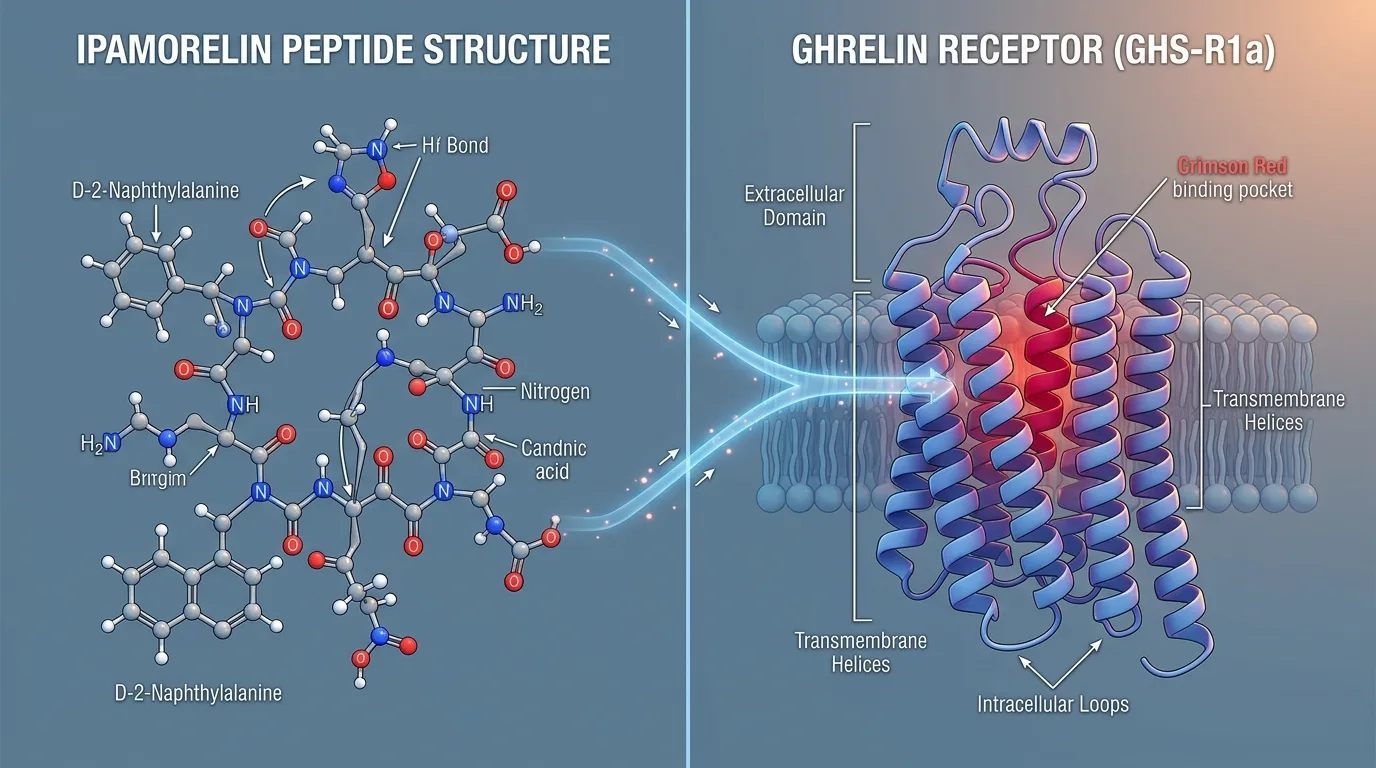
If CJC-1295 with DAC solved a duration problem, ipamorelin was engineered to solve a selectivity problem. Later-generation GHRPs were developed with structural modifications intended to bind the GHS-R more precisely than earlier compounds like GHRP-6 or GHRP-2 [3].
Receptor-binding studies describe this improved selectivity as the mechanism behind ipamorelin's reduced tendency to elevate cortisol and prolactin, the same off-target effects that limited earlier secretagogues [3]. The molecule was designed to activate GHS-R signaling with less spillover into adjacent hormonal systems.
The CJC-1295 vs ipamorelin GHRH GHRP difference is, at its core, a difference in what each molecule was built to fix. CJC-1295 with DAC is a modified natural hormone analog operating through the cAMP pathway, engineered primarily to extend duration. Ipamorelin is a selective synthetic secretagogue operating through the calcium pathway, engineered primarily to improve receptor specificity. Notably, ipamorelin retains a comparatively short duration of action by design, a pharmacokinetic profile that stands in deliberate contrast to CJC-1295's long-acting one.
Pulse Frequency and the 'Bleed and Burst' Model
Natural GH secretion does not occur as a steady stream; it occurs in discrete pulses throughout the day, with quiet troughs in between. Researchers modeling the combined use of long-acting GHRH analogs and selective GHRPs describe a "bleed and burst" pattern intended to mimic and amplify that natural rhythm.
In this model, a long-acting GHRH analog such as CJC-1295 with DAC provides the sustained "bleed," a continuous low-level signal that keeps GH synthesis elevated over time. A short-acting, selective GHRP such as ipamorelin is then described as triggering the "burst," an acute pulsatile release of the hormone that has been accumulating in storage [5].
This is a mechanistically coherent hypothesis grounded in the separate cAMP and calcium pathways discussed earlier. But coherence at the mechanistic level is not the same as demonstrated outcome at the level of large-scale human trials. Discussion of these specific combinations, including in forums where researchers and clinicians informally compare notes [7], repeatedly flags that direct, well-controlled human trial evidence on this exact pairing remains limited. The gap between plausible mechanism and confirmed human trial data is real, and it should be stated plainly rather than glossed over.
What Remains Unknown
Several questions sit outside the boundary of what current research has settled. The long-term effects of sustained cAMP elevation, of the kind produced by DAC-modified GHRH analogs, are not well characterized in controlled human studies extending over months or years.
Much of the mechanistic and synergy data cited throughout peptide research literature derives from smaller trials, animal models, or studies of older, less selective secretagogues rather than from large randomized trials of the newer modified combinations discussed here. That distinction matters when evaluating how confidently any of these mechanisms can be extrapolated.
There is also the open question of receptor desensitization. Prolonged stimulation of GHS-R or the GHRH receptor could,
Sources
- nih.gov -- pubmed.ncbi.nlm.nih.gov
- newtropin.com -- newtropin.com
- oup.com -- academic.oup.com
- peptidesinsider.com -- peptidesinsider.com
- peptideauthority.co.uk -- peptideauthority.co.uk
- superpower.com -- superpower.com
- reddit.com -- reddit.com