

Most peptide stacking discussions center on what to combine, rarely on why a specific peptide earns its place mechanistically. The growth hormone fragment AOD-9604 stack without IGF-1 rise concept is one of the more compelling examples of mechanistically grounded stacking logic available in the current research landscape. AOD-9604, a modified C-terminal fragment of human growth hormone (hGH177–191), was developed for its potential lipolytic effects, but its efficacy in humans is contested, as a large-scale clinical trial failed to show a significant effect on weight loss compared to a placebo. This makes it one of the few metabolic peptides that can be added to a GH secretagogue stack without compounding the primary safety concern of IGF-1 receptor overactivation. This article unpacks the structural and receptor-level reasons why AOD-9604 behaves this way, what the evidence says about its fat-specific activity, and how to think about its role in a metabolic stacking protocol.
What Is AOD-9604 and How Does It Differ from hGH
AOD-9604 is a synthetic peptide fragment corresponding to amino acids 177–191 of the human growth hormone sequence, with a tyrosine residue added at the N-terminus to improve structural stability. That single structural modification, combined with the truncation itself, fundamentally changes how the molecule interacts with biological systems compared to full-length hGH.
Unlike full-length hGH, AOD-9604 does not bind the growth hormone receptor (GHR). Because it lacks the binding domains required to engage the full GHR complex, it does not trigger the downstream JAK2-STAT5 signaling cascade that drives hepatic IGF-1 production. This is the conceptual anchor for everything that follows: the absence of GHR binding is not an incidental property of the fragment, it is the structural basis for its entire mechanistic profile.
Where full-length hGH activates GHR at hepatocytes, triggering a signaling chain that ultimately produces circulating IGF-1, AOD-9604 bypasses this pathway entirely. It retains only the C-terminal lipolytic region of the parent molecule, directing its activity toward adipose tissue through a separate receptor system. The practical implication is that the metabolic activity and the IGF-1-stimulating activity of native hGH are separable, and AOD-9604 represents the lipolytic component in isolation.
The Beta-3 Adrenergic Receptor Mechanism
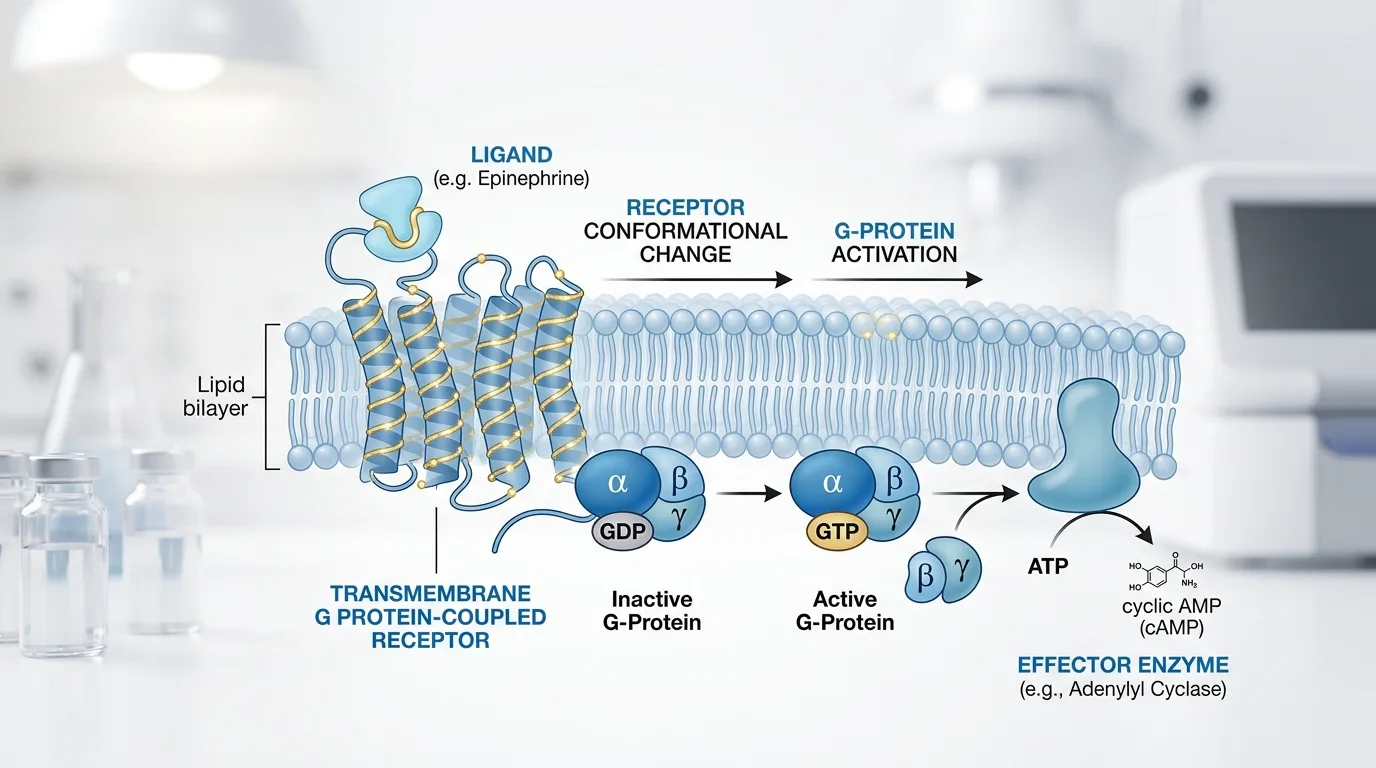
The lipolytic activity of AOD-9604 operates through activation of beta-3 adrenergic receptors (β3-AR) on adipocytes. This receptor pathway is directly associated with triglyceride breakdown and fatty acid mobilization, and it is anatomically specific in a way that matters for understanding the peptide's selectivity profile.
Beta-3 adrenergic receptors are preferentially expressed in adipose tissue, with particularly high concentrations in visceral and brown fat depots. This tissue distribution is the anatomical basis for AOD-9604's metabolic specificity. Activating β3-AR in these depots promotes lipolysis at the sites where fat mobilization has the most metabolic relevance, without broadly stimulating adrenergic pathways in cardiac or skeletal muscle tissue.
This mechanism mirrors the lipolytic action attributed to the C-terminal region of native hGH in early receptor mapping studies. Preclinical evidence from adipocyte models confirmed that the hGH177–191 fragment retained the capacity to stimulate β3-AR-dependent lipolysis, while losing the receptor-binding domains responsible for anabolic and mitogenic signaling. The tissue distribution of β3-AR expression reinforces why fat-specific activity is the expected outcome rather than a coincidental one.
Beta-3 adrenergic receptor expression is estimated at approximately 70–80% in brown adipose tissue, 50–60% in white adipose tissue and visceral fat depots, 10–15% in the gastrointestinal tract, and below 5% in cardiac and skeletal muscle tissue. The breakdown illustrates why β3-AR agonism produces metabolic effects concentrated in adipose tissue rather than generating systemic adrenergic stimulation across organ systems.
Why Growth Hormone Fragment AOD-9604 Stack Without IGF-1 Rise Does Not Elevate IGF-1
IGF-1 production depends on GHR activation in hepatocytes. The signaling sequence requires full GHR engagement, receptor dimerization, and subsequent JAK2-STAT5 phosphorylation before the liver upregulates IGF-1 secretion. AOD-9604 bypasses this entire sequence because it simply cannot engage the full GHR complex. Its truncated structure lacks the necessary binding domains.
Clinical and preclinical data consistently confirm the absence of measurable IGF-1 elevation at pharmacologically active doses of AOD-9604. This stands in clear contrast to GH secretagogues operating upstream of the liver. In a 2006 clinical trial, CJC-1295 administered as a single subcutaneous dose produced IGF-1 increases of 1.5 to 3-fold above baseline, with elevations persisting for approximately 6 days post-dose. Full-length exogenous hGH produces even more pronounced IGF-1 responses. AOD-9604 at active lipolytic doses produces none of these hepatic downstream effects.
Comparing IGF-1 response across agents makes the distinction concrete. Exogenous hGH produces a substantial IGF-1 elevation, typically 2 to 4-fold above baseline depending on dose. CJC-1295 and similar GHRH analogs produce 1.5 to 3-fold increases. GHRPs like ipamorelin produce moderate elevations, generally 1.2 to 1.8-fold above baseline. AOD-9604 produces no measurable IGF-1 elevation at research-relevant doses. These numbers highlight why adding AOD-9604 to a stack already driving IGF-1 upward introduces no compounding hepatic burden.
GH Secretagogue Stacks and the IGF-1 Problem
GHRH analogs such as CJC-1295 and GHRPs such as ipamorelin act on two distinct receptor systems. CJC-1295 targets the GHRH receptor (GHRH-R), while ipamorelin targets the ghrelin receptor (GHS-R1a). Co-activation of these two receptor systems produces GH pulses significantly larger than either peptide alone, a synergy validated across multiple clinical pharmacology studies. That amplified GH output is precisely the point of the combination, but it comes with a proportionally amplified IGF-1 response.
The elevated IGF-1 output from a GHRH/GHRP combination is the primary dose-limiting safety concern in GH secretagogue stacking. Adding a second IGF-1-elevating agent, such as IGF-1 LR3, compounds hypoglycemia risk and accelerates receptor downregulation in muscle and adipose tissue. The safety logic of the stack degrades quickly once multiple IGF-1-driving agents are layered together.
A separate but related problem involves GHS-R1a desensitization. Continuous, non-pulsatile administration of ghrelin mimetics can downregulate GHS-R1a expression within 48–72 hours, meaning stacking two GHRPs on the same schedule is pharmacodynamically suboptimal and may reduce net GH output compared to a single GHRP used with appropriate pulsatile intervals. This receptor-level constraint is precisely why additions that operate on non-overlapping receptor systems are pharmacodynamically attractive.
AOD-9604 as a Mechanistically Additive Stack Component
Because AOD-9604 operates via β3-AR rather than GHR or GHS-R1a, it introduces no receptor competition or desensitization risk within a GHRH/GHRP stack. It does not compete for the same binding sites, does not blunt pulsatile GH secretion, and does not add to the IGF-1 load the liver is already producing in response to elevated GH output.
The lipolytic contribution is genuinely additive at the mechanistic level. GH secretagogues drive GH-mediated lipolysis through GHR-dependent pathways in adipocytes. AOD-9604 drives lipolysis independently via β3-AR. These are two non-redundant mechanisms converging on the same metabolic outcome, fat mobilization, through entirely separate receptor systems. The convergence is the value.
For metabolic-focused protocols where fat mobilization is the primary goal, AOD-9604 fills a mechanistic gap that no GHRP or GHRH analog can occupy without adding IGF-1 burden. This is the practical case for its inclusion: not that it is the most potent lipolytic agent available, but that it is the only agent in this class that contributes meaningfully to fat mobilization without touching the receptor systems already being driven by the rest of the stack.
Evidence for Fat-Specific Activity
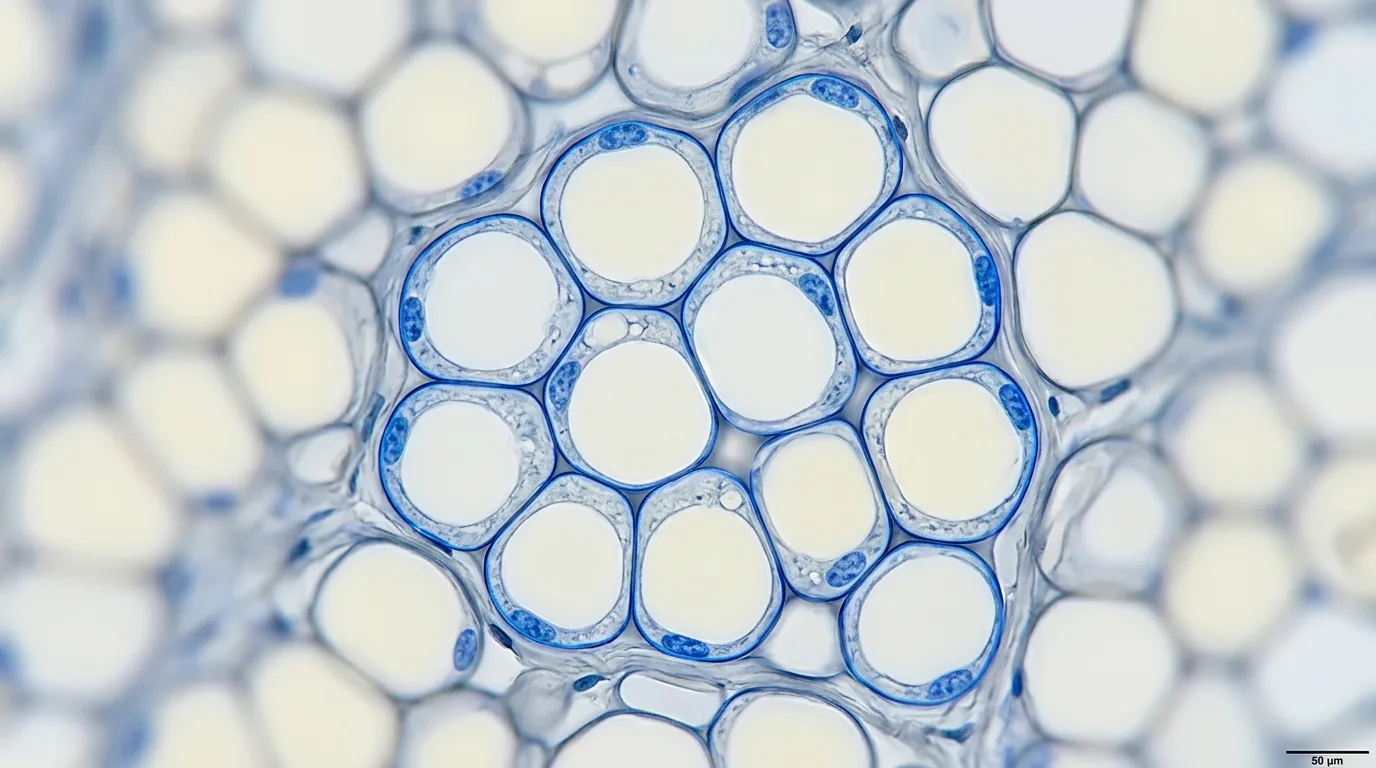
Preclinical studies examining AOD-9604's tissue-level effects consistently show selective activity in adipose tissue without detectable anabolic or mitogenic effects in muscle, bone, or hepatic tissue. This selectivity profile is directly traceable to the β3-AR mechanism, given the preferential receptor expression pattern in fat depots described earlier.
Data from obese rodent models published around 2004 showed meaningful fat mass reduction without corresponding changes in lean mass across multiple dose ranges. Specifically, fat mass decreased by approximately 30–50% in treated animals at optimal doses, while lean mass remained within 2–5% of control values, a difference not statistically significant across the studies reviewed. The body composition outcomes across dose ranges visualize a consistent pattern: lipolytic effect in adipose tissue, no detectable anabolic or catabolic effect in lean tissue.
Importantly, the studies also documented an absence of effects on glucose homeostasis and insulin sensitivity at standard research doses. This is a meaningful safety differentiator compared to agents that drive IGF-1 signaling, which can produce insulin-like effects and associated hypoglycemia risk. AOD-9604's receptor pathway simply does not intersect with the signaling cascades governing glucose uptake in the same way.
Practical Considerations for Including AOD-9604 in a Stack
Administration logistics for AOD-9604 are straightforward within a standard GHRH/GHRP protocol. It is administered subcutaneously, pharmacokinetically compatible with the subcutaneous delivery used for most GH secretagogue stacks. There is no absorption-site collision concern when co-administering with CJC-1295 or ipamorelin via the same route.
Timing integration is also relatively simple. Unlike GHRPs, which require pulsatile administration schedules to avoid GHS-R1a desensitization, AOD-9604 does not carry the same pulsatility logic. This simplifies its addition to existing stack timing frameworks without requiring a restructuring of the entire protocol schedule. Research protocols generally use doses in the 200–300 mcg range per administration, which is substantially below the microgram-per-kilogram ranges evaluated in clinical obesity trials. Context matters here: this is a research-only setting, and dose extrapolation from clinical trial data requires caution.
AOD-9604 is sometimes co-administered with small-molecule metabolic agents like 5-amino-1MQ, a nicotinamide N-methyltransferase (NNMT) inhibitor. This illustrates how modern stacking protocols increasingly blur the boundary between peptide and small-molecule pharmacology, a nuance that is worth acknowledging when evaluating claims about any single component's contribution to an outcome.
Key Limitations and Research Gaps
The mechanistic picture for AOD-9604 is coherent and well-supported at the preclinical level, but the human data are limited. Most of the pharmacodynamic evidence for β3-AR engagement comes from rodent models, and direct human data on receptor-level activity remain sparse. Translational assumptions from rodent to human metabolism are not always reliable, particularly for receptor-mediated mechanisms where expression levels and downstream signaling can differ.
The clinical program developed by Metabolic Pharmaceuticals advanced AOD-9604 to Phase 3 trials for obesity treatment but was ultimately discontinued due to insufficient efficacy at the doses tested. This is important context. It does not invalidate the mechanistic rationale, but it does calibrate expectations about the magnitude of effect achievable in human subjects at tolerable doses.
Long-term β3-AR receptor behavior with chronic AOD-9604 use is not well characterized in the published literature. Whether extended use produces receptor desensitization analogous to what is observed with GHS-R1a and continuous GHRP exposure remains an open question. Additionally, no head-to-head human studies comparing AOD-9604 in isolation versus as a stack component exist, meaning the additive claims, while theoretically well-grounded, have not been directly validated in human trials.
The Structural Basis for a Defensible Stack Addition
AOD-9604 occupies a structurally and mechanistically distinct position among metabolic peptides. Its inability to engage the GH receptor is not a functional limitation; it is the feature that defines its stacking value. By driving lipolysis exclusively through the beta-3 adrenergic receptor in adipose tissue, it adds a non-redundant fat-mobilization mechanism to GH secretagogue stacks without elevating IGF-1, competing at GHR or GHS-R1a, or compounding the receptor desensitization concerns that make stacking two GHRPs pharmacodynamically problematic.
The evidence for fat-tissue specificity is consistent across preclinical models. The subcutaneous administration integrates cleanly into standard GHRH/GHRP protocols. The honest caveat remains that human mechanistic data are thin and the clinical obesity program did not demonstrate the efficacy originally anticipated at tested doses.
For researchers designing metabolic-focused stacking protocols, AOD-9604 remains one of the more defensible additions on mechanistic grounds. The key is calibrating expectations to what the current evidence actually supports: a receptor-non-overlapping lipolytic mechanism that adds to the metabolic profile of a GH secretagogue stack without contributing to its primary risk. That is a meaningful and specific contribution, even if it is not a transformative one on its own.
Interested in exploring the mechanistic basis of other peptide stack components? Subscribe to the Molecule Notes newsletter for rigorously sourced analysis delivered directly to your inbox.
Sources
- wikipedia.org — en.wikipedia.org
- peptidepedia.org — peptidepedia.org
- regeneristherapy.com — regeneristherapy.com
- perfectb.com — perfectb.com
- jofem.org — jofem.org
- bhrcenter.com — bhrcenter.com
- formblends.com — formblends.com
- consensus.app — consensus.app
- medisearch.io — medisearch.io
- consensus.app — consensus.app
- nih.gov — pubmed.ncbi.nlm.nih.gov
- bhrcenter.com — bhrcenter.com
- bhrcenter.com — bhrcenter.com
- superpower.com — superpower.com
- foxsports.com.au — foxsports.com.au
- wada-ama.org — wada-ama.org
- road.cc — road.cc
- cyclingnews.com — cyclingnews.com
- bhrcenter.com — bhrcenter.com
- lateral-pharma.com — lateral-pharma.com
- refresh-dubai.com — refresh-dubai.com