

Most therapeutic peptides fail not because they lack potency. They fail because the body destroys them too quickly. Native glucagon-like peptide-1 (GLP-1) has a plasma half-life of roughly two minutes; without chemical engineering, it would be clinically useless as a drug scaffold. The story of how peptide chemists solved this problem is one of the most instructive case studies in modern drug design, and retatrutide (LY3437943), Eli Lilly's triple agonist targeting GLP-1R, GIPR, and GCGR simultaneously, sits at the apex of that engineering journey. This article unpacks the precise molecular strategies behind peptide albumin binding half-life extension mechanism, using retatrutide and semaglutide as parallel case studies to trace how fatty acid acylation, linker chemistry, and albumin-binding kinetics translate directly into pharmacokinetic parameters that determine clinical viability. For more on peptide pharmacokinetics, see Understanding Peptide Pharmacokinetics.
Why Peptides Have Short Half-Lives: The Clearance Problem
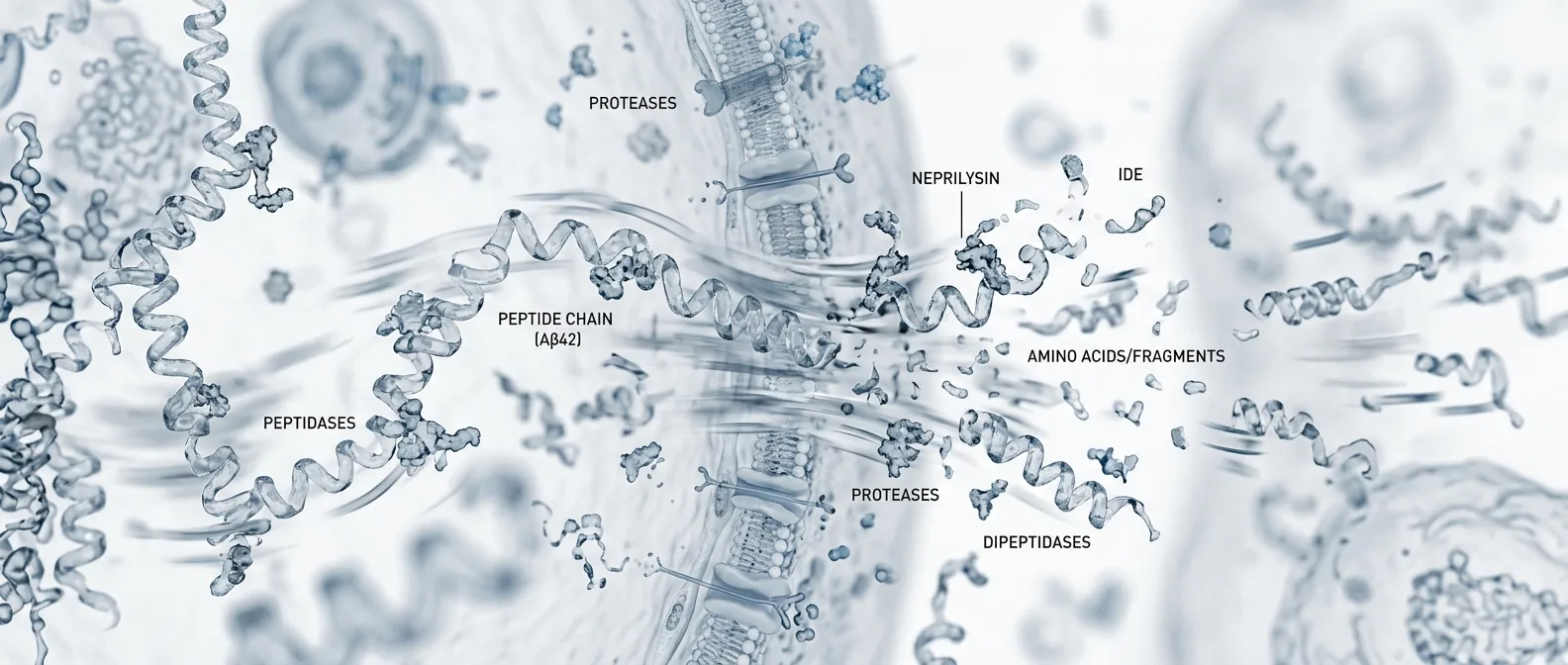
Unmodified peptides face two simultaneous clearance burdens that make them pharmacologically impractical without modification. The first is renal filtration. The glomerular filtration threshold sits at approximately 40 kDa; peptides well below this size, including GLP-1 at roughly 3.3 kDa, pass freely through the kidney and are eliminated within minutes of entering circulation. The second burden is enzymatic degradation. Dipeptidyl peptidase-4 (DPP-4) cleaves incretin peptides at the penultimate alanine of the N-terminus, while neutral endopeptidases attack internal sequence motifs, creating a degradation cascade that compounds renal clearance.
The clinical consequence of this dual clearance burden is starkly visible in the pharmacokinetic progression of GLP-1 analogs across generations. Native GLP-1 carries a half-life of approximately 2 minutes. Liraglutide, the first acylated GLP-1 analog, extended this to roughly 13 hours through C16 fatty acid attachment, enabling once-daily dosing. Semaglutide, with its C18 fatty diacid architecture, pushed the half-life to approximately 165 hours (nearly 7 days), unlocking once-weekly administration. Retatrutide achieves a comparable half-life of approximately 7 days through an analogous but structurally more complex acylation strategy. These numbers highlight the direct engineering trajectory from minutes to days, each generational advance representing deliberate chemical decisions rather than incremental luck. For an overview of peptide modifications that extend half-life, see Strategies for Extending Peptide Half-Life.
The engineering implication is clear. Achieving a once-weekly dosing window requires simultaneously defeating both proteolytic and renal clearance, not one or the other. A peptide that resists DPP-4 but remains small enough for glomerular filtration will still be eliminated rapidly. The solution required a strategy that addressed both mechanisms through a single architectural modification.
What Is Fatty Acid Acylation and Why Do Drug Designers Use It?
Fatty acid acylation is the covalent attachment of a fatty acid chain, typically ranging from C16 to C18 in length, to a lysine side chain amine or the peptide N-terminus via an amide bond. This single modification converts a hydrophilic peptide into an amphiphilic molecule with profoundly different pharmacokinetic behavior. The mechanistic rationale centers on serum albumin, the most abundant plasma protein in human blood at approximately 40 mg/mL, with an intrinsic half-life of roughly 19 days. By engineering a peptide to bind albumin reversibly through its acyl chain, the peptide effectively borrows albumin's extended circulation time. The bound fraction avoids renal filtration because the albumin-peptide complex greatly exceeds the 40 kDa glomerular threshold, and the steric bulk of albumin shields the bound peptide from DPP-4 access. To learn more about albumin binding strategies, visit Albumin Binding in Peptide Therapeutics.
It is worth distinguishing acylation from PEGylation, an alternative half-life extension strategy. PEGylation covalently attaches polyethylene glycol chains to extend half-life through increased hydrodynamic radius and reduced renal clearance, independent of albumin. Acylation, by contrast, is reversible and albumin-dependent; the peptide exists in dynamic equilibrium between free and bound states, with only the free fraction engaging receptors. This distinction carries significant implications for tissue distribution and immunogenicity. PEGylated drugs accumulate in tissues over time and have raised immunogenicity concerns in some contexts; acylated peptides are largely restricted to the vascular compartment and interstitial fluid, producing more predictable distribution profiles and no known polymer accumulation issues. For more on the differences between PEGylation and acylation, see PEGylation Versus Acylation in Peptide Drugs.
Liraglutide established the foundational proof of concept for GLP-1 analog acylation using a C16 fatty acid, demonstrating that albumin association could extend a 2-minute half-life to 13 hours. Semaglutide then advanced the approach significantly by switching to a C18 fatty diacid with a structured multi-unit linker, achieving a nearly tenfold further extension in half-life. This semaglutide architecture became the explicit template that the retatrutide design team built upon.
The Chemistry of C18 Fatty Diacid Moieties: Semaglutide as the Reference Model
Semaglutide's half-life advance over liraglutide is not simply a function of using a longer fatty acid chain. The critical innovation was replacing a monocarboxylic fatty acid (C16 palmitic acid in liraglutide) with a dicarboxylic fatty acid, specifically octadecanedioic acid, a C18 fatty diacid. The diacid configuration provides two polar carboxylate termini. One terminus anchors through the linker to the lysine side chain on the peptide backbone, while the second projects outward into aqueous solution. This dual-polarity architecture simultaneously increases aqueous solubility (addressing the aggregation and formulation challenges common to long-chain fatty acid conjugates) while preserving the hydrophobic core that drives albumin association. For a detailed review, see Semaglutide and its Structural Features.
The linker system connecting the fatty diacid to the peptide in semaglutide is equally important. It consists of a mini-PEG spacer combined with one gamma-glutamic acid (γGlu) unit, creating a flexible, hydrophilic tether between the peptide backbone and the fatty diacid terminus. This architecture serves two functions. First, it physically separates the bulky acyl chain from the peptide's receptor-binding surfaces, reducing steric interference with GLP-1R engagement. Second, the hydrophilic linker improves overall molecular solubility, supporting high-concentration subcutaneous formulations without aggregation-driven precipitation.
At the albumin-binding interface, the electron-rich carboxylate terminus of the diacid interacts with positively charged binding pockets in albumin's fatty acid binding sites, primarily FA7 and FA2. This interaction is non-covalent and pH-sensitive, reflecting the electrostatic character of the binding. The pH sensitivity is pharmacokinetically relevant: the slightly acidic environment of subcutaneous tissue after injection may modulate initial albumin association, while physiological plasma pH (~7.4) supports the equilibrium binding affinity that governs systemic circulation time. A comparison of liraglutide (C16 monoacid, albumin Kd in the low micromolar range, half-life ~13 hours) versus semaglutide (C18 diacid with structured linker, tighter albumin affinity, half-life ~165 hours) illustrates how each structural refinement cascades directly into measurable pharmacokinetic improvement.
Retatrutide's Peptide Structure and Acylation Architecture
Retatrutide's primary sequence is structurally derived from a modified glucagon analog backbone, a deliberate choice given that GCGR agonism requires a scaffold closer to glucagon than to GLP-1. This backbone was then re-engineered through strategic amino acid substitutions to achieve high-potency agonism at GLP-1R and GIPR alongside moderate, therapeutically meaningful GCGR activity. The challenge of designing simultaneous agonism across three receptor subtypes using a single linear peptide sequence is non-trivial; each receptor has distinct pharmacophoric requirements, and a substitution that enhances activity at one receptor can reduce selectivity or potency at another.
Like semaglutide, retatrutide employs a C18 fatty diacid moiety attached via a multi-unit linker to a lysine residue embedded within its backbone. The precise position of this lysine is a critical design variable because the acylation site determines both the spatial orientation of the acyl chain and the degree to which peptide albumin binding half-life extension mechanism interferes with any of the three receptor-binding epitopes. In a molecule designed for triple agonism, this constraint is considerably more complex than in semaglutide, which needed to protect only a single pharmacophoric surface. The linker in retatrutide serves the same dual purpose as in semaglutide: separating the acyl chain from receptor-binding residues and maintaining sufficient aqueous solubility for formulation stability.
Protease resistance is the complementary half of retatrutide's half-life engineering. Alpha-aminoisobutyric acid (Aib) substitutions are incorporated at positions vulnerable to DPP-4 and neutral endopeptidase cleavage. Aib is a non-proteinogenic amino acid carrying two methyl groups on the alpha carbon, creating steric obstruction that blocks enzymatic access to the peptide bond. These backbone modifications do not rely on albumin association for their protective effect; they function independently to prevent enzymatic degradation of the free-drug fraction. The combination of Aib-mediated protease resistance and acylation-mediated albumin protection constitutes the integrated dual-mechanism approach required to sustain a 7-day half-life in vivo.
The triple agonist requirement also means that any single structural modification must be evaluated against three pharmacological constraints simultaneously. Linker length, acyl chain orientation, and Aib placement are therefore not independently optimized variables; they are solved together as a constrained system, which explains the substantial medicinal chemistry investment required to move from a pharmacologically active peptide sequence to a developable drug candidate.
Albumin-Binding Kinetics: How Reversible Association Extends Plasma Half-Life
The peptide albumin binding half-life extension mechanism operates through reversible, equilibrium-driven association. At any moment in plasma, the acylated peptide exists as two populations: a small free fraction that is pharmacologically active but exposed to renal filtration and proteolysis, and a large albumin-bound fraction that is protected from both clearance mechanisms but pharmacologically silent. These two populations interconvert continuously, governed by the binding affinity constant (Kd) and the concentrations of free drug and available albumin binding sites.
Binding affinity is the single most important engineering parameter in this system, and it operates within a narrow optimal range. If the Kd is too high (weak binding), most of the peptide remains free, eliminating rapidly with a short half-life. If the Kd is too low (very tight binding), the peptide is effectively sequestered, unable to dissociate and engage receptors at therapeutic concentrations. Both semaglutide and retatrutide are tuned to Kd values in the low micromolar range, approximately 1 to 10 micromolar, a deliberately moderate affinity that creates a large protected reservoir while maintaining sufficient free-fraction receptor engagement to produce pharmacological effect. For a deeper dive into binding kinetics and their impact on drug half-life, see Reversible Albumin Binding and Pharmacokinetics.
The pharmacokinetic consequence is a concentration-time profile that declines far more slowly than would be predicted for an unmodified peptide of the same molecular weight. As free drug is cleared or consumed, the bound fraction continually replenishes it through equilibrium release, effectively buffering plasma concentrations over the dosing interval. This buffering mechanism is what sustains therapeutic concentrations throughout a 7-day dosing window without requiring multiple injections. The breakdown between free and albumin-bound fractions illustrates how even a small free fraction, actively replenished from the bound reservoir, can maintain continuous receptor engagement at the concentrations required for GLP-1R, GIPR, and GCGR activation.
Volume of distribution provides an additional pharmacokinetic perspective on this system. Albumin binding confines the drug predominantly to the vascular compartment and interstitial fluid, producing a relatively low volume of distribution. Semaglutide's reported Vd is approximately 10 to 20 liters, consistent with distribution that does not substantially penetrate intracellular compartments or highly perfused tissues beyond what albumin itself accesses. This low Vd supports predictable subcutaneous bioavailability and simplifies dose-response modeling, an important practical benefit for clinical development.
How Acylation Chemistry Translates Into Once-Weekly Dosing: Pharmacokinetic Parameters
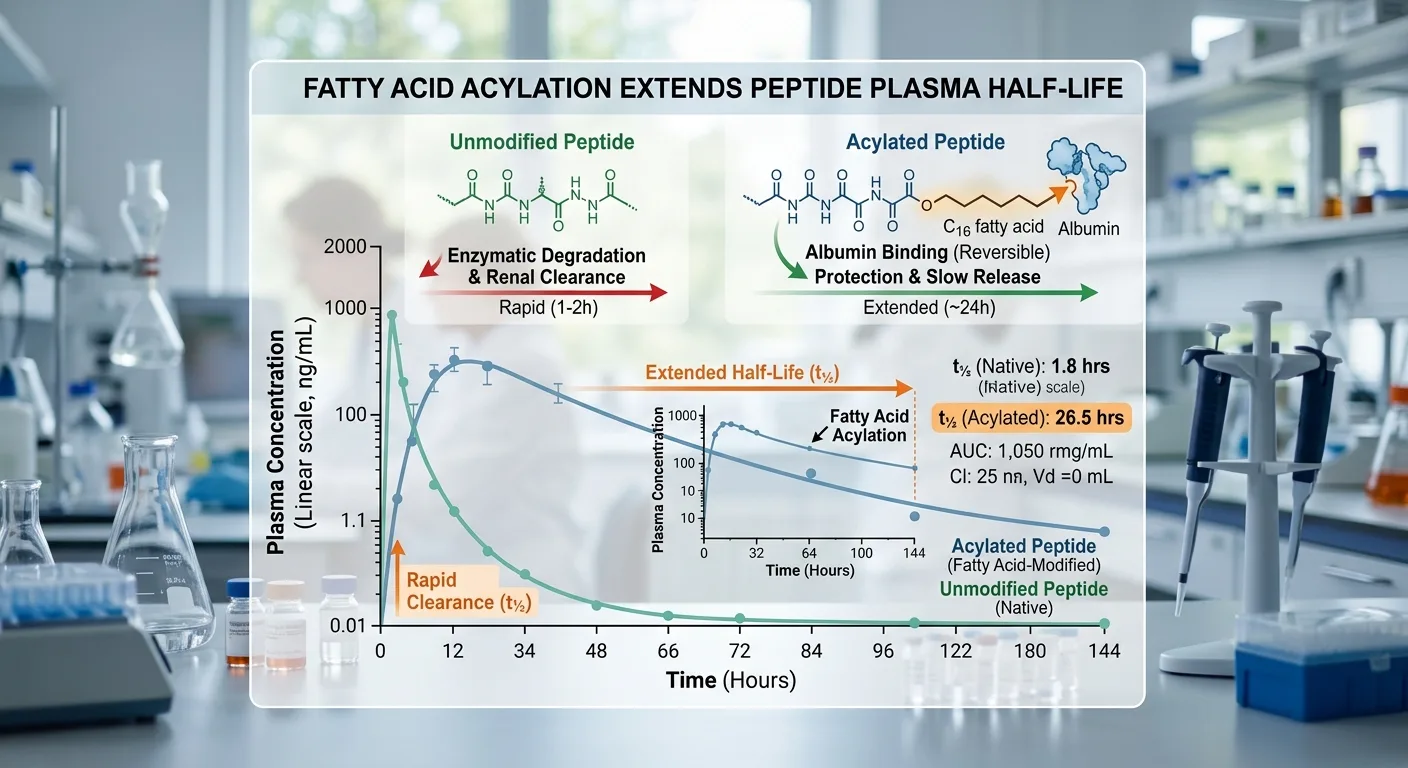
The translation from molecular chemistry to once-weekly dosing follows straightforwardly from the half-life arithmetic. With a half-life of approximately 168 hours (7 days), retatrutide reaches steady-state plasma concentrations after 4 to 5 half-lives, corresponding to approximately 4 to 5 weeks of weekly dosing. At steady state, trough concentrations (measured just before the next weekly dose) remain above the minimum effective concentration required to sustain meaningful GLP-1R, GIPR, and GCGR activation throughout the dosing interval. This continuous receptor engagement is what produces the sustained metabolic effects observed in clinical trials. For detailed pharmacokinetic modeling, see Pharmacokinetic Modeling of Peptides.
Subcutaneous bioavailability of acylated peptides benefits from an additional pharmacokinetic feature: the depot effect. At the subcutaneous injection site, the amphiphilic acylated peptide self-associates into slow-dissolving aggregates or micelle-like structures driven by the hydrophobic acyl chains. This depot behavior retards absorption from the injection site, smoothing the absorption curve and producing a flat, broad Tmax profile rather than a sharp peak followed by a rapid decline. The slow, sustained absorption from the subcutaneous depot complements the albumin-binding-mediated slow clearance from plasma, creating a doubly buffered pharmacokinetic system.
Comparing half-life values across peptide drug generations makes the engineering progression concrete. Exenatide achieves approximately 2.4 hours; liraglutide reaches approximately 13 hours; semaglutide extends to approximately 165 hours; tirzepatide achieves approximately 120 hours (5 days); and retatrutide reaches approximately 168 hours (7 days). These numbers highlight how each generational improvement in acylation chemistry produced measurable pharmacokinetic advances, each enabling a less frequent dosing schedule and more stable steady-state exposure. For a comprehensive review, see Advances in Peptide Drug Delivery.
The once-weekly profile of retatrutide is not incidental. It is the direct pharmacological consequence of C18 diacid acylation, optimized linker hydrophilicity, Aib-mediated protease resistance, and albumin-binding kinetics functioning as an integrated engineering system. Remove any single component and the half-life arithmetic changes unfavorably.
Clinical Validation: What Retatrutide's Phase 2 Results Tell Us About the Chemistry
The Phase 2 trial (NCT04881760, n=338) published in The New England Journal of Medicine in 2023 provides the most direct clinical validation of retatrutide's pharmacokinetic and pharmacodynamic engineering. Participants receiving 12 mg weekly retatrutide lost a mean of 24.2% of body weight over 48 weeks, the highest weight loss percentage reported in any randomized controlled trial of a pharmacological anti-obesity agent. For comparison, semaglutide 2.4 mg (STEP 1) achieved approximately 15% mean weight loss at 68 weeks, and tirzepatide 15 mg (SURMOUNT-1) achieved approximately 22.5% at 72 weeks. These figures reflect not just superior receptor pharmacology but the successful delivery of that pharmacology through a once-weekly dosing regimen enabled by the peptide albumin binding half-life extension mechanism. For more insights into clinical trial design, see ClinicalTrials.gov.
The dose-dependent weight reduction across all active arms (1 mg, 4 mg, 8 mg, and 12 mg weekly) provides clinical pharmacokinetic confirmation that the albumin-binding system is functioning as designed. Steady-state plasma concentrations scale approximately linearly with dose in well-engineered acylated peptides where albumin binding is not saturated at clinical doses. The proportional increases in weight loss observed across dose arms are consistent with this linear dose-concentration relationship, confirming that receptor engagement scales predictably with plasma exposure throughout the weekly dosing interval.
Beyond weight loss, Phase 2 data demonstrated statistically significant improvements across multiple metabolic parameters. HbA1c reductions reached up to 2.02 percentage points in participants with elevated baseline glucose. HOMA-IR, triglycerides, and systolic blood pressure all improved significantly versus placebo. These outcomes are specifically attributable to the triple agonist mechanism: GLP-1R activation driving glucose-dependent insulin secretion and appetite suppression, GIPR activation enhancing insulin secretion and potentially reducing GLP-1R-mediated nausea, and GCGR activation increasing basal metabolic rate and hepatic fatty acid oxidation. The fact that all three mechanisms were delivered intact and continuously over the weekly dosing cycle is the direct consequence of the peptide engineering described throughout this article. The breakdown across these metabolic endpoints illustrates how the chemistry of a single acylated peptide molecule can translate into broad, simultaneous improvements across cardiovascular, glycemic, and anthropometric outcomes. For further reading, see Phase 2 Results of Retatrutide.
Eli Lilly's Phase 3 TRIUMPH trial program, with results anticipated in 2025 to 2026, will determine whether these Phase 2 signals translate into the large-sample, longer-duration efficacy and safety data required for regulatory submission. The commercial context is significant: the global obesity drug market is projected by Goldman Sachs to exceed $100 billion annually by 2030, placing retatrutide's development within an unprecedented commercial and public health context. More on the future of obesity therapies can be explored at Obesity Drug Development Pipeline.
The Integrated Engineering Lesson
Retatrutide represents the current apex of a deliberate, decades-long engineering program to extend the therapeutic utility of incretin peptides. The molecule's once-weekly profile is not an accident of biology; it is the direct consequence of C18 fatty diacid acylation, carefully designed linker chemistry, albumin-binding affinity optimization, and protease-resistant backbone modifications working as a unified pharmacokinetic system. Understanding the peptide albumin binding half-life extension mechanism at this level of chemical resolution reveals why retatrutide, and the drug design philosophy it embodies, represents a meaningful advance over prior generations rather than an incremental refinement. For an in-depth review of peptide drug design, see Next-Generation Peptide Engineering.
As Phase 3 TRIUMPH trial data emerge in 2025 to 2026, the clinical outcomes will either validate or refine these engineering assumptions. The safety profile observed in Phase 2, predominantly mild to moderate gastrointestinal events consistent with the GLP-1R agonist drug class, suggests the acylation strategy did not introduce off-target complications, though longer-term data will be informative. For ongoing safety assessments, refer to FDA Guidance on Clinical Trials.
For peptide chemists and graduate-level researchers, the deeper lesson is this: in therapeutic peptide development, the pharmacology is inseparable from the chemistry. Every design choice at the molecular level, from acyl chain length to linker flexibility to amino acid substitution pattern, cascades directly into pharmacokinetic parameters, dosing intervals, and ultimately patient outcomes. Retatrutide did not achieve 24.2% mean weight loss because of a fortunate biological accident. It achieved that outcome because a series of precise, chemically informed decisions produced a molecule that could continuously engage three receptor systems at therapeutic concentrations for seven days from a single subcutaneous injection. That is what peptide half-life engineering, executed at its current state of the art, looks like in practice.
Sources
- mdpi.com — mdpi.com
- nih.gov — pmc.ncbi.nlm.nih.gov
- acs.org — pubs.acs.org
- nih.gov — pubmed.ncbi.nlm.nih.gov
- austinpublishinggroup.com — austinpublishinggroup.com
- acs.org — pubs.acs.org
- creative-biolabs.com — half-life-extension.creative-biolabs.com
- nih.gov — pmc.ncbi.nlm.nih.gov
- mdpi.com — mdpi.com
- semanticscholar.org — semanticscholar.org
- oup.com — academic.oup.com
- nih.gov — pmc.ncbi.nlm.nih.gov
- aacrjournals.org — aacrjournals.org
- epfl.ch — infoscience.epfl.ch