

Most peptide stacking guides stop at "combine these two for synergy" without explaining why timing matters. The reality is that two pharmacologically compatible peptides can underperform in a stack simply because their plasma half-lives create inadequate receptor-site overlap. This peptide half-life chart comparison stacking guide presents a research-backed look at half-lives across the most commonly studied research peptides, from native GHRH at under 2 minutes to CJC-1295 with DAC at 6 to 8 days, and explains how that temporal range directly governs stack design. Whether you are new to peptide research or looking to refine your understanding of combination pharmacokinetics, this guide bridges mechanistic depth with practical logic.
Why Half-Life Is the Most Underappreciated Stacking Variable
Plasma half-life refers to the time it takes for a peptide's concentration in the bloodstream to fall by 50 percent after administration. It is worth distinguishing this from biological effect duration. A peptide can trigger a receptor response that outlasts its plasma presence, particularly when downstream signaling cascades are involved. However, for receptor-site synergy in a stack, what matters most is simultaneous plasma concentration, not lingering downstream effects.
Pharmacodynamic overlap is the concept that two peptides must reach adequate receptor-site concentration at the same time to produce synergy. When they do not, each peptide operates in isolation, and the expected additive or multiplicative effect simply does not materialize. This is what researchers call temporal mismatch, and it is one of the most silent and costly failure modes in a peptide protocol.
The scale of the problem becomes clear when you look at the numbers. Half-lives across commonly researched peptides range from under 2 minutes for native GHRH(1-44) to over 8 days for CJC-1295 with DAC. That is a difference spanning four orders of magnitude. The breakdown illustrates why a one-size-fits-all dosing schedule applied across peptides with such different kinetic profiles will almost always produce suboptimal outcomes. Half-life awareness is not supplementary information; it is the prerequisite to rational stack design.
Peptide Half-Life Chart Comparison and Stacking Guide
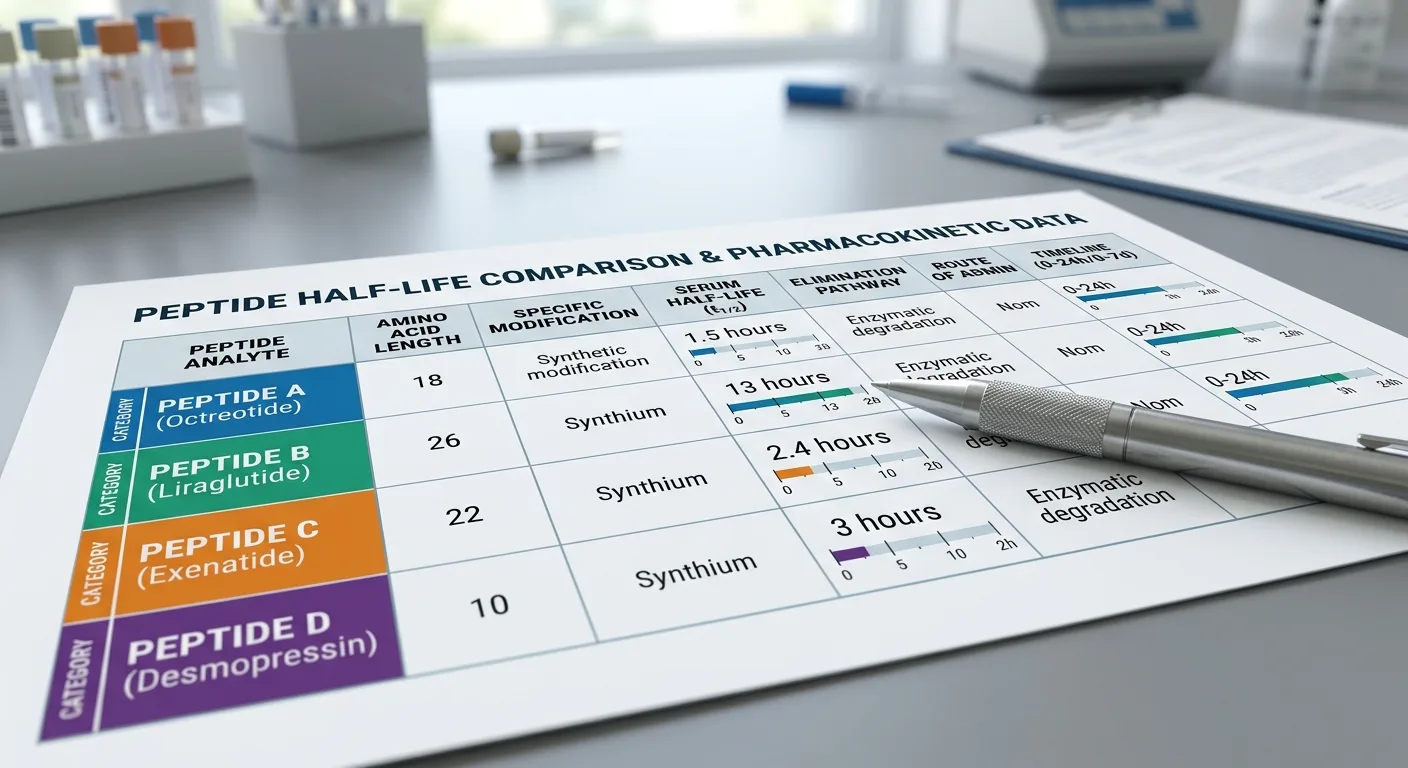
The following data points represent the most widely referenced half-life values for research peptides discussed in the literature. Native GHRH(1-44) has a half-life of under 2 minutes. CJC-1295 without DAC sits at approximately 30 minutes. GHRP-6 falls in the range of 15 to 20 minutes. Ipamorelin is approximately 2 hours. BPC-157 is approximately 3 to 4 hours. TB-500 is measured in days. CJC-1295 with DAC extends to 6 to 8 days.
These numbers highlight an enormous span of kinetic behavior that must inform how any combination protocol is structured. The chart ordered by half-life duration makes the asymmetry visually obvious, with the DAC-modified analog sitting far beyond anything else on the spectrum.
The reason CJC-1295 with DAC achieves such extended receptor occupancy is its albumin-binding mechanism. A Drug Affinity Complex modification introduces a lysine residue that covalently binds circulating albumin, effectively using the body's own carrier protein as a depot. This is not a subtle pharmacokinetic tweak; it transforms the peptide's stacking compatibility profile entirely.
A less commonly discussed modifier is DPP-IV sensitivity. Dipeptidyl peptidase-IV is a circulating enzyme that cleaves peptides at the penultimate position when an alanine or proline residue sits at position 2. Several GHRH analogs and GLP-1-type peptides are substrates for this enzyme. When two DPP-IV-sensitive peptides are administered simultaneously, they compete for the same degradative pathway, which can unpredictably extend both of their half-lives beyond expected values. This competitive inhibition effect is often overlooked when researchers combine analogs without accounting for shared enzymatic clearance.
Route of administration adds another layer. Subcutaneous delivery produces slower absorption and a flattened peak compared to intravenous administration, effectively extending the functional half-life at the receptor site. Intranasal delivery varies considerably by peptide. BPC-157 is a notable exception because it retains bioactivity when administered orally, resisting gastric peptidase degradation in animal models, while GH secretagogues are degraded rapidly in the GI tract and require subcutaneous or intranasal delivery. These absorption-site differences matter when planning multi-route stacks.
GHRH and GHRP: Why Opposite Half-Lives Create the Best Stack
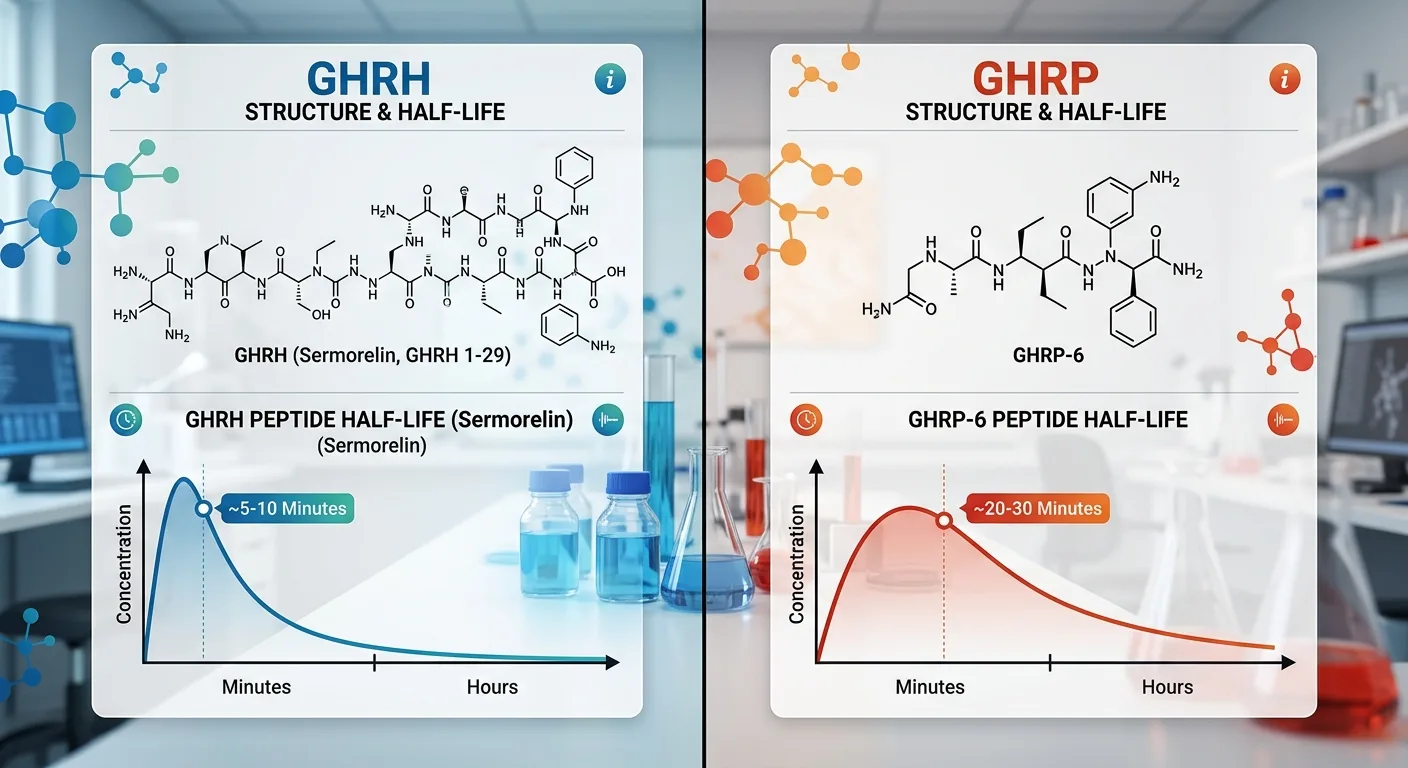
The GHRH receptor and the ghrelin receptor (GHS-R1a) are two distinct receptor systems located on somatotroph cells in the anterior pituitary. GHRH analogs act on the GHRH receptor to increase cyclic AMP and prepare somatotrophs for GH secretion. GHRPs act on GHS-R1a, a separate G-protein coupled receptor, to amplify that secretory response. Co-activation of both receptors produces GH pulses significantly larger than either peptide can generate alone, a mechanism validated across multiple clinical pharmacology studies.
This is where half-life asymmetry becomes a deliberate design tool rather than a problem to manage. CJC-1295 with DAC maintains sustained GHRH receptor occupancy for days, creating what researchers describe as a background elevation of GH secretory tone. A short-acting GHRP, such as ipamorelin or GHRP-6, is then administered at discrete intervals to deliver sharp GH pulses on top of that elevated baseline. The result is the "background elevation plus pulse" model, and it works precisely because the two peptides are not competing at the same receptor or operating on the same timescale.
The alternative approach, stacking two long-acting GH secretagogues, carries a specific risk that is often underappreciated. Physiological GH secretion is pulsatile by design. The liver's IGF-1 production, anabolic receptor sensitivity, and downstream metabolic effects all depend on rhythmic peaks and troughs rather than a sustained plateau. Blunting that pulsatility by maintaining continuous GH receptor stimulation through two long-acting analogs undermines the very biology the stack is meant to leverage.
Receptor desensitization is the other critical concern for GHRPs specifically. Continuous, non-pulsatile stimulation of GHS-R1a can downregulate receptor expression within 48 to 72 hours. Stacking two GHRPs on the same dosing schedule does not double the GH output. It accelerates receptor downregulation and reduces net GH output compared to a single GHRP used with appropriate pulsatile intervals. The pulsatile versus continuous GH output comparison demonstrates this clearly: intermittent GHRP dosing consistently outperforms continuous or redundant GHRP administration when measured against actual GH secretion profiles.
How to Calculate Your Stacking Window
A stacking window is the time period during which both peptides in a combination maintain pharmacologically relevant plasma concentrations simultaneously. For peptides with very different half-lives, this window requires deliberate scheduling rather than arbitrary concurrent administration.
A practical starting rule is to administer short-acting peptides within one to two half-lives of each injection of the long-acting anchor peptide. For a CJC-1295 with DAC plus ipamorelin stack, this means ipamorelin is injected at specific daily intervals while the DAC analog provides continuous background activity. The short-acting component creates the pulse; the long-acting component sets the stage. Timing the ipamorelin injection to occur when GHRH receptor occupancy is maximal, typically in the 24 to 48 hours following a CJC-1295 DAC dose, optimizes the overlap.
Circadian timing adds another dimension. GH receptor expression in hepatocytes peaks during early morning hours in both rodent and human models. Pre-sleep administration of a GHRP aligns the resulting GH pulse with the natural nocturnal GH surge, effectively amplifying a physiological process rather than working against it. This timing consideration is supported by evidence that secretagogue stacks administered at night consistently produce different efficacy profiles compared to morning administration.
For stacks involving peptides with half-lives under 30 minutes, a minimum 3-hour interval between injections of the same receptor class is a reasonable guideline to prevent acute desensitization. Repeated dosing within a shorter window risks starting the next injection on a partially downregulated receptor baseline, diminishing returns with each administration.
Tissue-Repair Stacks: BPC-157 and TB-500 Half-Life Compatibility
BPC-157 is a pentadecapeptide derived from human gastric juice with pleiotropic tissue-repair activity. Its mechanism operates through upregulation of GH receptor expression, nitric oxide pathways, and VEGF signaling. Crucially, this places BPC-157 mechanistically upstream of GH secretagogues rather than in competition with them. Stacking BPC-157 alongside GHRH or GHRP compounds does not create receptor conflict because the targets are entirely different.
TB-500, the research name for the active fragment of thymosin beta-4 (specifically the Ac-SDKP tetrapeptide), works through actin polymerization, cellular migration, and anti-inflammatory signaling. Preclinical rodent models show complementary, non-overlapping mechanisms when BPC-157 and TB-500 are co-administered at standard research intervals, with no reported antagonistic interactions. The two peptides approach tissue repair and vascular remodeling from distinct angles, making their combination mechanistically sound.
Route compatibility is a practical advantage of this particular stack. BPC-157 retains bioactivity orally due to its resistance to gastric peptidases, while TB-500 requires subcutaneous delivery. Because the two peptides are absorbed through entirely different sites, there is no pharmacokinetic collision at the absorption level. Researchers can administer them via different routes without altering each other's absorption profiles or creating local competition at the injection site.
Stacks to Avoid: Redundancy and Receptor Conflict
Not all peptide combinations produce synergy. Some create redundancy, some amplify side effects, and some actively antagonize each other's mechanism. Understanding which combinations fall into these categories is as important as knowing which ones work.
Melanotan II and PT-141 (bremelanotide) are both melanocortin receptor agonists. Both target MC1R through MC4R with overlapping affinity profiles. Stacking them is pharmacologically redundant: the second compound occupies receptors already engaged by the first, adding no meaningful therapeutic benefit while compounding side-effect risk. Nausea, facial flushing, and blood pressure changes are all dose-dependent effects of melanocortin agonism. Running two such compounds simultaneously scales those risks without scaling the intended benefit.
IGF-1 LR3 presents a different problem when layered onto GH secretagogue stacks. Its plasma half-life is approximately 20 to 30 hours compared to native IGF-1's 5 to 6 hours. GH secretagogues already drive endogenous IGF-1 elevation as a downstream consequence of increased GH secretion. Adding exogenous IGF-1 LR3 on top of a secretagogue-driven IGF-1 elevation creates a dual IGF-1 signal that raises hypoglycemia risk and can accelerate receptor downregulation in muscle and adipose tissue. The numbers here are relevant: IGF-1 LR3 at 20 to 30 hours half-life versus native IGF-1 at 5 to 6 hours means the exogenous signal accumulates and persists well beyond what endogenous systems regulate naturally.
Two GHRPs on the same dosing schedule represent the desensitization problem already discussed, but it is worth restating with clarity. Single GHRP protocols used with pulsatile intervals consistently outperform dual GHRP protocols in terms of net GH output when receptor downregulation data are factored in. The breakdown illustrates that receptor biology, not compound quantity, governs GH secretory capacity.
A practical note on peptide mixing stability is warranted here. Peptides with widely different isoelectric points may precipitate when combined in a single syringe due to charge neutralization. GHRPs are generally stable in the pH 5.5 to 6.5 range, while some thymosin derivatives require slightly alkaline conditions. Researchers preparing combination solutions should verify pH compatibility before mixing, as precipitation at the syringe level means neither compound reaches its target at the intended concentration.
Advanced Compatibility: Metabolic and Longevity Peptide Stacks
AOD-9604 is a modified fragment of human GH (residues 177 to 191) that specifically targets adipocyte beta-3 adrenergic receptors to stimulate lipolysis. Its mechanism bypasses the full GH receptor and does not raise IGF-1. This makes it mechanistically safe to layer onto GHRH and GHRP stacks without compounding IGF-1-driven risks, while adding an independent lipolytic pathway. The combination covers GH secretion, tissue repair signaling, and targeted fat metabolism through three non-competing mechanisms.
Epithalon, a synthetic tetrapeptide analogue of the pineal peptide epithalamin, is frequently included in longevity-focused protocols alongside GH secretagogues. Its proposed mechanisms, which include telomerase activation and cortisol normalization, operate through entirely different downstream pathways from GH axis peptides. This suggests low mechanistic conflict, though direct interaction data remain limited to animal studies and should be interpreted with that caveat.
Selank and Semax represent a well-characterized cognitive stack. Selank acts primarily on GABAergic and serotonergic systems, while Semax elevates BDNF and modulates dopaminergic pathways. These non-overlapping primary targets support additive rather than competitive effects, making their combination pharmacologically coherent from a receptor-conflict standpoint.
MOTS-c and Humanin are both mitochondria-derived peptides, but their signaling pathways are distinct. MOTS-c activates AMPK to regulate metabolic homeostasis, while Humanin signals through the tripartite receptor complex (CNTFR/WSX-1/gp130) and activates STAT3. Both are theoretically additive with GH axis peptides because AMPK activation and GH-driven IGF-1 signaling operate through parallel metabolic nodes. Animal studies suggest protective effects against age-related metabolic decline that are additive when these compounds are combined with other metabolic modulators.
Practical Half-Life Stacking Rules at a Glance
- Match half-lives deliberately. Asymmetric pairing, such as a long-acting GHRH analog with a short-acting GHRP, creates the background elevation plus pulse model. Symmetric pairing of two long-acting compounds risks blunting pulsatility.
- Avoid same-receptor-class co-administration on identical schedules. Two GHRPs or two melanocortin agonists run concurrently produce redundancy and accelerated receptor desensitization, not doubled output.
- Account for DPP-IV sensitivity when combining GHRH analogs. Competitive inhibition of the same degradative enzyme can unpredictably extend both compounds' effective half-lives beyond expected values.
- Respect circadian timing windows. Pre-sleep GHRP administration aligns GH pulses with the natural nocturnal surge and exploits peak hepatocyte GH receptor expression in early morning hours.
- Verify route-of-administration compatibility before combining. Oral BPC-157 and subcutaneous GHRPs involve no pharmacokinetic collision at the absorption site; combining peptides with incompatible pH stability in a single syringe may cause precipitation.
One further note: the category of "peptide stacks" in practice increasingly includes small molecules such as 5-amino-1MQ, a nicotinamide N-methyltransferase (NNMT) inhibitor. Its combination with metabolic peptides like AOD-9604 illustrates how modern protocols blur the boundary between peptide and small-molecule pharmacology. Most lay content ignores this hybrid pharmacology gap entirely, but researchers designing comprehensive metabolic protocols should account for it.
Pharmacodynamic synergy requires both receptor compatibility and temporal plasma overlap. Half-life is not optional information for stack design; it is foundational to it.
Peptide half-life is not a footnote. It is the architectural constraint around which every rational stack must be designed. From the under-2-minute window of native GHRH to the 6 to 8-day receptor occupancy of CJC-1295 with DAC, the temporal range across commonly researched peptides is vast, and ignoring it produces stacks that are either redundant, desensitizing, or simply never achieving meaningful receptor-site co-concentration. The background elevation plus pulse model exemplified by CJC-1295 DAC paired with ipamorelin is the clearest demonstration that deliberate half-life exploitation, not just mechanistic compatibility, is what separates an optimized stack from an expensive coincidence. As peptide research expands into metabolic, longevity, and immunomodulatory compounds, the same temporal logic applies: know your half-lives, respect receptor kinetics, and let the pharmacology guide the protocol.
Sources
- eden.health — eden.health
- halflife-labs.com — halflife-labs.com
- droracle.ai — droracle.ai
- fda.gov — accessdata.fda.gov
- halflife-labs.com — halflife-labs.com
- fda.gov — accessdata.fda.gov
- fda.gov — accessdata.fda.gov
- fellahealth.com — fellahealth.com
- ejpd.com — ejpd.com
- nih.gov — ncbi.nlm.nih.gov
- nih.gov — dailymed.nlm.nih.gov
- trimrx.com — trimrx.com
- rxlist.com — rxlist.com
- palmbeachpharmaceuticals.com — palmbeachpharmaceuticals.com
- nih.gov — pubmed.ncbi.nlm.nih.gov
- oup.com — academic.oup.com
- peptidepedia.org — peptidepedia.org
- superpower.com — superpower.com
- nih.gov — pubmed.ncbi.nlm.nih.gov
- peptpedia.org — peptpedia.org
- mdpi.com — mdpi.com
- nih.gov — pmc.ncbi.nlm.nih.gov
- clinicaltrials.gov — clinicaltrials.gov
- wikipedia.org — en.wikipedia.org
- halflife-labs.com — halflife-labs.com
- superpower.com — superpower.com
- pathtopeptides.com — pathtopeptides.com
- deltapeptides.com — deltapeptides.com