
In 2023, the FDA's Center for Drug Evaluation and Research flagged three peptides, BPC-157, Epitalon, and Ipamorelin, as substances warranting caution, citing immunogenicity risk among the concerns for compounds that had never gone through formal clinical safety assessment [1]. The nomination process itself is procedural and dry, but the underlying question is not. Why would a chain of amino acids, something the body manufactures versions of constantly, provoke an immune response at all?
Academic immunology labs publishing in journals like Frontiers in Immunology have spent the last two decades trying to answer a narrower version of that question: why does one therapeutic peptide slip past immune surveillance for years, while a nearly identical molecule, sometimes differing by a single amino acid, triggers a measurable antibody response within weeks of a clinical trial's first dosing cohort [2]. The answer involves a kind of biological security check, one that screens fragments of every protein and peptide circulating in the body and decides, fragment by fragment, whether something belongs or does not. That screening process, and what happens when a peptide fails it, is the subject of this article.
What Immunogenicity Means for Therapeutic Peptides

Immunogenicity, in the context of a therapeutic peptide, refers to the immune system identifying the drug as foreign material rather than as a normal biological component [2]. This is not the same as toxicity. A toxic reaction is often dose-dependent and nonspecific, affecting tissue broadly. Immunogenicity is targeted and adaptive. It involves the same machinery the body uses to recognize a virus or bacterial invader, redirected at a synthetic or recombinant peptide that resembles, but does not perfectly match, something the body already produces.
The downstream consequences vary. In some cases, the immune system produces antibodies that neutralize the drug's activity outright, rendering further doses ineffective. In others, antibodies accelerate the peptide's clearance from circulation without fully neutralizing it, shortening its functional half-life. In rarer instances, the immune response itself becomes the clinical problem, producing hypersensitivity reactions or, more concerning, cross-reactivity against the body's own native peptide if the sequences are similar enough.
What makes this difficult to generalize is that immunogenicity is not a binary outcome. It sits on a spectrum. Some peptide drugs generate a transient, low-titer antibody response that fades after a few months of dosing and has no measurable effect on efficacy. Others fail in trials specifically because antibody formation was fast, high-titer, and durable enough to blunt the therapeutic effect before the drug could demonstrate value. The same drug class can produce both outcomes in different patients, which is part of what makes prediction so difficult.
Inside the Immune Response: Epitopes, T Cells, and Antigen-Presenting Cells
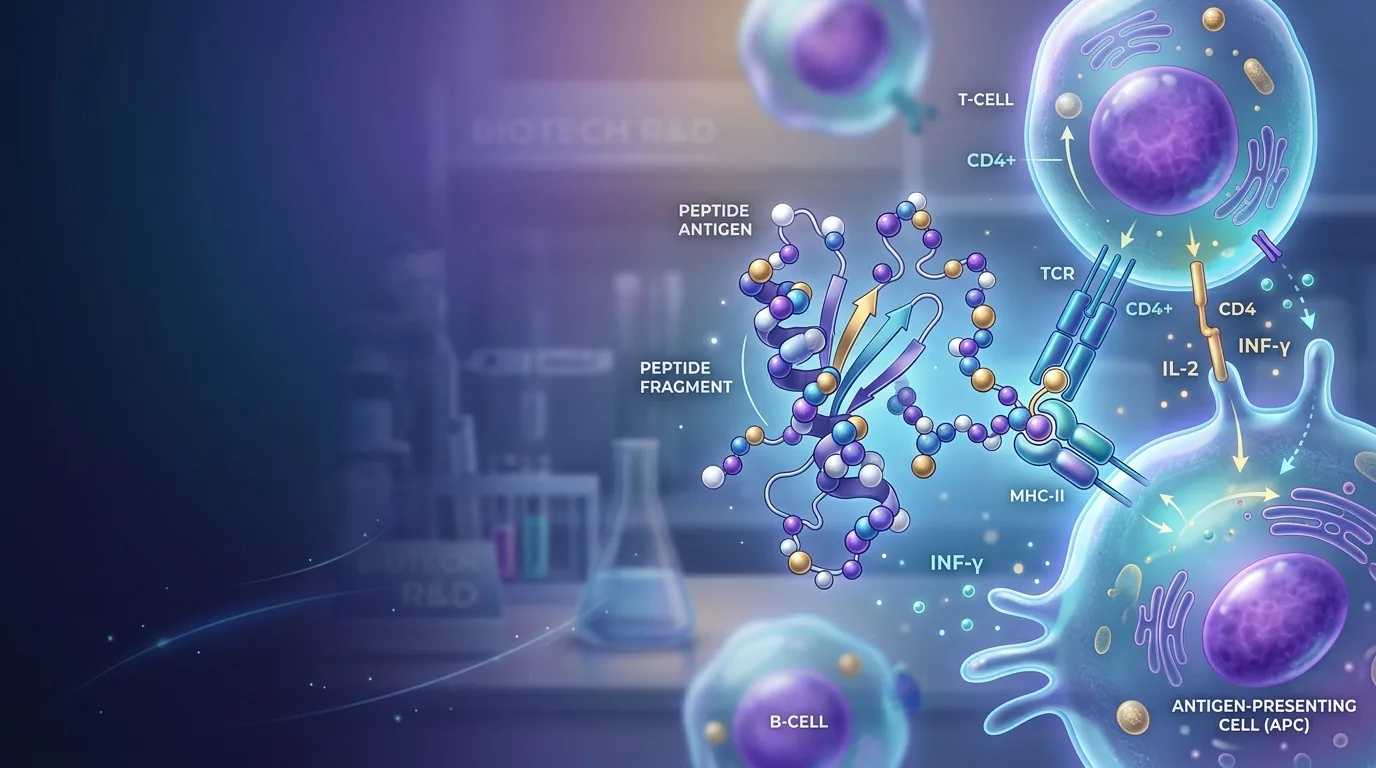
The immune system does not evaluate a peptide as a whole molecule. It breaks the peptide into smaller fragments called epitopes, and it is these individual fragments, not the intact drug, that get flagged as problematic or ignored entirely [3]. An epitope acts something like a red flag presented to internal security, except the security guards in this analogy, called antigen-presenting cells, are only shown small snippets of evidence rather than the full picture.
Antigen-presenting cells process the peptide internally and display fragments of it on Major Histocompatibility Complex (MHC) molecules, structures on the cell surface that essentially hold up the fragment for inspection [3]. Whether that inspection escalates into a full immune response depends on what happens next: T cells patrolling the area either recognize the MHC-bound fragment as familiar and move on, or recognize it as foreign and initiate an immune cascade.
T-cell activation is the pivotal step in the entire process, and it is well characterized at the cellular level. Researchers understand, in general terms, how a T cell receptor binds to an MHC-epitope complex and what happens biochemically once that binding occurs. What remains only partially predictable is which specific peptide sequences will be flagged this way before the fact. The mechanism is understood; the peptide-specific triggers are not fully mapped, which is why immunogenicity testing still requires empirical trial data rather than pure computational forecasting.
From T-Cell Activation to Anti-Drug Antibodies
Once T cells are activated by a foreign-looking epitope, they do not act alone. Activated T cells help drive the maturation of B cells, the immune cells responsible for producing antibodies, and this process can result in the generation of anti-drug antibodies, or ADAs, specifically tailored to bind the therapeutic peptide [4].
Mechanistically, ADAs do one of two things. They either neutralize the peptide directly, physically blocking the region of the molecule responsible for its biological activity, or they bind elsewhere on the peptide without blocking function but still accelerating its clearance from the bloodstream, shortening how long the drug remains active in circulation.
The incidence of ADA formation is not uniform across peptide drug classes. Literature comparing older insulin analogs, GLP-1 receptor agonist peptides, and newer synthetic peptide constructs shows meaningful variability in how often patients develop measurable antibody responses, with some drug classes showing low single-digit percentages of affected patients and others showing rates high enough to influence trial design and dosing strategy. The breakdown illustrates just how much immunogenicity risk depends on molecular class rather than being a uniform peptide-wide phenomenon.
One of the more persistent open questions in the field is that ADA formation does not always correlate with clinical symptoms. Some patients develop detectable antibodies against a peptide drug with no observed reduction in the drug's effectiveness and no adverse reaction. Whether this represents a benign immune footnote or an early warning sign that simply has not yet manifested clinically is unresolved, and researchers disagree on how seriously to weight ADA-positive, symptom-negative cases in long-term safety assessments.
Why Some Peptides Are Attacked and Others Are Not
The single strongest predictor of immunogenicity is how far a peptide's amino acid sequence diverges from the body's own native peptides. Sequences that closely mimic naturally occurring human peptides tend to be tolerated; sequences that differ substantially are more likely to be flagged as non-self and targeted [5]. This is the molecular logic behind why two peptides with similar therapeutic targets can have wildly different immunogenicity profiles depending on how much their structure deviates from an endogenous template.
Sequence divergence is not the only variable. Manufacturing impurities and peptide aggregation, meaning clumps of peptide molecules sticking together rather than remaining as discrete units, can act as danger signals that amplify an immune response that might otherwise have stayed dormant [6]. A peptide that would be tolerated in its pure, monomeric form can become immunogenic if manufacturing introduces contaminants or promotes clumping, which is part of why formulation science and manufacturing quality control are treated as immunogenicity variables in their own right, not just as separate purity concerns.
Patient genetics add another layer of unpredictability. A given patient's specific MHC haplotype, the particular version of MHC molecules that patient's cells express, determines which epitopes get presented to T cells in the first place [7]. This explains why immunogenicity often varies from person to person rather than being a fixed property of the drug itself. Two patients receiving an identical peptide, manufactured identically, can have entirely different immune outcomes because their MHC molecules present different fragments of the same molecule.
Route of administration, dosing frequency, and formulation stability can further modulate immunogenicity risk, though these variables are harder to isolate individually and tend to interact with sequence divergence and manufacturing quality rather than acting independently.
Engineering Around the Immune System: PEGylation and Humanization

Given how many variables converge to produce immunogenicity, drug developers have spent decades building engineering strategies meant to reduce the risk before a peptide ever reaches a patient.
PEGylation is among the oldest and most widely used of these strategies. It involves attaching chains of polyethylene glycol, a synthetic polymer, to the peptide's surface, which physically shields the molecule from immune recognition and also extends how long it circulates in the body [8]. The logic is straightforward: if antigen-presenting cells cannot easily access the peptide's surface, they cannot process it into epitopes as efficiently, reducing the odds of T-cell activation.
The strategy has a documented paradox. In a subset of patients, the immune system develops antibodies against the PEG polymer itself, meaning the very shield designed to prevent immunogenicity becomes a new immunogenic target [8]. This is not a rare theoretical edge case; anti-PEG antibodies have been documented clinically and have prompted some drug developers to reconsider PEGylation for certain peptide classes altogether.
Humanization and deimmunization operate differently, at the sequence level rather than the surface level. These techniques involve modifying specific amino acids within the peptide to eliminate segments that function as immunogenic epitopes, while attempting to preserve the structural regions responsible for the peptide's therapeutic activity [9]. Where PEGylation hides the peptide, deimmunization tries to make the peptide itself less provocative to the immune system.
Each approach carries distinct tradeoffs. PEGylation is comparatively simple to apply across many peptide classes but introduces its own antigenic risk and can sometimes reduce a peptide's binding affinity to its intended target. Humanization requires detailed structural knowledge of which residues can be altered without destroying function, making it more labor-intensive but potentially more durable as a long-term solution. Deimmunization sits between the two, often used in combination with computational epitope mapping to selectively knock out the most immunogenic fragments while leaving the rest of the sequence intact.
Predicting Immunogenicity Before It Happens
Before a peptide reaches a lab bench for synthesis, researchers increasingly rely on computational tools to estimate its immunogenicity risk in advance. The Immune Epitope Database, accessible through tools.iedb.org, is among the most widely used platforms for this kind of in silico prediction [10]. These tools model how strongly different fragments of a candidate peptide are likely to bind MHC molecules, flagging high-risk segments before a single dose is manufactured.
The computational approach works by scanning a peptide's sequence and scoring each possible fragment for its predicted binding affinity to common MHC variants, effectively simulating the same screening process the immune system performs naturally, but on a computer before human exposure ever occurs.
These tools reduce risk; they do not eliminate it. Prediction models are built on population-level data and known MHC variants, but they cannot account for every possible haplotype or every manufacturing variable that might introduce an unpredicted danger signal. Clinical immunogenicity can, and does, still emerge unexpectedly in trials even after a candidate has cleared in silico screening.
Regulatory bodies have responded by formalizing these expectations. The FDA now requires immunogenicity risk assessments as part of the therapeutic peptide development pipeline, meaning computational prediction, epitope mapping, and manufacturing quality controls are treated as standard components of the approval process rather than optional due diligence.
Real-World Stakes: The FDA and Unapproved Peptides
The FDA's 2023 nominated substances list, which flagged BPC-157, Epitalon, and Ipamorelin, illustrates what happens when a peptide bypasses this entire risk assessment framework [1].
Sources
- fda.gov — fda.gov
- frontiersin.org — frontiersin.org
- nih.gov — pmc.ncbi.nlm.nih.gov
- nih.gov — pmc.ncbi.nlm.nih.gov
- mdpi.com — mdpi.com
- cpcscientific.com — cpcscientific.com
- frontiersin.org — frontiersin.org
- explorationpub.com — explorationpub.com
- abzena.com — abzena.com
- iedb.org — tools.iedb.org