

Picture this: you spend time researching a GHRP stack, carefully selecting your peptides, sourcing them responsibly, and committing to a consistent dosing schedule. The first few days feel promising. Then, somewhere around day five or six, the results flatten. Not gradually. Suddenly. Most stacking guides will tell you to adjust your dose or add another compound. Almost none of them will tell you the real problem is happening at the molecular level, inside the receptor itself.
This is the receptor desensitization problem, and it is the most consequential variable that peptide stacking guides routinely ignore. It is not a matter of peptide quality or even dosing quantity. It is a matter of dosing structure. The peptide receptor desensitization stacking protocol you design determines whether your GHS-R1a receptors remain responsive across weeks of use or collapse into a silenced, internalized state within days.
The central mechanism here is GHS-R1a downregulation, the ghrelin receptor's well-documented tendency to withdraw from the cell surface under sustained ligand exposure. Understanding this process, and structuring your protocol around it, is what separates pharmacologically coherent stacking from expensive guesswork. This article moves from the molecular explanation directly to actionable protocol design, because the science only matters if it changes how you dose.
What Is Receptor Desensitization and Why It Matters for Peptide Stacking
Receptor desensitization is what happens when a receptor is exposed to its activating ligand for too long without interruption. The cell interprets sustained signaling as noise rather than signal, and it responds by reducing the receptor's availability. Mechanistically, this begins with phosphorylation of the receptor's intracellular domain by G-protein coupled receptor kinases (GRKs), which recruits beta-arrestin proteins. Beta-arrestin binding uncouples the receptor from its G-protein, halting downstream signaling, and then facilitates receptor internalization through clathrin-coated vesicles. The receptor is pulled off the cell surface and sequestered intracellularly.
It is worth distinguishing two phases here because they have different recovery timescales. Desensitization is the rapid phase, occurring within minutes to hours of continuous ligand exposure, and it is partially reversible. Once the ligand is cleared, internalized receptors can recycle back to the surface through endosomal sorting, typically within a few hours. Downregulation is the slower, more serious phase, involving transcriptional suppression of receptor gene expression. Recovery from downregulation requires new receptor synthesis and can take 24 to 72 hours or longer.
For anyone designing a peptide stacking protocol, this distinction carries direct practical weight. Combining two peptides that act on the same receptor system does not simply add their effects. It compounds the desensitization signal, accelerating receptor internalization and potentially driving net GH output below what a single peptide used correctly would produce. The breakdown illustrates why receptor-level thinking must precede peptide selection in any serious stacking framework.
The GHS-R1a Problem: How GHRPs Trigger Their Own Decline
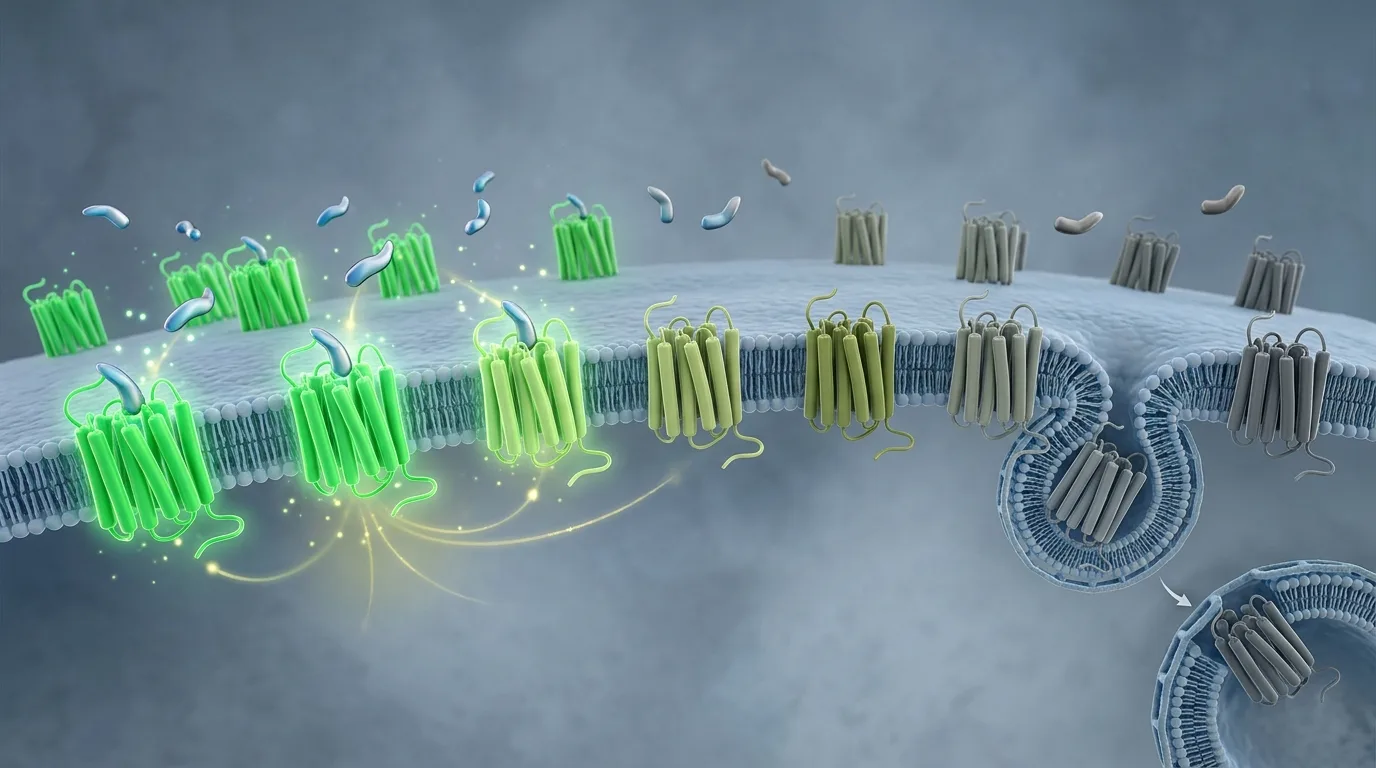
GHRPs such as GHRP-6 and ipamorelin are ghrelin mimetics. Their primary site of action is GHS-R1a, a G-protein coupled receptor expressed on pituitary somatotrophs and hypothalamic neurons. GHS-R1a is particularly sensitive to internalization because it exhibits constitutive activity even in the absence of a ligand, meaning it maintains a baseline level of signaling that makes its regulatory machinery chronically primed to respond to overstimulation.
Under non-pulsatile, continuous stimulation, GHS-R1a expression measurably downregulates within a 48 to 72 hour window. This is not a theoretical concern extrapolated from distantly related receptors. It is a documented kinetic property of the ghrelin receptor system. Dosing a GHRP two or three times daily with appropriate spacing exploits the receptor's recycling window. Dosing it continuously, or stacking two GHRPs on the same schedule without rest, saturates that recycling capacity and pushes the system toward transcriptional suppression. The result is a self-defeating pharmacodynamic loop.
GHRH receptor behavior offers a useful contrast. GHRH-R desensitizes through different intracellular pathways and does so more slowly. This difference in kinetics is precisely why co-administration of a GHRH analog and a GHRP is synergistic rather than redundant. They target two distinct receptor systems, and their combined activation produces GH pulses substantially larger than either compound alone. Research comparing GH pulse amplitude across dosing conditions shows estimated values of approximately 2 to 3 ng/mL for single GHRP alone, 1.5 to 2 ng/mL for GHRH analog alone, 6 to 10 ng/mL for a pulsatile GHRH plus GHRP combination, and less than 2 ng/mL for a continuous non-pulsatile dual-GHRP stack. These numbers highlight the dramatic cost of receptor redundancy when compared to receptor diversity in a stacking protocol.
CJC-1295 with DAC and the Peptide Receptor Desensitization Stacking Protocol Long-Acting Compatibility Trap
CJC-1295 with DAC (Drug Affinity Complex) occupies a pharmacologically distinct category from short-acting GHRH analogs. Its lysine residue modification enables covalent binding to circulating albumin, which extends its receptor occupancy to approximately 6 to 8 days per dose. This is not a slight extension; it is a categorical shift in how the compound interacts with GHRH-R over time.
The intended design logic for CJC-1295 DAC stacks is a background elevation plus pulse model. The long-acting GHRH analog provides tonic, low-level GHRH-R stimulation that primes somatotroph responsiveness, while a short-acting GHRP such as ipamorelin delivers discrete, time-separated GH pulses on top of that background. This is pharmacologically coherent because the two receptor systems remain distinct and the pulsatile GH secretion pattern is preserved through the ipamorelin dosing schedule.
The trap appears when researchers pair two long-acting analogs in the same stack. Sustaining non-pulsatile receptor stimulation across both GHRH-R and GHS-R1a simultaneously undermines the physiological pulsatility that GH secretion depends on for downstream efficacy. The 2006 CJC-1295 clinical trial data provide a useful quantitative reference point. A single subcutaneous dose produced GH concentrations 2 to 10 fold above baseline, with IGF-1 levels elevated 1.5 to 3 fold and remaining elevated for 6 days post-dose. When stacking compounds on top of this baseline receptor load, the cumulative desensitization pressure becomes significant and must be accounted for in the protocol design.
What Is a Pulsatile Dosing Protocol and Why It Preserves Receptor Sensitivity
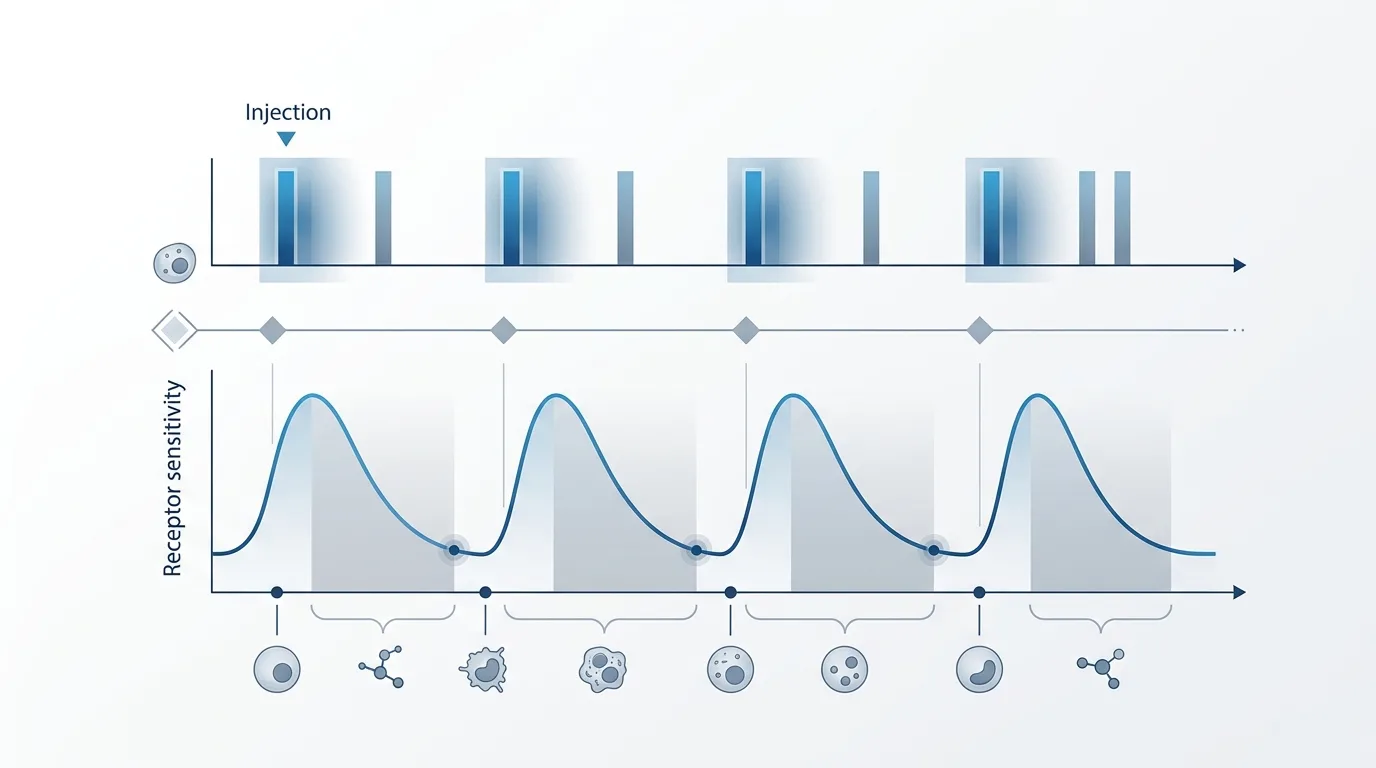
A pulsatile dosing protocol refers to discrete, time-separated administrations that mimic the natural episodic pattern of GH secretion. The pituitary does not release GH continuously. It fires in pulses, particularly during slow-wave sleep and in the early morning hours, with significant troughs between peaks. This pattern exists because it is what downstream receptors have evolved to respond to. Continuous stimulation is not the physiological norm; it is a pharmacological aberration that receptor regulatory machinery is specifically designed to suppress.
The biological mechanism that makes pulsatile dosing effective is receptor recycling. During inter-dose intervals, internalized GHS-R1a receptors are sorted through early endosomes. A portion of these receptors is directed back to the cell surface for re-expression rather than being routed to lysosomes for degradation. This recycling process restores surface receptor density and, with it, signaling responsiveness. The key is that it requires time and, critically, the absence of continued ligand stimulation during the recycling window.
What does the research suggest about minimum inter-dose intervals? For GHRP injections, at least 3 hours between administrations appears necessary for meaningful partial receptor recycling. Full resensitization for chronic protocols requires longer gaps. Under three dosing models, estimated receptor surface density across a 24-hour period differs substantially. Continuous infusion maintains near-zero available receptor density after the first few hours. Twice-daily pulsatile dosing allows receptor density to recover to roughly 60 to 70 percent of baseline between doses. Three-times-daily pulsatile dosing with 3-hour minimum intervals preserves approximately 40 to 55 percent recovery between each dose. The peptide receptor desensitization stacking protocol that honors these intervals consistently outperforms one that prioritizes dosing frequency over receptor biology.
How Long Should You Wait Between Peptide Injections in a Stack
Timing guidance needs to be specific to be actionable. For GHRP-only stacks, the minimum separation between doses is 3 hours, with 4 to 5 hours being preferable for protocols extending beyond two weeks. This is not an arbitrary buffer. It reflects the kinetics of GHS-R1a recycling under physiological conditions. Shorter intervals progressively erode receptor availability without compensatory benefit from the additional dosing.
For GHRH plus GHRP combination stacks, aligning GHRP injections with natural circadian GH troughs adds another layer of optimization. Evidence from both rodent and human models shows that GH receptor expression in hepatocytes peaks during early morning hours, and the pre-sleep window captures the largest physiological GH pulse of the day. Timing GHRP administrations to pre-sleep and early morning windows exploits these circadian rhythms rather than working against them.
Rest days deserve direct attention. Weekly breaks of 1 to 2 days from GHS-R1a-targeting peptides provide sufficient time for partial receptor re-expression when downregulation has progressed beyond the surface recycling phase. This is not optional for long protocols. Without scheduled rest days, the cumulative receptor suppression from even a well-spaced pulsatile protocol compounds across weeks and produces a gradual erosion of responsiveness that looks, from the outside, like peptide tolerance.
Rotation between GHRP-6 and ipamorelin on alternating dosing days represents an advanced refinement. These two peptides share the same primary receptor but differ in binding kinetics and receptor substate stabilization. GHRP-6 elicits broader effects including appetite stimulation through ghrelin pathway activation, while ipamorelin demonstrates higher selectivity and a cleaner GH release profile. Rotating between them may reduce receptor habituation to any single binding pattern. Finally, the half-life mismatch between CJC-1295 DAC and ipamorelin (6 to 8 days versus approximately 2 hours) means ipamorelin injections can and should occur on an independent schedule without waiting for DAC re-dosing windows, since the two receptor systems do not share the same desensitization clock.
Stacking GHRPs with Non-Competing Peptides: Reducing Desensitization Risk
The most underutilized strategy for managing receptor desensitization in a peptide stack is building around receptor diversity from the outset. Orthogonal stacking means combining a GHS-R1a agonist with peptides that operate on entirely separate receptor systems, eliminating receptor-level competition and desensitization crosstalk entirely. When peptides in a stack do not share receptors, their combination cannot produce additive desensitization at any single receptor system.
BPC-157 is the clearest example of an orthogonal partner for GHRPs. Derived from human gastric juice, this pentadecapeptide drives tissue repair through GH receptor upregulation, nitric oxide pathway activation, and VEGF signaling. It does not directly stimulate GHS-R1a. Its effects on the GH axis are downstream and facilitatory rather than competitive, making it mechanistically additive with GHRP-based stacks without compounding receptor load. BPC-157 also retains bioactivity when administered orally in animal models, a route that eliminates any pharmacokinetic collision with subcutaneously administered GHRPs at the absorption site.
TB-500 provides a second strong example. Its active fragment, Ac-SDKP, promotes actin polymerization, supports cellular migration, and exerts anti-inflammatory signaling through mechanisms entirely orthogonal to GH secretagogue receptor systems. Preclinical rodent models combining TB-500 with BPC-157 show complementary, non-overlapping activity on connective tissue and vascular repair with no reported antagonism. A compatibility comparison across key peptides in terms of GHS-R1a receptor system overlap shows high overlap for two stacked GHRPs, moderate indirect overlap for GHRH analog plus GHRP, and near-zero overlap for BPC-157 or TB-500 combined with any GHS-R1a agonist. These numbers highlight the strategic advantage of building receptor diversity into a peptide stack from the design stage rather than adding compounds without considering receptor-level interactions.
Designing a Desensitization-Resistant Protocol: A Framework
Three structural principles emerge from receptor biology and should anchor any serious peptide receptor desensitization stacking protocol. The first is pulsatile timing over continuous dosing. The second is planned rest days for GHS-R1a-targeting peptides. The third is building stacks around receptor diversity rather than receptor redundancy. Each principle addresses a different timescale of receptor regulation, and together they cover the full desensitization risk profile.
The single most common structural error in lay stacking guides is placing two GHRPs on the same dosing schedule. This is not a minor inefficiency. GHS-R1a internalization data directly refute it as a viable approach. Two compounds competing for the same receptor surface space, simultaneously preventing recycling and accelerating downregulation, cannot outperform one compound used with appropriate intervals. This is the error that explains why so many self-reported stacking protocols plateau within the first week.
A practical example protocol structure grounded in these principles looks like this. CJC-1295 DAC administered twice weekly provides the tonic GHRH-R background. Ipamorelin administered three times daily, timed to pre-sleep, early morning, and a midday window with at least 4-hour separations, delivers discrete GH pulses. BPC-157 operates on an independent daily schedule without receptor conflict. This structure exploits two distinct receptor systems, preserves pulsatility, and adds a mechanistically orthogonal repair component without any receptor-level interference.
Stack duration matters independently of dosing structure. Even protocols built on sound pulsatile principles benefit from 4 to 8 week active cycles followed by 2-week recovery intervals. This cycling pattern aligns with the time course of receptor re-expression following chronic agonist exposure. Receptor biology does not reset between individual doses; it integrates the entire exposure history. Planned cycling allows that history to resolve before the next active phase begins.
Receptor desensitization is not an abstract pharmacology concern you can acknowledge and then ignore in practice. It is a time-sensitive mechanism that begins operating within hours of the first dose and can dismantle a carefully constructed peptide stack within days if dosing structure is poorly designed. The three actionable principles, pulsatile intervals, scheduled rest days, and receptor diversity in stack design, are not theoretical preferences. They are practical translations of GHS-R1a and GHRH-R biology into protocol structure.
It is also worth acknowledging honestly that the field lacks large-scale human clinical trials specifically examining combination peptide protocols. Most of the receptor kinetics data comes from single-compound studies, animal models, or clinical trials designed around therapeutic endpoints rather than stacking optimization. This gap is a reason to apply receptor biology principles conservatively, not a reason to dismiss them. The mechanisms are real. The uncertainty is about precise magnitudes, not about whether desensitization occurs.
For deeper reading on individual peptide pharmacokinetics that underpin these stacking decisions, explore related Molecule Notes content covering ipamorelin, CJC-1295, and BPC-157 in detail. Subscribe to the Molecule Notes newsletter to receive protocol updates as new research on combination peptide strategies continues to emerge.
Sources
- oup.com — academic.oup.com
- nih.gov — pubmed.ncbi.nlm.nih.gov
- dntb.gov.ua — ouci.dntb.gov.ua
- healthrx.com — healthrx.com
- gla.ac.uk — theses.gla.ac.uk
- newtropin.com — newtropin.com
- durhampeptides.ca — durhampeptides.ca
- nih.gov — pubmed.ncbi.nlm.nih.gov
- oup.com — academic.oup.com
- oup.com — academic.oup.com
- nih.gov — pubmed.ncbi.nlm.nih.gov
- reddit.com — reddit.com
- nih.gov — pmc.ncbi.nlm.nih.gov
- examine.com — examine.com
- nih.gov — pubmed.ncbi.nlm.nih.gov
- nih.gov — pmc.ncbi.nlm.nih.gov