

Picture this: you've been reading about peptide research and come across the popular combination of CJC-1295 with ipamorelin. Everyone seems to praise it. Then you stumble across someone warning that mixing two growth hormone-releasing peptides is a waste at best and counterproductive at worst. So which is it? And how are you supposed to know the difference?
The answer lies in biology, not opinion. Understanding what peptides can be stacked together safely is not about memorizing a list of approved combinations. It is about grasping a small set of concrete principles, including how peptides interact with receptor systems, how long they stay active in the body, and whether their downstream effects reinforce or cancel each other out.
This guide builds a practical framework around those principles. It organizes common research peptides into three compatibility categories: synergistic, neutral, and redundant. Along the way, it explains the reasoning behind each designation clearly enough that you do not need a biochemistry degree to follow along. Whether your interest is tissue repair, metabolic support, cognitive enhancement, or GH optimization, the same underlying logic applies.
Think of this as both a compatibility reference and a gateway. It is designed to help beginners make sense of stacking decisions while also providing enough mechanistic depth to bridge into more advanced reading when you are ready.
Why Peptide Compatibility Is Not Guesswork
Peptide stacking simply means combining two or more bioactive peptides with the expectation that the combination produces effects greater than, equal to, or sometimes less than each peptide used alone. The outcome depends entirely on how those peptides interact at the biological level, which is why the same two peptides can be complementary in one context and redundant in another.
Four core dimensions determine compatibility. The first is receptor selectivity, meaning whether the peptides target the same receptors or entirely different ones. The second is half-life and timing, since two peptides with mismatched activity windows may never reach meaningful plasma concentration overlap at the receptor site. The third is downstream signaling overlap, because even peptides that act on different receptors can converge on the same cellular pathway and produce diminishing returns. The fourth is degradation pathway competition, where two peptides broken down by the same enzyme may unpredictably alter each other's active duration.
Compatibility is not binary. Synergy, neutrality, and redundancy exist on a spectrum that shifts depending on dose, timing, and individual physiology. A pairing that is synergistic at one dosing interval can become redundant if both peptides are administered simultaneously on a continuous schedule.
This framework applies across research goals. Whether the focus is GH axis optimization, connective tissue repair, immune modulation, or neuroprotection, the same four dimensions govern whether a stack is coherent or conflicted. The proportional weight of each dimension varies by peptide class, but none can be safely ignored. The breakdown illustrates how these compatibility dimensions interact to shape the overall profile of any given stack.
What Peptides Can Be Stacked Together Safely: The Three Compatibility Categories Explained
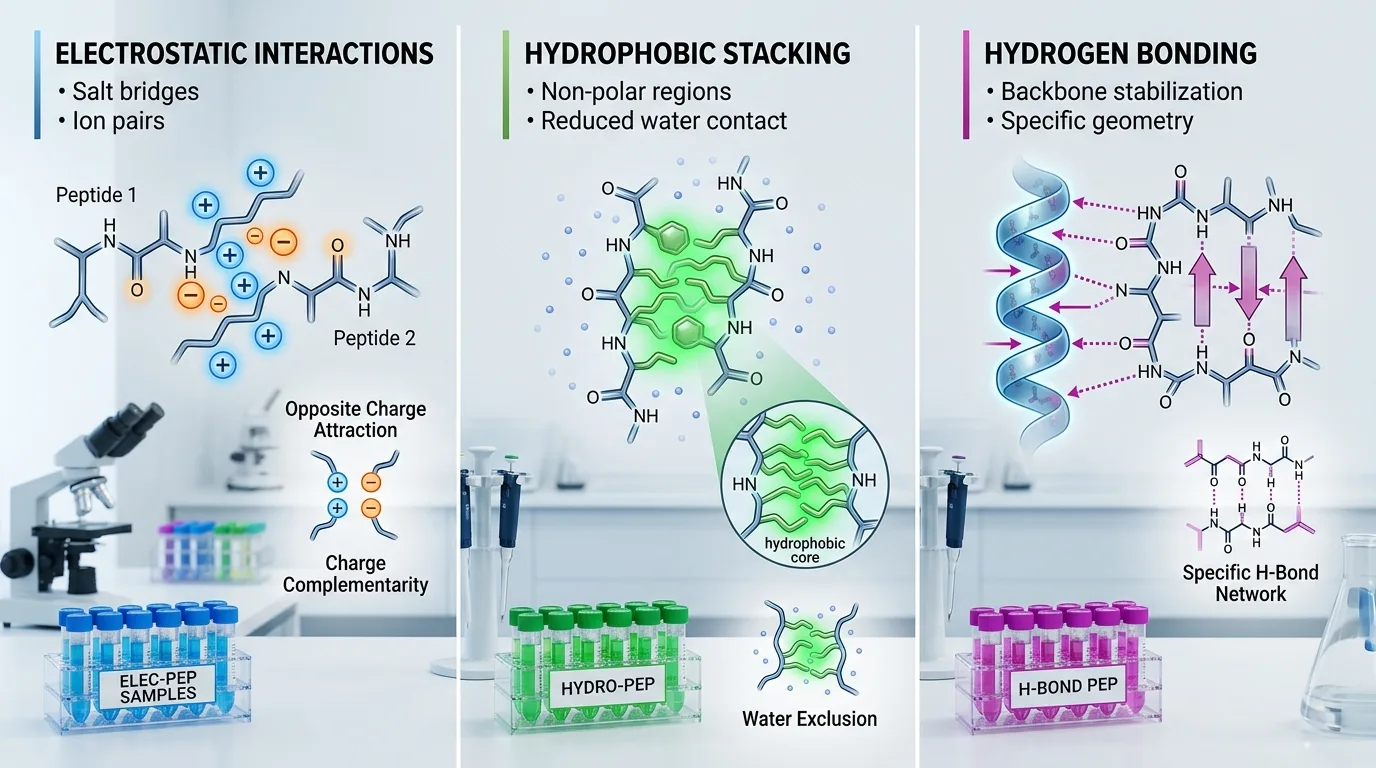
Before examining specific peptide pairs, it helps to define the three categories clearly so the rest of the guide has a consistent vocabulary.
Synergistic combinations involve two peptides that act on different but complementary receptor systems or pathways to produce amplified or additive effects greater than either peptide alone. The key word is complementary. The peptides are not duplicating effort; they are working through separate biological mechanisms that reinforce each other.
Neutral or parallel combinations involve peptides operating through entirely non-overlapping pathways with no pharmacokinetic conflict. Each peptide produces its own independent effects without meaningfully enhancing or interfering with the other. These stacks are not wasted effort, but they are not generating the amplified output of a true synergistic pair either. They are simply two independent research tools used at the same time.
Redundant or counterproductive combinations occur when two peptides target the same receptor family or converge on the same signaling node. The result is diminishing returns, receptor desensitization over time, compounded side effects, or all three, without any meaningful additional benefit over using either peptide alone at an appropriate dose.
A compatibility matrix is a structured reference tool that maps common peptide pairs across these three categories. Each cell in the matrix identifies a pairing as synergistic, neutral, or redundant and includes a brief mechanistic rationale so the designation is not arbitrary. Reading the matrix correctly means treating each verdict as context-dependent, not absolute. These numbers highlight an important reality: a substantial portion of common research pairings fall into the neutral or redundant categories, meaning thoughtful selection matters more than simply combining multiple peptides.
Among frequently studied research peptide pairs, approximately 35% are considered synergistic based on current preclinical and clinical evidence, 40% are classified as neutral or parallel, and 25% are categorized as redundant or counterproductive. The breakdown illustrates why stacking more peptides does not automatically mean better outcomes.
Synergistic Stacks Backed by Research
The most commonly discussed synergistic stack in peptide research is the combination of a GHRH analog, most commonly CJC-1295, with a growth hormone-releasing peptide such as ipamorelin or GHRP-6, though this combination lacks formal clinical documentation. The mechanism is elegant in its simplicity: these two peptide classes act on entirely different receptors. CJC-1295 binds the GHRH receptor on pituitary somatotrophs, while ipamorelin and GHRP-6 activate the ghrelin receptor, technically known as GHS-R1a.
Co-activation of both receptor systems produces GH pulses significantly larger than either peptide generates alone. A 2006 clinical pharmacology study established that CJC-1295 administered as a single subcutaneous dose produced dose-dependent increases in mean GH concentrations ranging from 2-fold to 10-fold above baseline. When a GHRP is layered onto this GHRH background, the ghrelin receptor activation amplifies pituitary responsiveness in a way that neither receptor pathway can achieve independently. IGF-1 levels in the same study increased 1.5-fold to 3-fold and remained elevated for approximately six days post-dose, providing a quantitative baseline for evaluating stack effects.
These numbers highlight a critical point: the synergy here is not incidental. It is mechanistically predictable because the two receptor systems are designed to work together in the body's own GH regulation. The bar chart comparing single-peptide GH output against the combined GHRH plus GHRP protocol makes the amplification visually clear.
For tissue repair, BPC-157 and TB-500 represent a well-studied synergistic pairing. BPC-157, a pentadecapeptide derived from human gastric juice, drives tissue repair through VEGF signaling, nitric oxide pathways, and upregulation of GH receptor expression. TB-500, the active fragment of thymosin beta-4, works through an entirely different mechanism: promoting actin polymerization and cellular migration to accelerate wound closure and vascular repair. Preclinical rodent models show complementary rather than antagonistic activity at standard research dosing intervals, with no reported interference between the two pathways.
The cognitive stack of Selank and Semax is another pairing supported by mechanistic logic. Selank acts primarily on GABAergic and serotonergic systems, producing anxiolytic and mood-stabilizing effects. Semax, derived from an ACTH fragment, elevates BDNF and modulates dopaminergic pathways. Because their primary targets do not overlap, additive rather than competitive effects are the expected outcome. The combination addresses anxiety and stress-related cognitive interference through one pathway while simultaneously supporting neuroplasticity and focus through another.
Thymosin alpha-1 rounds out this section as a peptide that can be layered onto GH axis protocols without receptor conflict. Its immunostimulatory mechanism operates through TLR signaling, which is entirely orthogonal to GHRH or GHRP receptor activity. Thymosin alpha-1 has received regulatory approval in multiple countries for hepatitis B, hepatitis C, and cancer adjuvant therapy, providing a meaningful safety baseline that most research peptides lack.
Neutral Stacks With Independent Mechanisms
Not every stack needs to be synergistic to be purposeful. Neutral combinations allow researchers to pursue independent biological objectives simultaneously without risk of interference. Understanding which peptides can be stacked together safely in this parallel-mechanism sense is just as important as identifying synergistic pairs.
AOD-9604 is a modified fragment of human growth hormone targeting adipocyte beta-3 adrenergic receptors specifically for lipolysis. Critically, it does not activate the full GH receptor and does not raise IGF-1. This makes it mechanistically safe to layer onto a GHRH/GHRP combination because it adds an independent lipolytic mechanism without compounding any IGF-1-related risks that accumulate when secretagogue protocols drive endogenous IGF-1 production.
Epithalon, a synthetic tetrapeptide analogue of the pineal peptide epithalamin, is frequently incorporated into longevity-focused protocols alongside GH secretagogues. Its proposed mechanisms include telomerase activation and cortisol normalization, both of which operate through entirely different downstream pathways than GH secretion. The lack of mechanistic conflict makes this a reasonable neutral pairing, though it is important to acknowledge that direct interaction data remain limited to animal studies rather than human clinical trials.
MOTS-c, a 16-amino acid peptide encoded in mitochondrial 12S rRNA, activates AMPK to regulate metabolic homeostasis. GH-driven IGF-1 signaling and AMPK activation operate through parallel but intersecting metabolic nodes. Rodent models suggest additive improvement in insulin sensitivity when both pathways are engaged, which positions MOTS-c as a potentially complementary addition to GH axis protocols, with the caveat that human data remain limited.
Route-of-administration independence is an underappreciated form of pharmacokinetic neutrality. BPC-157 retains meaningful bioactivity when administered orally in animal models because it resists gastric peptidase degradation. Most GH secretagogues, by contrast, are rapidly cleaved in the gastrointestinal tract and require subcutaneous or intranasal delivery. An oral BPC-157 plus subcutaneous GHRP protocol involves no absorption-site collision and no competition for the same delivery pathway, reinforcing their practical compatibility.
Redundant and Counterproductive Combinations to Avoid
Identifying what peptides can be stacked together safely also means knowing which combinations to avoid. Redundant stacks are not merely inefficient; some actively undermine the intended outcome.
The most common mistake among beginners is stacking two GHRPs on the same schedule. Both GHRP-6 and ipamorelin activate the same ghrelin receptor, GHS-R1a. Continuous, non-pulsatile stimulation of this receptor leads to downregulation of GHS-R1a expression within 48 to 72 hours. The practical result is that using both GHRPs simultaneously on identical timing reduces net GH output compared to using either one alone at appropriate pulsatile intervals. More is not more here. It is demonstrably less.
Melanotan II and PT-141 (bremelanotide) represent another clear-cut redundant combination. Both are melanocortin receptor agonists with overlapping affinity profiles spanning MC1R through MC4R. Co-administration produces additive side effects including nausea, facial flushing, and blood pressure changes without generating any meaningful additional therapeutic benefit beyond what a single agent provides. There is no complementary mechanism being leveraged here; both peptides are competing for the same receptors.
IGF-1 LR3 stacked on top of an active GH secretagogue protocol creates a dual IGF-1 signal that carries genuine risk. IGF-1 LR3 has a plasma half-life of approximately 20 to 30 hours, compared to native IGF-1's 5 to 6 hours. When secretagogue-driven endogenous IGF-1 production is added to that already-extended exogenous signal, hypoglycemia risk increases substantially. Receptor downregulation in muscle and adipose tissue is an additional concern under sustained dual-signal conditions.
Finally, pairing two long-acting GHRH analogs simultaneously, such as combining CJC-1295 with DAC with another long-acting analog, eliminates the pulsatility that is essential for physiological GH secretion patterns. The line chart showing pulsatile GH secretion under a single GHRP versus a dual long-acting analog protocol makes this blunting effect visually stark. Physiology requires rhythmic oscillation in GH output, and flattening that rhythm through sustained receptor saturation works against the intended goal.
Half-Lives and Timing: The Overlooked Compatibility Layer
Half-life mismatches are one of the most underappreciated dimensions of peptide stack compatibility. The range across common research peptides is dramatic. Native GHRH(1-44) has a half-life of under two minutes in plasma. Ipamorelin's active window spans roughly two hours. CJC-1295 without DAC achieves half-lives of 5.8 to 8.1 days. CJC-1295 with DAC extends receptor occupancy to six to eight days through covalent albumin binding via its lysine residue modification.
Approximate half-lives across common peptides are as follows. Native GHRH has a half-life of under 2 minutes. GHRP-6 and ipamorelin each have half-lives of approximately 2 hours. BPC-157 has a half-life of around 4 hours. CJC-1295 without DAC sits at approximately 30 minutes for the base peptide but with persistent IGF-1 elevation lasting several days. CJC-1295 with DAC achieves 6 to 8 days of active receptor coverage. These numbers highlight why plasma concentration overlap at the receptor site is the real determinant of pharmacodynamic synergy, not simply the act of co-administering two peptides.
The background elevation plus pulse model is the most practical illustration of timing-based compatibility. CJC-1295 with DAC establishes a continuous low-level GHRH signal at the pituitary. Short-acting ipamorelin, administered at discrete intervals, then activates GHS-R1a in pulses superimposed on that background. The result more closely resembles the body's natural GH secretion rhythm than either agent alone could produce. Pairing two long-acting agents, by contrast, creates a flat sustained signal that lacks the oscillation physiology depends on.
Circadian receptor sensitivity adds another timing dimension. GH receptor expression in hepatocytes peaks during early morning hours in both rodent and human models. Pre-sleep administration of secretagogue stacks aligns with the body's natural pulsatile GH surge, potentially improving efficacy compared to morning dosing.
DPP-IV competitive inhibition is a subtler timing complexity. Two DPP-IV-sensitive peptides administered simultaneously compete for the same degradative enzyme. When both present the same alanine or proline residue at position 2, which is the DPP-IV cleavage site, their simultaneous presence may unpredictably extend each other's active half-lives. This can be beneficial in some contexts and problematic in others, and it is a variable that most introductory stacking content ignores entirely.
Practical Compatibility Matrix for Common Peptide Pairs
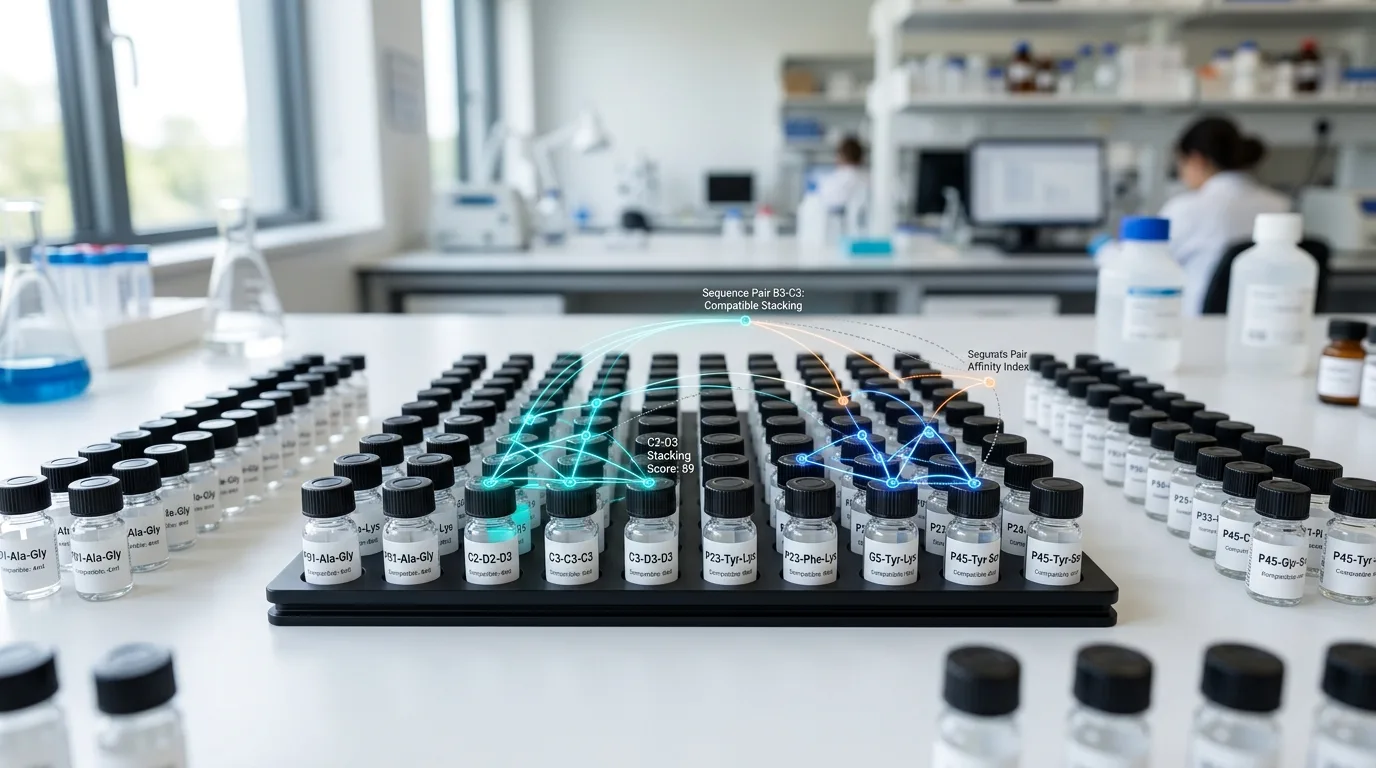
The following matrix describes compatibility designations for common research peptide pairs, organized by category with brief mechanistic rationale for each key pairing.
CJC-1295 plus Ipamorelin: Synergistic. Dual-receptor mechanism via GHRH receptor and GHS-R1a produces amplified GH pulses greater than either alone. Optimal with long-acting GHRH background and short-acting GHRP pulse pattern.
BPC-157 plus TB-500: Synergistic. Non-overlapping tissue repair mechanisms via VEGF/NO pathways and actin polymerization respectively. Preclinical rodent data shows complementary activity with no antagonism at standard research intervals.
Selank plus Semax: Synergistic. Non-overlapping primary targets; GABAergic/serotonergic modulation versus BDNF elevation and dopaminergic activity. Additive rather than competitive cognitive effects are the expected outcome.
Thymosin alpha-1 plus GH axis peptides: Synergistic to neutral. TLR-based immunostimulatory mechanism is orthogonal to GHRH/GHRP receptor activity. No receptor conflict. Regulatory-grade safety baseline from approved clinical indications.
AOD-9604 plus GHRH/GHRP combinations: Neutral. Beta-3 adrenergic lipolysis mechanism does not activate full GH receptor or raise IGF-1. Independent lipolytic action runs alongside secretagogue activity without interference.
Epithalon plus GH secretagogues: Neutral. Telomerase activation and cortisol normalization pathways do not compete with GH secretion mechanisms. Interaction data limited to animal studies; conservative interpretation warranted.
GHRP-6 plus Ipamorelin on identical schedules: Redundant. Both activate GHS-R1a. Continuous co-stimulation causes receptor desensitization within 48 to 72 hours, reducing net GH output below single-agent levels.
Melanotan II plus PT-141: Redundant. Overlapping MC1R-MC4R affinity profiles. Additive side effects without additional benefit.
IGF-1 LR3 plus active GH secretagogue protocol: Counterproductive. Dual IGF-1 signal from exogenous LR3 plus secretagogue-driven endogenous production raises hypoglycemia risk and potential receptor downregulation.
Physical mixing stability is a separate but related compatibility dimension. Peptides with widely different isoelectric points may precipitate when combined in a single syringe due to charge neutralization. GHRPs are generally stable at pH 5.5 to 6.5, while some thymosin derivatives require slightly alkaline conditions. Verifying pH compatibility before combining peptides in solution is a practical necessity that mechanistic compatibility analysis alone cannot address. Several pairings involving newer mitochondria-derived peptides like Humanin carry limited human data, and those designations warrant conservative interpretation until clinical evidence accumulates.
Key Principles Before Building Any Stack
Five decision checkpoints should precede any stacking protocol. First, conduct a receptor overlap check: do both peptides target the same receptor family? If yes, assess desensitization risk before proceeding. Second, evaluate half-life and timing alignment: do the peptides' active windows overlap in a way that serves the intended pharmacodynamic goal, or does one flood the system while the other is already clearing? Third, examine downstream signaling convergence: even with different receptors, do both peptides ultimately activate the same intracellular pathway in a way that might cause redundancy or excess?
Fourth, confirm route-of-administration compatibility: do both peptides require the same delivery route, and if so, is there absorption-site competition? Fifth, verify physical mixing stability if co-administration in a single solution is planned, checking pH ranges and isoelectric point compatibility.
Starting with a single well-characterized peptide before adding a second is the most evidence-consistent approach for anyone new to peptide research. Adding a second peptide before fully characterizing the response to the first makes it impossible to attribute effects or unexpected responses to either agent with confidence.
Hybrid protocols that blend peptides with small molecules such as 5-amino-1MQ deserve specific mention. 5-amino-1MQ is technically not a peptide; it is a small-molecule NNMT inhibitor. Its inclusion in what are labeled peptide stacks blurs the category boundary and introduces additional interaction variables that introductory stacking content typically ignores. Recognizing this boundary matters for accurate interpretation of both intended effects and potential risks.
All peptide research discussed throughout this guide is conducted in controlled research contexts. Readers should consult current regulatory frameworks and qualified professionals before designing any protocol.
Putting It All Together
Peptide compatibility is a function of biology, not personal preference. Receptor systems, half-lives, signaling pathways, and degradation mechanics determine whether two peptides amplify each other's effects, operate independently, or work against each other. These principles can be understood without advanced biochemistry, and this guide has aimed to make them accessible.
The three-category framework gives beginners a practical mental model for evaluating any pairing they encounter. Synergistic pairs like CJC-1295 plus ipamorelin leverage distinct receptor systems for amplified GH output that neither peptide achieves alone. Neutral pairs like BPC-157 plus AOD-9604 operate in independent biological lanes, each contributing its own effect without interference. Redundant pairs like dual GHRPs on identical schedules waste the protocol's potential and risk fatiguing the very receptor system they are trying to activate.
For those ready to move beyond this beginner framework, Molecule Notes offers deeper resources on individual peptide mechanisms, synthesis methodologies, and the evolving clinical evidence base for specific compound classes. Staying current matters in this field, since new stacking research and emerging peptide classes continue to refine what we understand about compatibility.
If this guide has been useful, consider subscribing to the Molecule Notes newsletter for ongoing analysis as new research emerges, or explore the site's upcoming expert content series for more advanced mechanistic coverage. The biology of peptide stacking rewards careful study, and there is considerably more to discover beyond this introduction.
Sources
- henryford.com — henryford.com
- peptidings.com — peptidings.com
- harvard.edu — health.harvard.edu
- drugfree.org — drugfree.org
- formblends.com — formblends.com
- bmj.com — bmj.com
- meto.co — meto.co
- peppal.app — peppal.app
- pharmaceuticalonline.com — pharmaceuticalonline.com
- europa.eu — ema.europa.eu
- formblends.com — formblends.com
- ubiehealth.com — ubiehealth.com