
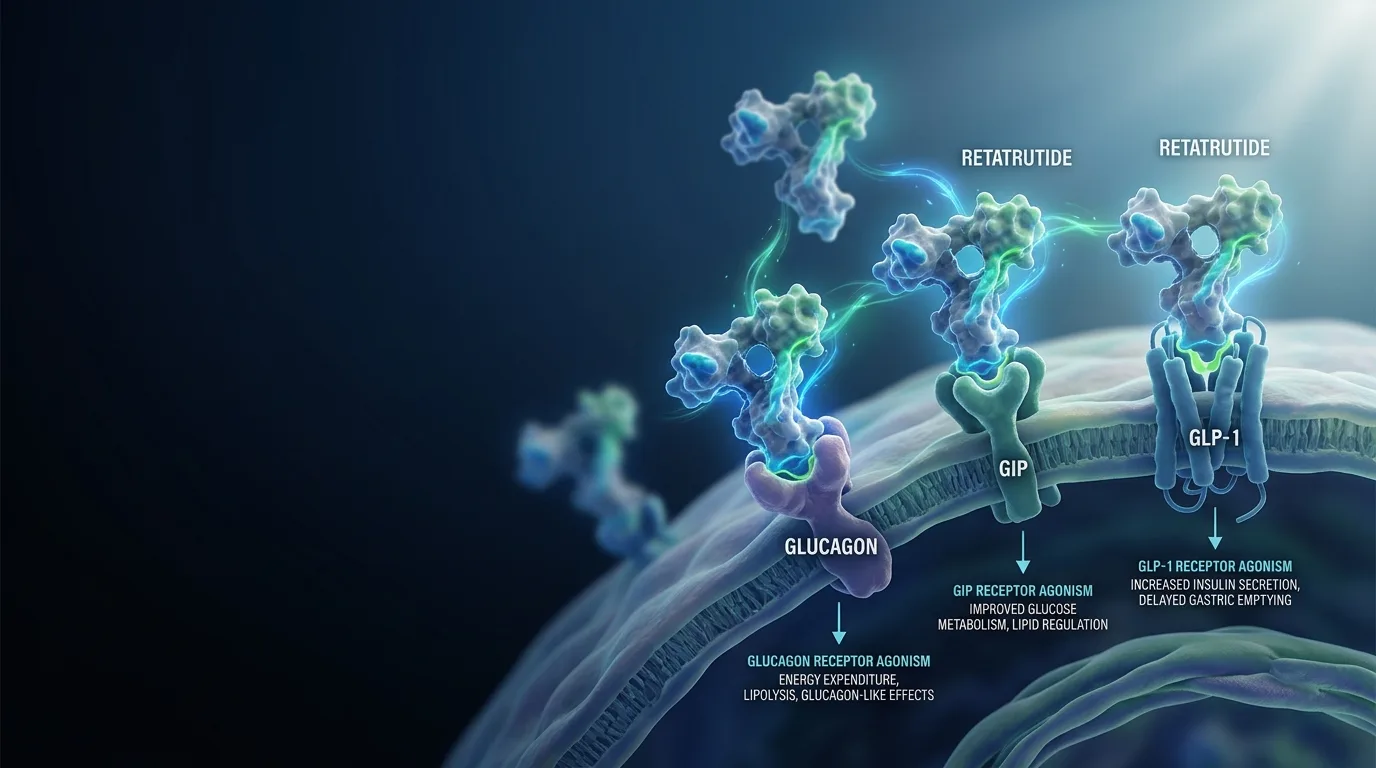
Most anti-obesity drugs work like a single key cut for a single lock. They target one receptor, trigger one cascade of physiological responses, and produce weight loss within the boundaries of that singular mechanism. Retatrutide works differently. It carries three keys simultaneously, each engineered to fit a distinct receptor lock: the GLP-1 receptor, the GIP receptor, and the glucagon receptor. That structural distinction is not a minor pharmaceutical footnote. It is the reason Phase 2 trial participants lost a mean of 24.2% of their body weight in just 48 weeks, a figure that genuinely stunned researchers in metabolic medicine and set a new benchmark for pharmacological weight loss.
This article is a receptor-by-receptor explainer of exactly what retatrutide does inside the body and why engaging three distinct hormone receptors at once produces effects that no single or dual agonist can replicate. No PhD in endocrinology required. By the end, the retatrutide mechanism of action explained here should feel intuitive, not intimidating.
Retatrutide, also designated LY3437943, is a synthetic acylated peptide developed by Eli Lilly. It represents the third generation in a clear pharmacological lineage of incretin-based therapies, and it sits at the frontier of what peptide engineering can achieve in obesity and metabolic disease pharmacology.
What Is Retatrutide? The Third Generation of Incretin-Based Therapy
Incretin-based pharmacology has evolved in distinct steps. The first generation brought GLP-1 receptor monoagonists: exenatide, liraglutide, and semaglutide. These drugs produced meaningful weight loss, with semaglutide achieving approximately 15% body weight reduction over 68 weeks in the STEP 1 trial. The second generation arrived with tirzepatide, a dual GLP-1R and GIPR agonist, which pushed that number to approximately 20.9% over 72 weeks in SURMOUNT-1. Retatrutide, the third generation, adds glucagon receptor agonism to that dual framework and has produced 24.2% mean body weight loss at 48 weeks in Phase 2 testing.
These numbers tell a clear generational story. Semaglutide (GLP-1R monoagonist) achieved roughly 15% weight loss; tirzepatide (GLP-1R plus GIPR dual agonist) achieved approximately 22.5%; and retatrutide (GLP-1R plus GIPR plus GCGR triple agonist) reached 24.2% in a shorter timeframe. The breakdown illustrates how each additional receptor target has contributed meaningfully to efficacy outcomes across generations.
Structurally, retatrutide is derived from a modified GIP (glucose-dependent insulinotropic polypeptide) analog backbone. Its amino acid sequence has been engineered to achieve high potency at GLP-1R and GIPR while maintaining potent activity at GCGR. All three targets are G protein-coupled receptors, meaning they share a common intracellular signaling architecture even though their physiological roles differ substantially.
The Phase 2 trial, registered as NCT04881760, enrolled 338 adults with obesity or overweight plus at least one weight-related comorbidity. Participants were randomized across four active dose arms: 1 mg, 4 mg, 8 mg, and 12 mg administered subcutaneously once weekly, alongside a placebo group. Weight reduction was dose-dependent across all active arms, with the 12 mg group achieving the headline 24.2% figure. These numbers are well-suited to illustrating the dose-response relationship visually, as each dose arm produced a distinct and progressively greater outcome.
Eli Lilly has since initiated the TRIUMPH Phase 3 program for obesity and a separate Phase 2 trial in type 2 diabetes (NCT05019755), with results anticipated in 2025 and 2026. Retatrutide remains an investigational compound, but its regulatory trajectory is clearly defined.
How Retatrutide Is Built: Peptide Engineering for a Once-Weekly Dose
Understanding why retatrutide can be dosed just once a week requires a brief look at its molecular architecture. The peptide carries a C20 fatty diacid chain attached via a chemical linker to a lysine residue within its amino acid backbone. This fatty acid tail enables the peptide to bind reversibly to serum albumin, the most abundant protein in human blood at approximately 66 kilodaltons.
Think of serum albumin as a molecular bodyguard. When retatrutide binds to it, the peptide becomes shielded from two processes that would otherwise eliminate it rapidly: renal clearance, which filters small peptides through the kidneys, and proteolytic degradation, in which circulating enzymes break peptide bonds. Albumin binding effectively disguises retatrutide as a large, established blood protein, dramatically extending its active lifetime in circulation to approximately one week.
This fatty acid acylation strategy is not new to peptide pharmacology. Semaglutide uses the same approach. What distinguishes retatrutide is that the linker chemistry and fatty acid chain length have been tuned to preserve adequate receptor binding affinity across all three target receptors while still achieving the albumin interaction required for once-weekly dosing. Getting that balance right is genuinely difficult: the fatty acid modification affects not just half-life but also the three-dimensional shape of the peptide and how it docks with each receptor.
The GIP analog backbone provides the structural starting point. From there, the amino acid sequence diverges through deliberate substitutions designed to introduce GLP-1R and GIPR potency while retaining glucagon receptor activity at a level that is therapeutically useful without being glycemically destabilizing. This is a non-trivial peptide design challenge: each amino acid substitution can shift the balance of activity across the three receptors, and finding a sequence that simultaneously satisfies three different pharmacological requirements demands both computational modeling and extensive empirical optimization.
This structural foundation sets up everything that follows. Each receptor that retatrutide activates has a distinct physiological role, and understanding those roles individually is the key to appreciating why triple activation produces synergistic outcomes.
Receptor One: GLP-1R — The Appetite and Insulin Controller

GLP-1, or glucagon-like peptide-1, is released from specialized cells in the gut wall after a meal. Its primary job is to signal the pancreatic beta cells to secrete insulin, but it does so in a glucose-dependent manner. This is a critical safety feature. Think of it like a restaurant bill that only charges you if you actually ordered food: GLP-1R-driven insulin release only kicks in when blood glucose is elevated, which means GLP-1R agonism does not cause dangerous hypoglycemia the way some older insulin secretagogues can.
GLP-1R activation also suppresses glucagon secretion from pancreatic alpha cells, reduces hepatic glucose output, and slows gastric emptying. The slowing of gastric emptying means food moves more slowly from the stomach into the intestine, extending the feeling of fullness after a meal. Crucially, GLP-1R is also expressed in the hypothalamus and brainstem, where its activation sends appetite-suppressing signals that reduce caloric intake at the level of the brain, not just the gut. This central appetite suppression is the primary mechanism behind the weight loss associated with semaglutide.
In retatrutide's Phase 2 trial, GLP-1R agonism contributed to HbA1c reductions of up to 2.02 percentage points in participants with elevated baseline glucose, consistent with the receptor's established role in enhancing insulin secretion and reducing hepatic glucose output. These glycemic improvements were statistically significant and occurred alongside the primary weight loss outcomes.
GLP-1R activation is also responsible for the drug class's most common adverse events: nausea, vomiting, and constipation. These effects arise partly because slowing gastric motility, while beneficial for satiety, can produce gastrointestinal discomfort. Importantly, GIPR co-activation may attenuate some of this side effect burden, which becomes relevant when examining the second receptor in retatrutide's profile.
Receptor Two: GIPR — The Overlooked Synergist
GIP, or glucose-dependent insulinotropic polypeptide, was once considered the forgotten incretin. Early research suggested that GIPR agonism might promote fat storage in adipose tissue, making it seem counterproductive as a target in obesity pharmacology. For years, drug developers focused almost exclusively on GLP-1R. The clinical data from tirzepatide and retatrutide have fundamentally reversed that thinking.
GIPR, like GLP-1R, stimulates glucose-dependent insulin secretion from pancreatic beta cells. When both receptors are activated simultaneously, their effects on insulin release are synergistic, meaning the combined response exceeds what either receptor produces alone. Beyond the pancreas, GIPR is expressed in adipose tissue, where it modulates fat storage and lipolysis, and in the central nervous system, where its activation contributes to appetite reduction. The CNS effects of GIPR agonism appear to synergize directly with GLP-1R's hypothalamic signaling, producing a stronger appetite suppression signal than either receptor generates independently.
The tolerability advantage of GIPR co-activation is particularly significant. Evidence from tirzepatide and retatrutide data suggests that GIPR agonism may reduce the nausea associated with GLP-1R activation, potentially making the triple agonist more tolerable than GLP-1R monoagonists despite its more complex mechanism. The safety profile observed in retatrutide's Phase 2 trial was consistent with the broader GLP-1R drug class: gastrointestinal events were the most common adverse effects, mostly mild to moderate in severity, and increased with dose escalation.
GIPR activation also carries an intriguing signal in bone metabolism. The receptor has known anabolic effects in bone tissue, and early research suggests retatrutide may have more favorable effects on musculoskeletal health than pure GLP-1R agonists. A key concern with any significant weight loss therapy is the potential for lean mass and bone density reduction alongside fat mass loss. If GIPR agonism offers a degree of protection against those losses, it would represent a meaningful clinical advantage. This remains an area of active investigation rather than an established benefit, but it is a scientifically compelling question.
Receptor Three: GCGR — The Metabolic Rate Amplifier That Sets Retatrutide Apart

The glucagon receptor is where retatrutide's mechanism most sharply diverges from everything that came before it. Glucagon is classically described as insulin's antagonist: when blood glucose drops, the pancreas releases glucagon to raise it back up by stimulating the liver to release stored glucose. That counter-regulatory role makes glucagon receptor agonism sound dangerous in the context of obesity treatment, where improved glycemic control is a primary goal. The logic appears straightforward: activating a receptor that raises blood sugar seems like precisely the wrong approach for a drug targeting metabolic disease.
The key to resolving this apparent contradiction is understanding what else glucagon receptor activation does when glucose-raising effects are simultaneously suppressed by GLP-1R agonism. Think of the glucagon receptor as a furnace thermostat. Normally, turning it up raises the temperature of blood glucose. But if GLP-1R activation is simultaneously acting as a governor on that glucose-raising function, the thermostat's effect on glucose is blunted while the furnace's other outputs, specifically heat generation and fuel consumption, continue running. In metabolic terms, those other outputs are increased basal metabolic rate, stimulation of hepatic fatty acid oxidation, and promotion of lipolysis in adipose tissue.
These are the non-glycemic benefits of glucagon receptor activation, and they represent a distinct energy expenditure dimension that incretin-only agents simply cannot access. Preclinical animal model data showed that triple GLP-1R/GIPR/GCGR agonism produced greater reductions in body fat mass and improvements in hepatic steatosis than dual agonism alone, providing the biological rationale for the Phase 2 outcomes. The liver, in particular, becomes a site of significantly enhanced fat burning when GCGR is activated, which has implications beyond weight loss.
The NASH and MASH implication is substantial. Non-alcoholic steatohepatitis (now more commonly called metabolic dysfunction-associated steatohepatitis, or MASH) is characterized by excessive fat accumulation in liver tissue combined with inflammation and fibrosis. Retatrutide's triple mechanism targets this condition from multiple angles simultaneously: GLP-1R activation reduces hepatic lipogenesis and improves insulin sensitivity, while GCGR activation drives hepatic fatty acid oxidation, essentially accelerating the liver's fat-burning capacity. The combination may produce synergistic histological improvement that neither receptor achieves as powerfully on its own. A direct comparison of outcomes with and without the GCGR component would illustrate this differential clearly.
The Synergy Effect: Retatrutide Mechanism of Action Explained Through Triple Receptor Convergence
Receptor synergy is easier to understand with a physical analogy. Imagine trying to drain water from a flooded room using one pump. Adding a second pump drains water faster. Adding a third pump that also heats the room and accelerates evaporation does something qualitatively different: it changes the physics of the problem, not just the quantity of force applied. Retatrutide's triple agonism works by a similar logic. Each receptor activates different intracellular pathways, but their downstream effects converge on the same outcome: a caloric deficit driven simultaneously from appetite regulation, insulin enhancement, and energy expenditure amplification.
All three target receptors signal intracellularly through cyclic AMP, a shared second messenger. But the cell populations they activate, and the physiological consequences of that activation, differ substantially. GLP-1R primarily operates in pancreatic beta cells, the brainstem, and the hypothalamus. GIPR adds activity in adipose tissue and bone alongside pancreatic effects. GCGR drives hepatic responses that neither incretin receptor reaches with comparable potency. The convergence of these three distinct pathways on the same physiological goal is what produces outcomes beyond additive expectations.
The Phase 2 weight loss comparison data makes the generational progression concrete. At 48 weeks, retatrutide 12 mg produced a mean 24.2% body weight loss. Semaglutide 2.4 mg reached approximately 15% at 68 weeks in STEP 1. Tirzepatide 15 mg achieved approximately 22.5% at 72 weeks in SURMOUNT-1. Retatrutide not only surpassed both predecessors in absolute weight loss percentage but did so over a shorter trial duration. These numbers highlight why the Phase 2 results generated such significant attention across metabolic medicine and pharmaceutical development.
Beyond weight loss, Phase 2 data showed statistically significant improvements across multiple metabolic markers. Fasting glucose declined meaningfully. HOMA-IR, a standard index of insulin resistance, improved significantly. Systolic blood pressure dropped. Triglyceride levels fell. Waist circumference reduced. These are not peripheral benefits; they represent improvements in the core drivers of cardiometabolic disease risk. The breadth of these improvements across multiple independent metabolic parameters reflects the multi-receptor mechanism at work rather than any single pharmacological effect.
Achieving this breadth required careful molecular calibration. Too much glucagon receptor potency raises blood glucose and undermines the glycemic benefits of GLP-1R activation. Too little wastes the energy expenditure advantage that distinguishes retatrutide from tirzepatide. The specific amino acid sequence of retatrutide, with its balance of high GLP-1R and GIPR potency alongside moderate GCGR activity, represents the result of that calibration. Molecular-level engineering decisions translate directly into the clinical outcomes observed in trial participants.
Retatrutide vs. Semaglutide vs. Tirzepatide: A Generation-by-Generation Comparison
Positioning these three agents side by side clarifies where retatrutide sits in the therapeutic landscape. Semaglutide targets one receptor (GLP-1R), is approved for both obesity and type 2 diabetes, and is administered once weekly subcutaneously (or orally in lower doses). It achieves approximately 15% mean body weight loss. Tirzepatide targets two receptors (GLP-1R and GIPR), is approved for type 2 diabetes and obesity, and is also dosed once weekly subcutaneously, achieving approximately 22.5% mean body weight loss. Retatrutide targets three receptors (GLP-1R, GIPR, and GCGR), remains investigational, and has demonstrated approximately 24.2% mean body weight loss in Phase 2 at 48 weeks. The weight loss percentages by agent break down as follows: semaglutide at 15%, tirzepatide at 22.5%, and retatrutide at 24.2%. These figures illustrate the stepwise efficacy progression across generations.
What retatrutide adds over tirzepatide specifically is the GCGR component. The glucagon receptor drives increased energy expenditure and hepatic fat oxidation, mechanisms that incretin-only agents do not access. That mechanistic addition is the most plausible explanation for the incremental weight loss advantage beyond tirzepatide's already best-in-class results.
One important caveat deserves explicit acknowledgment. These comparisons draw from different trials with different populations, different treatment durations, and different endpoints. Direct head-to-head trial data does not yet exist. The Phase 2 signal is compelling, but translating that signal into definitive superiority claims requires Phase 3 confirmation. Maintaining scientific credibility means holding that distinction clearly.
The commercial context amplifies the stakes. Goldman Sachs projects the global obesity drug market will exceed $100 billion annually by 2030. A molecule demonstrating potential superiority to existing agents across both efficacy and secondary metabolic endpoints carries enormous clinical and commercial significance. Retatrutide mechanism of action explained in the context of that market means understanding not just the pharmacology but the scale of what is at stake if Phase 3 results confirm Phase 2 findings.
Where Retatrutide Goes Next: Phase 3 Trials, NASH, and Beyond
The TRIUMPH Phase 3 program represents the critical next step for retatrutide's obesity indication. Alongside it, NCT05019755 investigates the compound specifically in patients with type 2 diabetes, with HbA1c reduction as a primary endpoint alongside body weight outcomes. Early signals from Phase 2 data suggest superior glucose lowering compared to relevant comparators, consistent with the triple mechanism's insulin-enhancing profile. Results from both programs are anticipated in 2025 and 2026. If those results confirm Phase 2 findings, they would set the stage for regulatory submission and clinical availability.
The MASH application is arguably as significant as the obesity indication. Fatty liver disease affects an estimated 25% of the global population, and effective pharmacological treatment options remain limited. Retatrutide's triple mechanism, which simultaneously reduces hepatic lipogenesis through GLP-1R, increases hepatic fat oxidation through GCGR, and improves insulin sensitivity across tissues, is mechanistically well-suited to address the core pathophysiology of MASH. The GCGR-driven hepatic fat oxidation component represents a meaningful advantage over GLP-1-only agents in this context.
Cardiovascular and musculoskeletal signals from the Phase 2 data add further dimensions to retatrutide's potential utility. Reductions in blood pressure, triglycerides, and insulin resistance suggest a cardiometabolic benefit profile that extends beyond weight loss per se. The GIPR-associated bone anabolic signal raises questions about whether retatrutide might preserve lean mass and bone density during weight loss more effectively than GLP-1R monoagonists, a clinically important consideration given that rapid weight loss can accelerate muscle and bone loss.
Taken together, these signals suggest retatrutide is not a single-indication molecule. It is better understood as a platform-level therapeutic agent whose full clinical utility is still being mapped. Each new trial adds a dimension to that map, and the picture that emerges is of a compound with potential applications across obesity, type 2 diabetes, fatty liver disease, and cardiometabolic risk reduction simultaneously.
What It All Means
Retatrutide's unprecedented efficacy is not magic. It is the product of deliberate, sophisticated peptide engineering that enables a single molecule to simultaneously engage three metabolically distinct receptor systems. Each receptor contributes a distinct layer to the overall effect. GLP-1R suppresses appetite and stimulates glucose-dependent insulin secretion. GIPR provides synergistic insulin enhancement and may attenuate GLP-1R-mediated nausea. GCGR amplifies basal metabolic rate and drives hepatic fatty acid oxidation, adding an energy expenditure dimension that neither incretin receptor can access. Together, these three mechanisms converge on a caloric deficit driven from multiple physiological directions at once, which is why triple agonism produces outcomes that no single or dual agonist can replicate.
The 24.2% mean body weight loss figure is not just a clinical data point. It is a signal about the ceiling of pharmacological efficacy available through multi-receptor agonism, and about how far above that ceiling retatrutide mechanism of action explained in full actually sits relative to what came before. The retatrutide mechanism of action explained here across three receptors and their synergistic interactions illustrates precisely why this molecule represents a genuine generational step forward rather than an incremental refinement.
The broader lesson for biomedical science is about the power of peptide engineering itself. The ability to tune multi-receptor agonism at the amino acid sequence level, to balance potency across three distinct G protein-coupled receptors while simultaneously engineering a plasma half-life suitable for once-weekly dosing, is one of the most productive frontiers in contemporary pharmacology. What retatrutide demonstrates is that the design space for peptide therapeutics is far richer than any single-receptor framework allows.
For readers interested in exploring the underlying science further, Molecule Notes covers incretin receptor biology, peptide half-life extension strategies, and the structural pharmacology of acylated peptides in depth. The molecular details behind the next generation of metabolic medicine are there to be understood, one receptor at a time.
Sources
- wikipedia.org — en.wikipedia.org
- nih.gov — pmc.ncbi.nlm.nih.gov
- superpower.com — superpower.com
- uchealth.org — uchealth.org
- universaldrugstore.com — universaldrugstore.com
- patsnap.com — synapse.patsnap.com
- infiniskin.com — infiniskin.com
- nih.gov — pmc.ncbi.nlm.nih.gov
- retapath.com — retapath.com