

The pharmacological management of obesity has never looked more promising, or more competitive. Three molecules now define the cutting edge of this field: semaglutide, the GLP-1 receptor agonist that first demonstrated double-digit weight loss in a clinical trial; tirzepatide, which added GIP receptor engagement and pushed those numbers higher; and retatrutide, a triple agonist targeting GLP-1R, GIPR, and the glucagon receptor simultaneously. The retatrutide vs semaglutide vs tirzepatide comparison is not merely a horse race between pharmaceutical products. It is a window into the iterative logic of peptide engineering, where each structural decision at the molecular level produces measurable consequences in clinical outcomes. Understanding why these molecules perform differently requires understanding how they were built.
The Incretin Pharmacotherapy Generations: From Monoagonist to Triple Agonist
Incretin-based obesity pharmacotherapy has progressed through three distinct generations, each defined by an expansion in receptor targeting strategy. The first generation, GLP-1 receptor monoagonists, includes exenatide, liraglutide, and semaglutide. These agents replicate the action of endogenous GLP-1, a gut-derived hormone that stimulates insulin secretion in response to food and reduces appetite through central nervous system signaling. Semaglutide represents the most refined monoagonist developed, achieving its once-weekly profile through fatty acid acylation and half-life engineering.
The second generation arrived with tirzepatide, a dual GLP-1R and GIP receptor agonist. GIP receptor agonism was historically viewed as counterproductive in obesity pharmacology, with older research suggesting it might even promote fat storage. Tirzepatide reversed that assumption entirely, demonstrating that GIPR co-activation amplifies rather than undermines the weight-reducing effects of GLP-1R engagement, particularly in central appetite regulation and adipose tissue metabolism.
Retatrutide (LY3437943) represents the third generation. By adding glucagon receptor agonism to the dual incretin platform, it introduces a mechanism entirely absent from its predecessors: direct stimulation of energy expenditure and hepatic fat oxidation. Each generational leap was not incremental tinkering; it reflected a deliberate pharmacological hypothesis about which receptor combinations would produce the greatest metabolic benefit. The clinical data now arriving suggests those hypotheses were well-founded.
Mechanism of Action: How Each Peptide Works at the Receptor Level
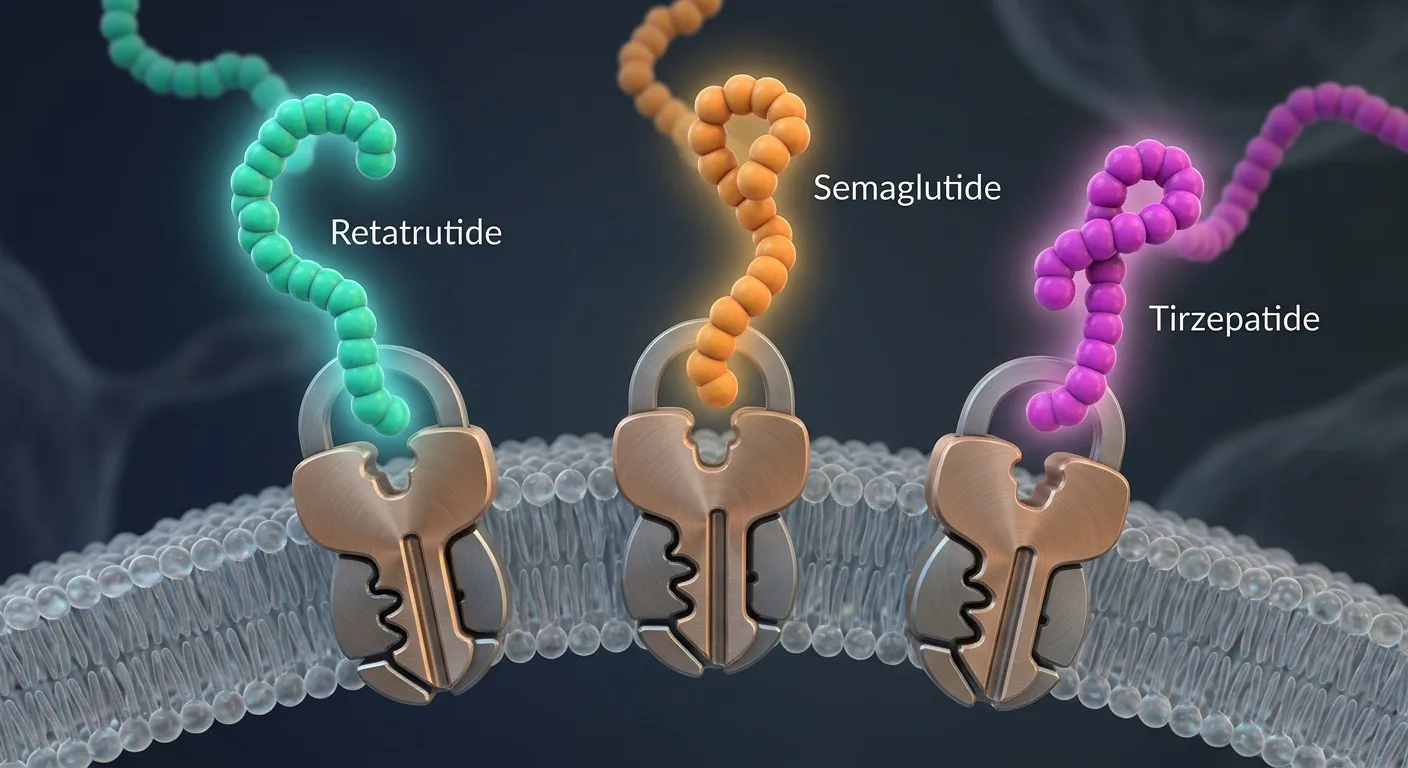
Semaglutide operates through selective GLP-1 receptor agonism. When it binds GLP-1R, it stimulates glucose-dependent insulin secretion from pancreatic beta cells, suppresses inappropriate glucagon release, slows gastric emptying to reduce post-meal glucose excursions, and activates hypothalamic circuits that reduce appetite and caloric intake. These effects are well-characterized and underpin its approximately 15% mean body weight loss in the STEP 1 trial. Its selectivity is both its strength and its ceiling.
Tirzepatide adds GIP receptor activation to this profile. GIPR agonism in the central nervous system appears to synergize with GLP-1R signaling to further suppress food intake. In adipose tissue, GIPR activation modulates fat storage and may improve insulin sensitivity in a manner complementary to GLP-1R effects. Critically, there is evidence that GIPR co-agonism attenuates GLP-1R-mediated gastrointestinal side effects, potentially improving tolerability alongside efficacy. The net result is the approximately 22.5% weight loss observed at the 15 mg dose in SURMOUNT-1.
Retatrutide retains both of those receptor actions and layers glucagon receptor agonism on top. Glucagon receptor activation drives two outcomes particularly relevant to obesity: an increase in basal metabolic rate and an acceleration of hepatic fatty acid oxidation. Where GLP-1R and GIPR primarily act by reducing energy intake through appetite suppression, GCGR agonism increases energy expenditure, creating an additive thermogenic effect. This mechanistic expansion, from appetite suppression alone to appetite suppression plus increased energy expenditure, is the structural basis for retatrutide's superior Phase 2 efficacy data.
Retatrutide's engineering is grounded in a modified glucagon analog backbone. Its amino acid sequence was redesigned to achieve high potency at GLP-1R and GIPR while retaining moderate but clinically meaningful activity at GCGR, carefully balanced to avoid the hyperglycemia risk that unmodified glucagon receptor agonism would carry. The receptor engagement profile across all three agents can be summarized clearly. Semaglutide activates GLP-1R only. Tirzepatide activates GLP-1R and GIPR. Retatrutide activates GLP-1R, GIPR, and GCGR. Each addition corresponds to a measurable step up in clinical outcome.
Peptide Engineering: Why Structural Design Explains Clinical Outcomes
The pharmacokinetic profiles of these molecules do not emerge from chance. Both semaglutide and retatrutide achieve their once-weekly dosing window through fatty acid acylation, a half-life extension strategy that attaches a fatty acid chain to the peptide backbone, enabling reversible binding to serum albumin. Albumin is a large circulating protein (approximately 66 kDa) that acts as a biological depot; by associating with it, the peptide evades renal filtration and proteolytic degradation, extending its effective plasma half-life to approximately one week. The specific fatty acid used in both molecules is a C18 fatty diacid moiety, attached via a chemical linker to a lysine residue in the backbone.
The linker chemistry and fatty acid chain length are not arbitrary choices. They critically determine albumin binding affinity, which in turn determines how slowly the peptide is released back into circulation and how long its receptor-active concentration is maintained. Small differences in these parameters translate into meaningful differences in duration of action and dosing frequency requirements.
Tirzepatide takes a structurally different approach. Rather than using a glucagon-based backbone like retatrutide, tirzepatide is built on a GIP peptide backbone with GLP-1 receptor pharmacophore elements grafted in. This backbone selection shapes which receptor the molecule engages most potently and how its receptor selectivity profile is distributed. The fact that retatrutide uses a glucagon analog backbone is not incidental. It is the structural reason why it retains meaningful GCGR activity while achieving high GLP-1R and GIPR potency; the backbone was chosen precisely because it offered the most tractable starting point for engineering balanced tri-receptor agonism without compromising metabolic safety.
Clinical Efficacy: Retatrutide vs Semaglutide vs Tirzepatide Head-to-Head Weight Loss Data

The efficacy numbers across these three agents now form one of the most striking progressions in modern pharmacology. Semaglutide 2.4 mg achieved a mean body weight loss of approximately 15% at 68 weeks in the STEP 1 trial. Tirzepatide 15 mg achieved approximately 22.5% at 72 weeks in SURMOUNT-1. Retatrutide 12 mg achieved 24.2% at 48 weeks in its Phase 2 trial published in the New England Journal of Medicine in 2023 (NCT04881760). The breakdown illustrates a consistent stepwise increase aligned precisely with receptor target expansion.
- Semaglutide 2.4 mg: approximately 15% mean body weight loss at 68 weeks (STEP 1)
- Tirzepatide 15 mg: approximately 22.5% mean body weight loss at 72 weeks (SURMOUNT-1)
- Retatrutide 12 mg: 24.2% mean body weight loss at 48 weeks (Phase 2, NEJM 2023)
These numbers highlight something particularly significant about retatrutide's result. The 24.2% figure was achieved in 48 weeks, fewer than the trial durations for either comparator, in a Phase 2 population of 338 adults with obesity or overweight plus at least one weight-related comorbidity. The trial used dose-dependent arms at 1 mg, 4 mg, 8 mg, and 12 mg weekly, all demonstrating dose-dependent weight reduction. This dose-response relationship strengthens the mechanistic interpretation; the weight loss tracks with receptor engagement intensity, not statistical noise.
The cardiometabolic data beyond body weight adds further clinical relevance. Retatrutide Phase 2 participants showed statistically significant improvements in fasting glucose, insulin resistance as measured by HOMA-IR, systolic blood pressure, triglycerides, and waist circumference. Hemoglobin A1c was reduced by up to 2.02 percentage points in participants with elevated baseline glucose. These improvements across multiple cardiovascular risk markers suggest a therapeutic benefit profile extending well beyond what weight loss alone would predict.
Preclinical animal model data provides mechanistic context for these human outcomes. Studies of triple GLP-1R/GIPR/GCGR agonism showed greater reductions in body fat mass and more pronounced improvements in hepatic steatosis compared to dual agonism alone. The clinical Phase 2 results therefore did not emerge as a surprise to researchers tracking the preclinical literature; they represented a confirmation of the predicted pharmacological consequence of adding GCGR engagement.
Safety Profiles and Tolerability: What the Trial Data Shows
All three agents share the class-effect adverse event profile characteristic of GLP-1 receptor agonism. Nausea, vomiting, diarrhea, and constipation are the most commonly reported events across semaglutide, tirzepatide, and retatrutide trials. For all three molecules, these events are predominantly mild to moderate in severity and most frequent during dose escalation phases, typically resolving as patients stabilize on maintenance doses.
Retatrutide's Phase 2 gastrointestinal adverse event frequency followed a dose-escalation-dependent pattern consistent with the drug class. No new safety signals uniquely attributable to glucagon receptor agonism were identified at clinically used doses, which is a meaningful finding given historical concerns about glucagonergic stimulation and hyperglycemia. The carefully engineered balance of GCGR potency in retatrutide's backbone appears to have avoided that risk in the Phase 2 dataset.
A theoretical tolerability advantage applies to both tirzepatide and retatrutide relative to semaglutide. Evidence suggests that GIPR activation in the central nervous system may attenuate the nausea mediated by GLP-1R agonism. If this mechanism is confirmed at scale, dual and triple agonists may carry a better gastrointestinal side effect burden than GLP-1R monoagonists at equivalent weight loss efficacy levels.
Two additional signals from retatrutide's profile warrant attention, though both remain under active investigation. GIPR agonism has established anabolic effects in bone tissue, raising the possibility that retatrutide may have a more favorable impact on bone metabolism than pure GLP-1R agonists, which is relevant given emerging concerns about bone density with sustained caloric restriction and weight loss. Separately, the GCGR-mediated enhancement of hepatic fat oxidation creates a mechanistic rationale for retatrutide's investigation in NASH (now classified as MASH), where hepatic lipid accumulation and inflammation represent the central pathology.
Dosing, Administration, and Development Stage
All three molecules are administered via once-weekly subcutaneous injection. This shared dosing frequency reflects the success of the same underlying half-life engineering strategy, specifically fatty acid acylation with serum albumin binding. The contrast with earlier daily GLP-1R agonists like liraglutide is significant; moving from daily to weekly dosing represented a major advance in patient adherence and clinical practicality, and all three agents benefit from this improvement.
The key comparison data across the three agents is organized below.
- Semaglutide (Ozempic/Wegovy): GLP-1R agonist; highest dose 2.4 mg; trial duration 68 weeks; approximately 15% weight loss; FDA-approved for obesity (Wegovy) and type 2 diabetes (Ozempic); dose escalation from 0.25 mg to 2.4 mg over 16 to 20 weeks
- Tirzepatide (Mounjaro/Zepbound): GLP-1R/GIPR dual agonist; highest dose 15 mg; trial duration 72 weeks; approximately 22.5% weight loss; FDA-approved for obesity (Zepbound) and type 2 diabetes (Mounjaro); dose escalation from 2.5 mg to 15 mg over approximately 20 weeks
- Retatrutide (LY3437943): GLP-1R/GIPR/GCGR triple agonist; highest Phase 2 dose 12 mg; trial duration 48 weeks; 24.2% weight loss; not yet FDA-approved; Phase 3 TRIUMPH program initiated by Eli Lilly with results anticipated 2025 to 2026
A separate Phase 2 trial (NCT05019755) is evaluating retatrutide specifically in type 2 diabetes, examining HbA1c reduction and body weight endpoints alongside each other. Early signals suggest superior glucose lowering compared to existing agents, which would position retatrutide as competitive in the diabetes pharmacotherapy market as well as in obesity management. These numbers highlight the breadth of retatrutide's potential clinical utility, pending Phase 3 confirmation.
Beyond Obesity: Expanding Therapeutic Applications
The mechanistic architecture of retatrutide creates a natural rationale for therapeutic applications extending beyond weight management. In NASH/MASH, the convergence of GLP-1R-mediated insulin sensitization and reduced hepatic lipogenesis with GCGR-mediated hepatic fatty acid oxidation addresses multiple pathological drivers simultaneously. No approved pharmacological treatment currently exists for MASH at the scale of need; retatrutide's combination of mechanisms positions it as a candidate of significant interest in that space.
Cardiovascular risk reduction has already been established as a clinical benefit for semaglutide through the SELECT trial. Given retatrutide's superior improvements across fasting glucose, blood pressure, triglycerides, HOMA-IR, and HbA1c in Phase 2, cardiovascular outcome trials are an anticipated next step in its development program. Whether the incremental metabolic improvements over tirzepatide translate to incremental cardiovascular event reduction will be a closely watched question.
The commercial context for all of this is substantial. The global obesity drug market is projected to exceed $100 billion annually by 2030, according to Goldman Sachs analysis. These numbers highlight that the competitive significance of a molecule achieving 24.2% weight loss extends far beyond academic pharmacology. A successful Phase 3 and regulatory approval would position retatrutide within one of the largest pharmaceutical market opportunities in history.
The potential musculoskeletal health advantage through GIPR-mediated bone anabolic activity adds a further dimension. Pure GLP-1R agonists do not carry this potential benefit, and if clinical evidence confirms it at scale, it would represent a meaningful differentiator in the context of long-term obesity pharmacotherapy where bone health is a relevant safety consideration.
Which Peptide Wins? A Structured Takeaway for Informed Readers
The retatrutide vs semaglutide vs tirzepatide comparison resolves differently depending on the question being asked. If the question is which molecule is available now for clinical use, tirzepatide holds the efficacy lead among approved agents, with semaglutide as the established and widely accessible option. If the question is which molecule has produced the highest weight loss ever recorded in a randomized controlled trial of an anti-obesity pharmacotherapy, the answer is retatrutide at 24.2% over 48 weeks, though Phase 3 confirmation remains pending.
The progression from semaglutide to tirzepatide to retatrutide is not a sequence of marginal improvements. It reflects deliberate receptor engineering choices, each adding a mechanistically distinct physiological action, and each producing a measurable increment in clinical outcome. Semaglutide demonstrated the GLP-1R ceiling; tirzepatide demonstrated that GIPR co-activation could surpass it; retatrutide now demonstrates that GCGR engagement may push pharmacological weight loss toward territory previously associated only with bariatric surgery.
For those tracking the retatrutide vs semaglutide vs tirzepatide comparison as a matter of near-future clinical relevance, the Phase 3 TRIUMPH data expected in 2025 to 2026 will be the defining data set. If it confirms the Phase 2 findings, the regulatory and clinical calculus for obesity pharmacotherapy will shift again.
Retatrutide, semaglutide, and tirzepatide are successive chapters in the iterative science of incretin pharmacology, each made possible by increasingly refined peptide engineering. Semaglutide established that sustained GLP-1R activation could produce clinically meaningful weight loss. Tirzepatide demonstrated that GIPR co-activation amplified those outcomes. Retatrutide now suggests that adding glucagon receptor engagement, and with it a direct increase in energy expenditure and hepatic fat oxidation, may push pharmacological weight loss toward levels previously only associated with surgical intervention. With Phase 3 TRIUMPH data anticipated in 2025 to 2026, retatrutide's trajectory will either confirm or contextualize the extraordinary Phase 2 findings. For anyone tracking this space, whether as a researcher, student, or informed health enthusiast, the mechanistic logic behind each molecule remains the most reliable framework for interpreting what comes next in this rapidly evolving field. Subscribe to Molecule Notes to receive in-depth analysis as Phase 3 results emerge.
Sources
- prnewswire.com — prnewswire.com
- easo.org — easo.org
- appliedclinicaltrialsonline.com — appliedclinicaltrialsonline.com
- ajmc.com — ajmc.com
- retaweightloss.com — retaweightloss.com
- clinicaltrialsarena.com — clinicaltrialsarena.com
- joinvoy.com — joinvoy.com
- fda.gov — fda.gov
- ajmc.com — ajmc.com
- pharmacist.com — pharmacist.com
- ajmc.com — ajmc.com
- drugs.com — drugs.com
- fda.gov — fda.gov
- freemedicaljournals.com — freemedicaljournals.com
- drugs.com — drugs.com
- goodrx.com — goodrx.com
- skinlogic.org — skinlogic.org
- nih.gov — ncbi.nlm.nih.gov
- nih.gov — pmc.ncbi.nlm.nih.gov
- forbes.com — forbes.com
- goodrx.com — goodrx.com
- nih.gov — ncbi.nlm.nih.gov
- nih.gov — pmc.ncbi.nlm.nih.gov
- wikipedia.org — en.wikipedia.org
- wikipedia.org — en.wikipedia.org
- patsnap.com — synapse.patsnap.com
- nih.gov — pmc.ncbi.nlm.nih.gov
- infiniskin.com — infiniskin.com
- pace-cme.org — pace-cme.org
- goodrx.com — goodrx.com
- prnewswire.com — prnewswire.com
- fellahealth.com — fellahealth.com
- cornell.edu — news.weill.cornell.edu
- patientcareonline.com — patientcareonline.com
- prnewswire.com — prnewswire.com
- fda.gov — fda.gov
- revistaalfa.org — revistaalfa.org
- lww.com — journals.lww.com