

For decades, glucagon occupied a peculiar position in metabolic medicine: it was the hormone clinicians spent enormous effort suppressing. In type 2 diabetes, excess glucagon drives runaway hepatic glucose production. In obesity, elevated fasting glucagon contributes to metabolic dysregulation. The idea of deliberately activating the glucagon receptor as part of an anti-obesity therapy would have seemed, not long ago, like a category error. Retatrutide (LY3437943), Eli Lilly's investigational triple-agonist peptide, does exactly that — and the Phase 2 data it generated has forced a reassessment of that long-held assumption.
The central question worth answering here is not simply what is retatrutide — it is why engineering a glucagon agonist into a weight-loss molecule makes coherent scientific sense. The headline number from the Phase 2 TRIUMPH trial published in The New England Journal of Medicine in 2023 is striking enough on its own: participants receiving retatrutide 12 mg once weekly achieved a mean body weight reduction of 24.2% at 48 weeks — the largest mean pharmacological weight loss reported in a randomized trial to date. But the number only becomes meaningful when you understand the mechanism behind it. This article works through that mechanism first, then anchors it in the clinical evidence.
What Is Retatrutide? Compound Profile and Pharmacokinetic Design

Retatrutide is a 36-amino acid synthetic acylated peptide developed by Eli Lilly under the development code LY3437943. It is pharmacologically distinct from every currently approved anti-obesity or anti-diabetic agent in one critical respect: it co-activates three separate G-protein-coupled receptors — the glucagon-like peptide-1 receptor (GLP-1R), the glucose-dependent insulinotropic polypeptide receptor (GIPR), and the glucagon receptor (GCGR) — within a single molecular entity.
Its extended plasma half-life of approximately six days is not an intrinsic property of the peptide backbone itself. Like semaglutide, retatrutide incorporates a C18 fatty diacid moiety that enables reversible albumin binding in the bloodstream. This pharmacokinetic engineering reduces renal clearance and prolongs systemic exposure, making once-weekly subcutaneous injection not just viable but practically equivalent in convenience to the current standard of care. The structural strategy is deliberate — borrowing a proven half-life extension approach and applying it to an entirely new pharmacological target profile.
Dose escalation follows a structured titration schedule to manage gastrointestinal tolerability: patients begin at 2 mg weekly, stepping through 4 mg, 8 mg, and 12 mg over approximately 16 to 24 weeks. This mirrors the titration logic behind tirzepatide and reflects the GLP-1 class reality that tolerability is dose-dependent and time-dependent.
Within Lilly's internal pipeline logic, retatrutide represents a coherent third generation: GLP-1 monotherapy (Gen 1) → GLP-1/GIP dual agonism with tirzepatide, LY3298176 (Gen 2) → GLP-1/GIP/glucagon triple agonism with retatrutide (Gen 3). Each generation adds a distinct receptor layer with an explicit metabolic rationale, not merely an incremental target.
The Three Receptors: What Each One Actually Does
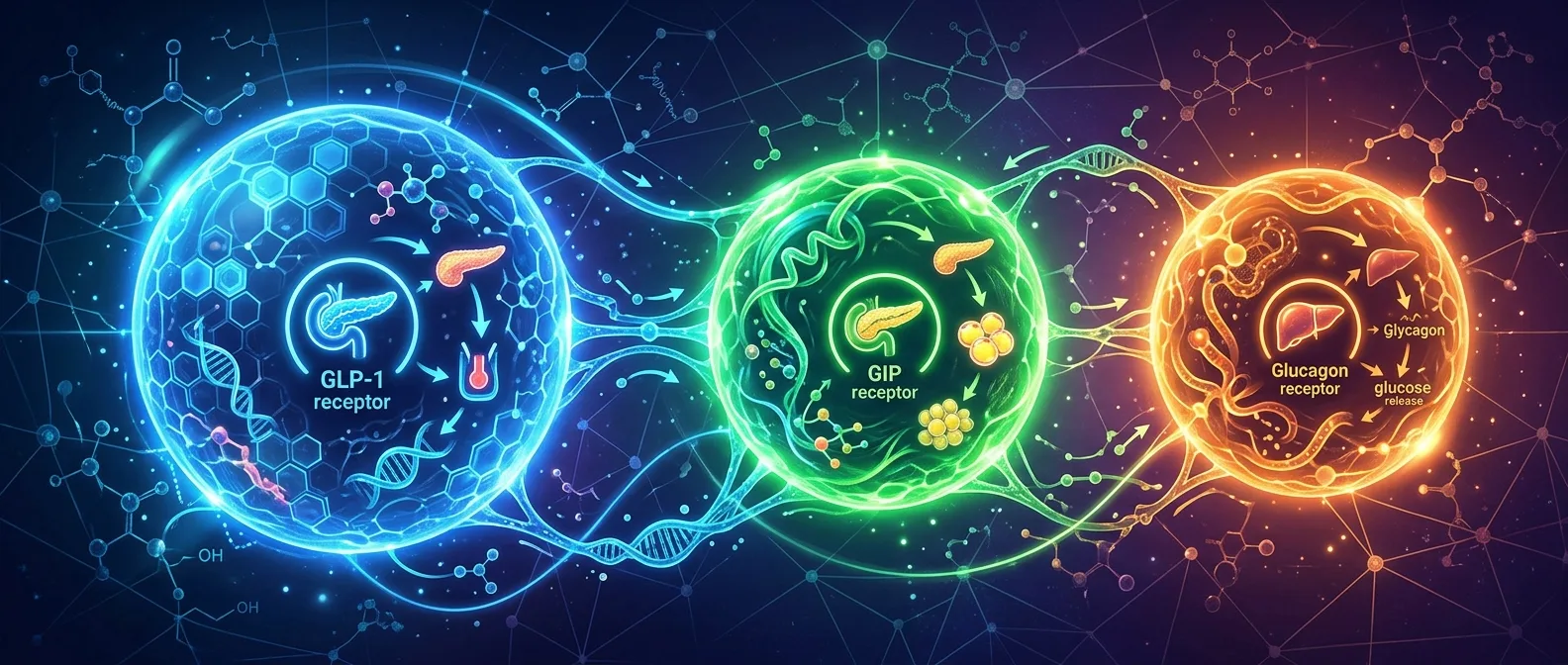
Understanding retatrutide requires understanding what each of its three receptor targets contributes independently — and why those contributions are partially distinct rather than redundant.
GLP-1 Receptor Activation
GLP-1R agonism forms the foundational pillar. When GLP-1R is activated, pancreatic beta cells increase insulin secretion in a glucose-dependent manner — meaning insulin release scales with ambient glucose, reducing hypoglycemia risk. Simultaneously, pancreatic alpha cells are suppressed, lowering endogenous glucagon. Gastric emptying slows, moderating postprandial glucose excursions. Critically, GLP-1R activation in the hypothalamus and via vagal afferents produces robust satiety signaling, which is the primary driver of reduced caloric intake in GLP-1-based therapies.
GIP Receptor Activation
GIPR agonism augments glucose-dependent insulin secretion and modulates adipose lipid metabolism. Its role in weight loss has been the subject of genuine mechanistic controversy: early rodent data appeared to favor GIPR antagonism as an obesity intervention, while human clinical data — most compellingly tirzepatide's superiority over semaglutide — validated agonism as the correct pharmacological direction in humans. Retatrutide takes this agonist position to a logical extreme, with potency at GIPR approximately 9-fold greater than endogenous GIP.
Glucagon Receptor Activation
GCGR agonism produces effects that are genuinely distinct from GLP-1R and GIPR activation. In the liver, glucagon promotes fatty acid oxidation and reduces hepatic steatosis — a mechanistically unique contribution with implications for MASH. In peripheral metabolic tissue, it activates thermogenic pathways including brown adipose tissue, increasing energy expenditure independent of caloric intake changes. In the hypothalamus, glucagon acts on specific neuronal populations to suppress appetite through a signaling pathway separate from GLP-1's vagal mechanism. Retatrutide therefore achieves appetite suppression through at least two distinct neural routes simultaneously.
The three-receptor profile delivers overlapping benefits in some domains — appetite suppression, insulin secretion — and genuinely additive benefits in others, particularly thermogenesis and hepatic lipid metabolism. The breakdown of distinct contributions helps explain why the clinical efficacy signal exceeds what either GLP-1 or dual GLP-1/GIP agonism produces alone.
Why Glucagon Was Historically Avoided — And How Retatrutide Changes That

The traditional objection to glucagon agonism in metabolic disease is straightforward and historically sound. Glucagon drives hepatic glycogenolysis and gluconeogenesis — the biochemical processes that raise blood glucose. In a patient already managing insulin resistance or frank type 2 diabetes, amplifying glucagon signaling would be expected to worsen glycemic control. For generations, the pharmacological goal was glucagon suppression, not activation.
What Eli Lilly's molecular engineers resolved is a problem of context. Glucagon's hyperglycemic effects are dangerous in isolation or in the absence of adequate insulinotropic counter-signaling. Retatrutide does not activate GCGR in isolation. The simultaneous co-activation of GLP-1R and GIPR stimulates insulin secretion in a glucose-dependent manner, providing a dynamic insulinotropic buffer against glucagon-driven glucose elevation. The Phase 2 TRIUMPH data confirmed this pharmacological reasoning was sound: despite incorporating glucagon receptor agonism, retatrutide reduced HbA1c by up to 2.02 percentage points in participants with type 2 diabetes at 24 weeks — a meaningfully favorable glycemic outcome.
This is a carefully engineered pharmacological balance, not a simple additive effect. The relative potency ratios across the three receptors are integral to maintaining glucose safety while preserving glucagon's thermogenic and hepatic lipid-clearing benefits. An imbalanced molecule with excessive GCGR potency relative to its insulinotropic components would tip the glucose equilibrium in the wrong direction. Retatrutide's design specifically avoids this — which is what separates it conceptually from any naive 'more receptors equals better outcome' framing.
Retatrutide's Receptor Potency Hierarchy: A GIPR-Dominant Molecule
One of the most technically important and least-discussed aspects of retatrutide's pharmacology is its asymmetric potency profile. It is not a balanced triple agonist. Phase 1 characterization data show that retatrutide's potency at GIPR is approximately 9-fold greater than that of endogenous GIP. Its potency at GLP-1R and GCGR, by contrast, is sub-endogenous to near-endogenous — meaning the native hormones actually outcompete retatrutide at those receptors under physiological conditions.
The relative receptor potency hierarchy looks like this: GIPR at roughly 9× supraphysiological, GLP-1R at sub-endogenous levels, and GCGR at sub-endogenous levels. These numbers highlight why describing retatrutide as simply a "triple agonist" undersells the deliberate design intent — it is a GIPR-dominant molecule that layers in GLP-1R and GCGR activity as complementary, not co-equal, mechanisms.
The scientific rationale connects directly to the tirzepatide data. GIPR hyperactivation is widely credited as a key driver of tirzepatide's superior weight loss over semaglutide — approximately 22.5% versus 15% mean body weight reduction in their respective pivotal trials. Retatrutide amplifies this GIPR-dominant mechanism further, while adding glucagon-mediated thermogenesis and hepatic lipid clearing that GLP-1/GIP dual agonism cannot achieve alone.
The GIPR agonism versus antagonism debate also resolves clearly in this context. Animal model data had suggested GIPR antagonism might be the more effective obesity intervention. Human clinical outcomes — first with tirzepatide, now with retatrutide — consistently validate agonism as the correct direction for human metabolic pharmacology. The 9-fold GIPR potency in retatrutide represents Lilly's pharmacological conviction in that conclusion.
Phase 2 TRIUMPH Trial: Clinical Data and Weight Loss Comparisons
The Phase 2 TRIUMPH-1 trial enrolled 338 adults with obesity or overweight and ran for 48 weeks. At the highest tested dose — retatrutide 12 mg once weekly — participants achieved a mean body weight reduction of 24.2% from baseline. The New England Journal of Medicine published these results in 2023, characterizing this as the largest mean weight loss reported for any pharmacological agent in a randomized controlled trial at that time.
The three-drug weight loss comparison across the incretin class is instructive. Semaglutide 2.4 mg (Wegovy) produced approximately 15% mean weight loss at 68 weeks in the STEP 1 trial. Tirzepatide 15 mg (Zepbound) produced approximately 22.5% at 72 weeks in SURMOUNT-1. Retatrutide 12 mg produced 24.2% at just 48 weeks in TRIUMPH Phase 2. The fact that retatrutide's superior efficacy signal emerged at a shorter observation window makes the result particularly noteworthy — weight loss curves in this class typically continue descending beyond 48 weeks.
These numbers highlight a consistent trajectory: each generation of incretin therapy has produced meaningfully greater weight reduction, with the gap between semaglutide and tirzepatide approximately 7.5 percentage points, and an additional ~1.7 points separating tirzepatide from retatrutide at interim comparison — with the caveat that cross-trial comparisons carry inherent methodological limitations.
Beyond body weight, Phase 2 metabolic data showed reductions in liver fat content confirmed by MRI-based assessment, consistent with potential MASH activity. HbA1c fell by up to 2.02 percentage points in type 2 diabetes participants, validating the glucagon receptor's metabolic safety within the triple-agonist construct. The adverse event profile was dominated by gastrointestinal effects — nausea reported in up to 42% of participants at higher doses, with vomiting and diarrhea also present — consistent with the GLP-1 class mechanism and titration-dependent in onset. No novel safety signals emerged in Phase 2 that would differentiate retatrutide from the established GLP-1 class profile.
Beyond Weight Loss: MASH, Cardiovascular Risk, and the Phase 3 Roadmap
The glucagon receptor's hepatic fat-clearing properties give retatrutide a potentially significant role in MASH — metabolic dysfunction-associated steatohepatitis — a liver disease for which no GLP-1 monotherapy currently holds regulatory approval. GCGR activation promotes hepatic fatty acid oxidation through mechanisms that are distinct from simple caloric restriction or weight-loss-mediated hepatic fat reduction, and the MRI-confirmed liver fat reductions seen in Phase 2 were sufficient to justify including a dedicated MASH arm in Phase 3 planning.
The Phase 3 TRIUMPH trial family mirrors the regulatory strategy Lilly used to expand tirzepatide from Mounjaro (type 2 diabetes) to Zepbound (obesity): separate studies for adults with obesity, adults with obesity and type 2 diabetes, a cardiovascular outcomes study powered for MACE endpoints, and a MASH-specific trial. The TRANSCEND cardiovascular trial is designed to capture the effects of retatrutide on triglycerides, LDL-C, blood pressure, and major adverse cardiovascular events — leveraging both the weight loss benefits and the hepatic lipid-clearing properties unique to glucagon receptor activation.
As of 2024–2025, no regulatory filing has been submitted to the FDA or EMA for retatrutide. The earliest realistic approval timeline, contingent on successful Phase 3 data readouts across these parallel trials, is 2026. The Phase 2 signal is compelling, but Phase 3 data — with larger populations, longer follow-up, and harder clinical endpoints — will determine whether the mechanism-first promise translates into a regulatory-grade clinical profile.
How Does Retatrutide Compare to Semaglutide and Tirzepatide?
Positioning retatrutide within the incretin class requires comparing it across mechanism, efficacy, trial duration, dosing, and regulatory status simultaneously. Semaglutide (Wegovy/Ozempic) activates GLP-1R only, produces approximately 15% mean weight loss at 68 weeks via STEP 1, is dosed at up to 2.4 mg weekly subcutaneously, and holds full FDA approval for both obesity and type 2 diabetes. Tirzepatide (Zepbound/Mounjaro) activates GLP-1R and GIPR, produces approximately 22.5% mean weight loss at 72 weeks via SURMOUNT-1, is dosed at up to 15 mg weekly subcutaneously, and holds full FDA approval for obesity and type 2 diabetes. Retatrutide activates GLP-1R, GIPR, and GCGR, has produced 24.2% mean weight loss at 48 weeks in Phase 2, is dosed at up to 12 mg weekly subcutaneously, and remains investigational with no regulatory filing submitted as of 2024–2025.
The breakdown illustrates a coherent scientific narrative: each generation adds a receptor layer with an explicit metabolic justification rather than simply layering targets. The GCGR component is the only one in the class that introduces genuine thermogenic capacity and direct hepatic lipid-clearing effects — mechanisms that GLP-1R or GIPR activation alone cannot replicate.
Preclinical rodent data from Lilly's internal development work showed that the triple-agonist approach produced greater fat mass reduction and better lean mass preservation compared to dual GLP-1/GIP agonism. Lean mass preservation is a clinically important consideration in any weight-loss intervention, since GLP-1-class agents as a group have been associated with some loss of lean tissue alongside fat loss. Whether this preclinical lean mass advantage translates into human Phase 3 data is a key open question — one that the TRIUMPH obesity trial is positioned to answer.
Key Takeaways
Retatrutide is not a drug that works simply by activating more receptors. It is a precisely engineered, GIPR-dominant triple agonist whose three receptor targets serve distinct, partially overlapping, and mutually reinforcing metabolic functions. The glucagon receptor component — historically considered incompatible with anti-diabetic therapy — is rendered pharmacologically safe by the glucose-dependent insulinotropic coverage provided by simultaneous GLP-1R and GIPR co-activation. This is the engineering insight at the molecule's core, and the Phase 2 HbA1c data confirm it holds in humans at therapeutic doses.
The Phase 2 TRIUMPH results position retatrutide as the highest-efficacy pharmacological weight-loss agent tested in a randomized trial as of its publication — a distinction that carries particular weight given the shorter observation window relative to comparators. The additional signals in hepatic fat, glycemic control, and metabolic risk factors across the trial's secondary endpoints suggest the glucagon layer is contributing meaningfully beyond placebo effects of body weight reduction alone.
Phase 3 data across obesity, type 2 diabetes, MASH, and cardiovascular outcomes will ultimately determine whether retatrutide's mechanistic design translates into a regulatory-grade, broadly applicable clinical profile. Within the broader incretin platform evolution, it represents the current frontier of rational receptor polypharmacology — a field that has moved from single-target GLP-1 agents to a carefully titrated three-way receptor engagement in under a decade. Molecule Notes will continue tracking Phase 3 TRIUMPH and TRANSCEND data as readouts emerge. Subscribe to the Molecule Notes newsletter to receive in-depth analysis as new data becomes available.
Sources
- prnewswire.com — prnewswire.com
- patsnap.com — synapse.patsnap.com
- nih.gov — pmc.ncbi.nlm.nih.gov
- infiniskin.com — infiniskin.com
- universaldrugstore.com — universaldrugstore.com
- wikipedia.org — en.wikipedia.org
- nih.gov — pubmed.ncbi.nlm.nih.gov
- prnewswire.com — prnewswire.com
- nih.gov — pubmed.ncbi.nlm.nih.gov
- adameetingnews.org — adameetingnews.org
- sio-obesita.org — sio-obesita.org
- healio.com — healio.com
- bmj.com — bmj.com
- lilly.com — investor.lilly.com
- clinicaltrials.gov — clinicaltrials.gov
- clinicaltrials.gov — clinicaltrials.gov
- pace-cme.org — pace-cme.org