
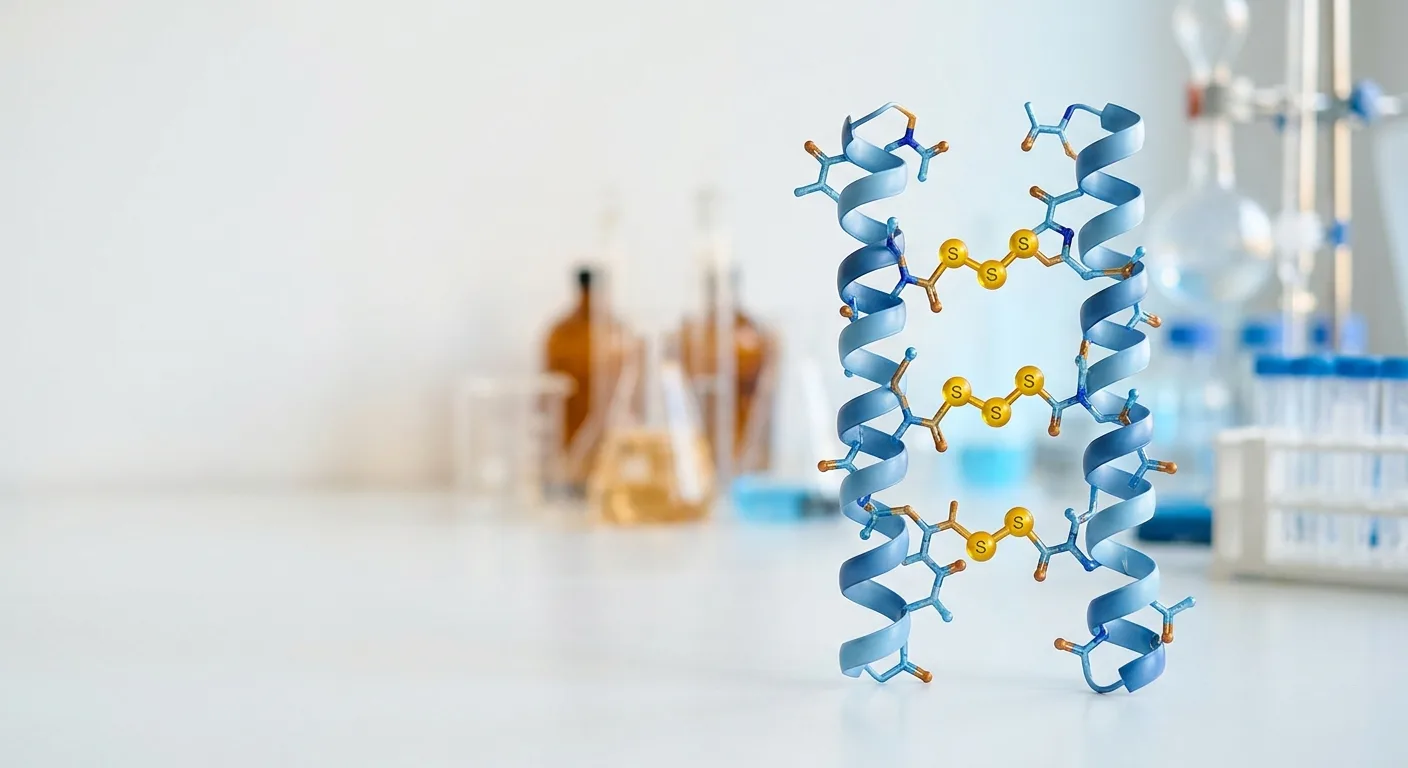
Insulin has been administered to humans for more than a century. It is one of the most studied, most manufactured, and most clinically consequential peptides in the history of medicine. Without two disulfide bonds connecting its A and B chains, it would be a disordered string of amino acids with no capacity to bind its receptor. The bonds are not a refinement. They are a prerequisite. Disulfide bond formation in peptide synthesis through oxidation and cyclization represents one of the most critical steps in creating functional therapeutic molecules.
That structural fact points toward a deeper tension in peptide chemistry. The oxidation reaction that locks a peptide into its functional three-dimensional shape is also one of the most technically demanding steps in its synthesis. Scrambled isomers form when thiol groups pair incorrectly. Competing side reactions modify sensitive residues. Yields can collapse without warning when conditions shift by a fraction. For peptides with multiple cysteine pairs, the problem compounds rapidly.
This article examines the four principal strategies used in laboratories to achieve disulfide bond formation in peptide synthesis: air oxidation, iodine-mediated oxidation, DMSO-mediated oxidation, and glutathione redox buffer systems. Each method represents a distinct set of tradeoffs. The evidence on yield, purity, and selectivity varies considerably across published literature, and no universally optimal approach has emerged. The comparative picture is what matters here, along with an honest account of where the chemistry remains unresolved.
Why Disulfide Bonds Matter in Peptide Chemistry
A disulfide bond forms when two cysteine residues, each carrying a free thiol group (-SH), undergo oxidation. The reaction removes two hydrogen atoms, one from each thiol, and produces a covalent sulfur-sulfur bond. The mass consequence is precise: each bond formed reduces the peptide's molecular weight by 2 Daltons, a figure that becomes analytically useful when monitoring the reaction by mass spectrometry.
The structural consequence is significant. A disulfide bond constrains the peptide backbone, forcing specific segments into fixed spatial relationships. This reduces conformational entropy, meaning the peptide has fewer available shapes. For biologically active peptides, that constraint is the point. The reduced conformational flexibility concentrates the peptide in its active shape and, as a secondary effect, makes it more resistant to proteolytic degradation, since the constrained backbone presents fewer accessible cleavage sites to proteases.
The range of approved therapeutic peptides that depend on disulfide architecture is instructive. Insulin carries two interchain disulfide bonds linking its A and B chains, plus one intramolecular bond within the A chain. Oxytocin, the nine-residue neuropeptide, contains one intramolecular disulfide bond. Linaclotide, a 14-residue peptide approved for irritable bowel syndrome treatment, requires two disulfide bonds for its activity. A 2022 analysis published in Molecules examining FDA-approved peptides identified disulfide-containing compounds as a structurally significant category across the approved peptide drug landscape.
Among approved therapeutic peptides, roughly 20 percent contain at least one disulfide bond. Insulin has 3 total bonds, oxytocin has 1, and linaclotide has 2. These numbers highlight how frequently the oxidation step sits at the center of synthesis, not at its periphery.
The Linear Peptide Problem: When Disulfide Bond Formation and Oxidation Cyclization Goes Wrong
Solid-phase peptide synthesis, the dominant manufacturing method for peptides up to roughly 50 residues, produces a linear, fully reduced peptide as its output. All cysteine residues carry free thiol groups. No disulfide bonds are present. Oxidation is a separate, subsequent step, and it is not straightforward.
The fundamental problem is selectivity. For a peptide with two cysteine pairs, three distinct disulfide arrangements are chemically possible. Only one is typically biologically active. The other two are scrambled isomers: structurally distinct molecules with incorrect connectivity that are, in most cases, inert. According to Current Protocols in Protein Science, the scrambled isomer problem scales sharply with peptide complexity. For a peptide containing three disulfide bonds, the number of possible incorrect pairings rises to fourteen. Only one arrangement is correct.
Scrambled isomers are also notoriously difficult to separate from the correctly folded product. They often share very similar physicochemical properties, because the same atoms are present in all isomers and only their connectivity differs. High-performance liquid chromatography, or HPLC, is the primary analytical tool for tracking oxidation progress. The reduced linear peptide and the oxidized cyclic product have distinct retention times due to the conformational change introduced by cyclization. As oxidation proceeds, the HPLC chromatogram shows a diminishing peak for the linear form and a growing peak for the product. Mass spectrometry provides complementary confirmation: a 2 Da mass decrease per bond formed is an unambiguous signal of successful oxidation.
The analytical challenge is that scrambled isomers and correctly folded peptides can co-elute on HPLC, sharing nearly identical retention times. Distinguishing them sometimes requires orthogonal methods or, in the case of bioactive peptides, functional activity assays.
Air Oxidation: The Simplest Method and Its Limits
Air oxidation is the oldest and technically simplest strategy. The peptide is dissolved in an aqueous buffer at a slightly alkaline pH, typically between 8.0 and 8.5, and atmospheric oxygen does the oxidative work. No added chemical reagent is required. The mild conditions are a genuine practical advantage: they minimize the risk of side reactions on residues sensitive to harsher reagents, particularly tyrosine and tryptophan.
The tradeoffs are substantial. According to the International Journal of Peptide Research and Therapeutics, air oxidation is slow, requiring hours to days for completion, and yields are variable. For short peptides carrying a single cysteine pair and no sensitive aromatic residues, the method can be adequate. For more complex sequences, it often is not.
The primary failure mode is concentration-dependent. At higher peptide concentrations, intermolecular oxidation competes with intramolecular oxidation. Two thiol groups from different peptide molecules react with each other rather than within the same chain, producing dimers, oligomers, and aggregates. The desired intramolecular disulfide bond never forms. Dilute conditions mitigate this problem but extend reaction times and reduce throughput. Air oxidation yields for simple peptides typically range from 40 to 70 percent. For complex multi-disulfide sequences, yields can fall below 20 percent.
Chemical Oxidants: Speed, Control, and Selectivity Tradeoffs
Chemical oxidants accelerate disulfide bond formation considerably, but each introduces its own constraints.
Iodine is the fastest option. At micromolar concentrations in an appropriate solvent, iodine drives thiol oxidation to near-completion within minutes. The speed is an operational advantage for industrial-scale synthesis where reaction time is a cost factor. The documented liability is chemoselectivity. Iodine reacts not only with thiol groups but also with electron-rich aromatic systems. Tyrosine and tryptophan residues are susceptible to iodination under these conditions, per Fernando Albericio's Solid-Phase Peptide Synthesis: A Practical Approach. For peptides that contain these residues, iodine oxidation produces a heterogeneous mixture of modified byproducts that complicate purification.
DMSO, dimethyl sulfoxide, is a milder alternative. It oxidizes thiol groups more slowly than iodine but with a cleaner reaction profile. Side reactions on tyrosine and tryptophan are substantially reduced. DMSO is widely used in laboratory settings as a practical compromise between speed and selectivity. Typical yields under optimized DMSO conditions range from 50 to 75 percent for single-disulfide peptides, with purity of the crude product generally higher than what air oxidation produces.
A structured comparison of the three methods across four parameters illustrates the tradeoffs clearly. Reaction speed: iodine requires minutes, DMSO requires one to four hours, and air oxidation requires hours to days. Typical yield range for single-disulfide peptides: iodine achieves 60 to 85 percent, DMSO achieves 50 to 75 percent, and air oxidation achieves 40 to 70 percent. Purity of crude product: iodine is lowest due to aromatic side reactions, DMSO is moderate, and air oxidation is moderate but aggregate-prone. Residue sensitivity constraints: iodine is incompatible with tyrosine and tryptophan, DMSO has minimal constraints, and air oxidation has concentration constraints rather than residue constraints. The breakdown illustrates why no single chemical oxidant dominates practice across all sequence types.
A critical limitation applies to all three methods. None of them directs thiol groups toward the correct pairing. They oxidize whichever thiol groups are in proximity when the reaction occurs. For single-disulfide peptides, this is not a problem. For multi-disulfide peptides, it is a serious one.
Redox Buffer Systems and Oxidative Folding
Glutathione redox buffer systems take a fundamentally different approach. Rather than driving oxidation directly, they create conditions that allow a peptide to explore multiple disulfide arrangements and converge on the most thermodynamically stable one.
The system uses a mixture of reduced glutathione (GSH) and oxidized glutathione (GSSG). The ratio of these two forms determines the redox potential of the solution. This combination mimics the oxidative environment of the endoplasmic reticulum, the cellular compartment where most secreted disulfide-containing proteins fold in vivo. According to a methodology published in Nature Protocols, the mechanism operates through disulfide bond shuffling. A peptide can form an incorrect disulfide bond, break it via thiol-disulfide exchange with GSH, and reform a different bond. This process repeats until the peptide reaches its thermodynamically favored conformation, which, for most biologically active sequences, corresponds to the correct disulfide connectivity.
The practical consequence for multi-disulfide peptides is significant. Glutathione redox buffer systems produce substantially higher yields of the correct isomer compared to air or chemical oxidation, particularly for peptides with two or more disulfide bonds. The cost is time and complexity. Reactions run for hours to days, and the buffer conditions, specifically the GSH:GSSG ratio, pH, temperature, and peptide concentration, require optimization for each new sequence. Standard conditions that work for one peptide may produce poor yields for another with a similar cysteine count.
The open question is practical: how to predict optimal glutathione buffer conditions from sequence information alone, without empirical screening. Published yield data across varying GSH:GSSG ratios suggests that the relationship between buffer composition and yield is nonlinear and sequence-dependent. Several computational groups are currently working on predictive models, though no validated approach has yet been published at scale.
Monitoring Oxidation: HPLC and Mass Spectrometry
Analytical monitoring is not an afterthought in disulfide chemistry. It is integral to the synthesis strategy.
HPLC tracks the reaction in real time. The linear, reduced peptide and the cyclized, oxidized product adopt different conformations, which translates to different interactions with the stationary phase and distinct retention times on a reversed-phase column. As oxidation proceeds, the chromatogram shows the linear peptide peak diminishing and the cyclized product peak growing. For multi-disulfide peptides, intermediate peaks corresponding to partially oxidized species appear transiently before resolving into the final product.
Mass spectrometry provides the complementary bond-count confirmation. Each disulfide bond formed reduces the peptide mass by exactly 2 Da. A peptide forming two bonds shows a 4 Da total mass reduction relative to the fully reduced linear form. This provides unambiguous confirmation of bond count, independent of retention time data.
The analytical limitation is the co-elution problem. Scrambled isomers often share retention times with the correctly folded product, because their overall shape and charge distribution can be nearly identical despite different connectivity. In practice, this means that a clean-looking HPLC trace does not always guarantee a pure, correctly folded product. Orthogonal analytical methods, such as nuclear magnetic resonance spectroscopy or enzymatic activity assays, are sometimes required to confirm correct connectivity, particularly for novel sequences where no reference standard exists.
Choosing an Oxidation Strategy: A Comparative Framework
The choice of oxidation method follows from peptide complexity and residue composition.
For peptides with a single disulfide bond and no aromatic residues at risk of modification, air oxidation or DMSO are generally adequate. The conditions are manageable, the yields are acceptable, and the analytical burden is lower. For peptides with two disulfide bonds that contain tyrosine or tryptophan, DMSO is preferred over iodine, given the documented side reaction risks. For peptides with three or more disulfide bonds requiring correct pairing, glutathione redox buffer systems are the most appropriate starting point, despite their operational complexity.
A summary comparison across all four parameters illustrates the method hierarchy. For reaction speed, iodine ranks first (minutes), DMSO ranks second (one to four hours), air oxidation ranks third (hours to days), and glutathione buffers rank last (hours to days). For yield in multi-disulfide peptides specifically, glutathione buffers rank first, DMSO ranks second, air oxidation ranks third, and iodine ranks last due to side product formation. For crude purity, DMSO and glutathione buffers outperform iodine and air oxidation. These numbers highlight the sequence-dependent nature of the decision; no single method dominates across all criteria simultaneously.
An emerging alternative that the comparative literature increasingly references is orthogonal cysteine protecting group strategies. By equipping different cysteine residues with chemically distinct protecting groups that are removed under different conditions, chemists can direct disulfide bond formation sequentially rather than simultaneously. A first pair of cysteines is deprotected and oxidized before a second pair is exposed. This approach removes the scrambled isomer problem almost entirely, at the cost of substantially more complex synthesis planning and additional synthetic steps. For three-disulfide peptides such as conotoxins and certain enzyme inhibitors, it is becoming the standard approach in leading synthesis laboratories.
The analytical pipeline is not separable from the strategy choice. Whichever oxidation method is selected determines what monitoring is required and what purification steps follow. A peptide oxidized under iodine conditions requires HPLC fractionation capable of separating iodinated byproducts. A peptide folded under glutathione conditions requires monitoring of buffer components and potentially multiple purification passes to achieve the purity required for characterization.
The chemistry of disulfide bond formation in peptide synthesis sits at an intersection of precision and unpredictability. Air oxidation, iodine, DMSO, and glutathione redox buffers each represent a different negotiation between speed, selectivity, yield, and analytical complexity. No universally optimal method has emerged from the published literature, and the choice remains sequence-dependent in ways that cannot yet be fully predicted from first principles.
What is clear, from decades of work on peptides ranging from oxytocin to linaclotide, is that the oxidation step is not a footnote to synthesis. For cysteine-rich peptides, it is the step on which biological activity depends. Scrambled isomers do not activate receptors. Aggregates do not circulate. Getting the connectivity right is not optional.
Open questions remain about how to predict optimal conditions for a given sequence without empirical screening. Several research groups are currently investigating computational approaches, including molecular dynamics simulations and machine learning models trained on published folding data. Whether those approaches will reduce the burden of empirical optimization, or whether sequence-specific unpredictability will persist, is not yet resolved. The field is active, the chemistry is consequential, and the published data leaves substantial room for further work.
Stay current with peptide chemistry research. Subscribe to the Molecule Notes newsletter for rigorous, sourced analysis of synthesis methodologies, analytical techniques, and emerging findings in peptide science, delivered to researchers and curious readers who want more than surface-level coverage.
Sources
- nih.gov — pmc.ncbi.nlm.nih.gov
- benchchem.com — pdf.benchchem.com
- acs.org — pubs.acs.org
- creative-peptides.com — creative-peptides.com
- altabioscience.com — altabioscience.com
- nih.gov — pubmed.ncbi.nlm.nih.gov
- nih.gov — pmc.ncbi.nlm.nih.gov
- acs.org — pubs.acs.org
- researchgate.net — researchgate.net
- biotage.com — biotage.com
- nih.gov — pmc.ncbi.nlm.nih.gov
- acs.org — pubs.acs.org
- nih.gov — pmc.ncbi.nlm.nih.gov
- nih.gov — pmc.ncbi.nlm.nih.gov
- nih.gov — pmc.ncbi.nlm.nih.gov
- biotage.com — biotage.com