
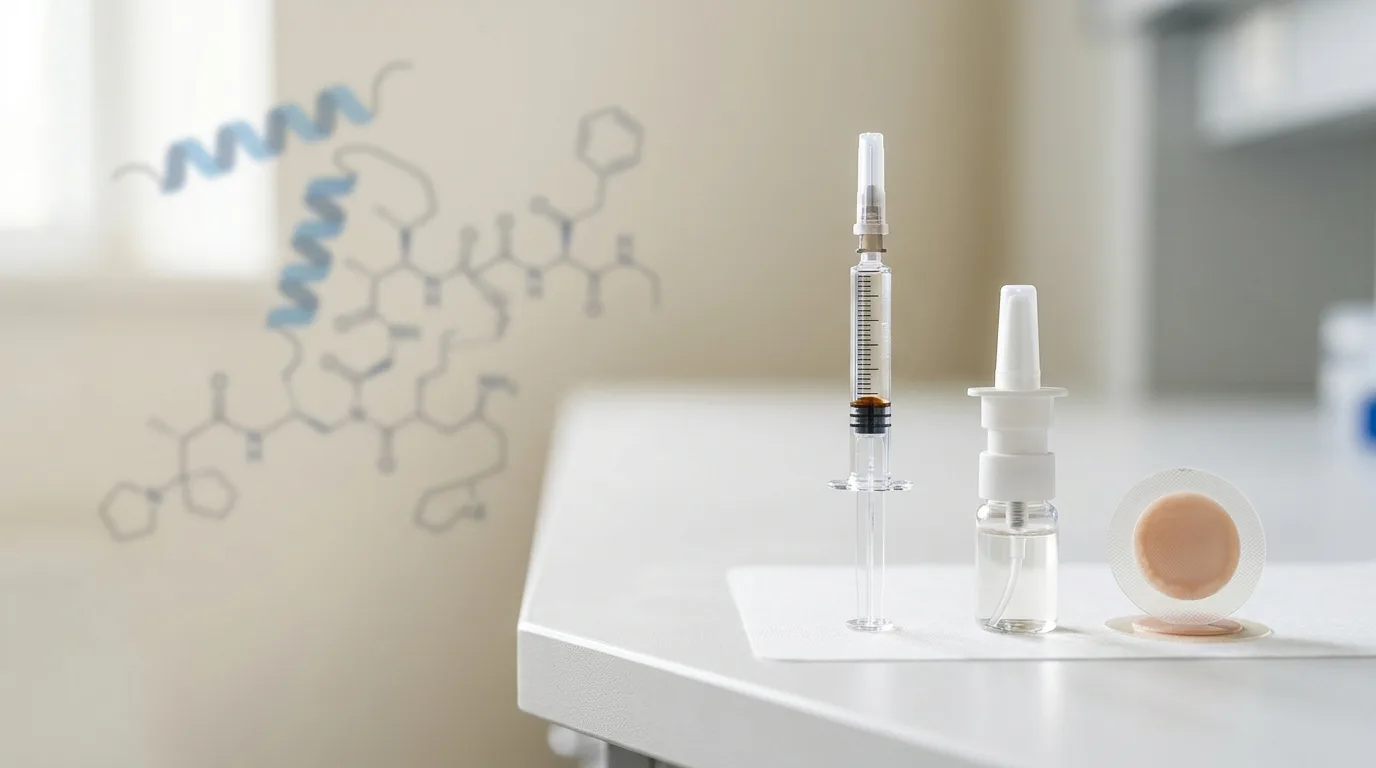
Desmopressin, a synthetic analog of the antidiuretic hormone vasopressin, achieves roughly 85% absolute bioavailability via subcutaneous injection. Via standard intranasal spray, the same molecule achieves approximately 0.16%. The two administration sites are anatomically close. The systemic exposure they produce is separated by orders of magnitude. According to data published in Clinical Pharmacokinetics, this disparity is not an artifact of a poorly designed formulation or an outlier peptide. It is a precise illustration of why peptide bioavailability subcutaneous intranasal transdermal delivery comparison is one of the more consequential problems in pharmaceutical science.
The body is exceptionally efficient at destroying peptides before they reach their target. Enzymatic barriers, physical membrane exclusion, and rapid clearance mechanisms operate at nearly every surface a peptide might encounter. The route of administration is not a logistical footnote to peptide pharmacology. It is a primary determinant of whether a compound produces any measurable systemic or tissue-level effect at all.
Three routes structure most of the current clinical and experimental literature on non-oral peptide delivery. Subcutaneous injection remains the established benchmark. Intranasal delivery offers speed and a plausible, if contested, pathway to the central nervous system. Transdermal delivery holds theoretical appeal but faces barriers that unassisted formulations cannot overcome. Each route can be evaluated across five parameters: mechanism of absorption, bioavailability and time to maximum concentration (Tmax), key limitations, ideal peptide candidates, and the state of emerging research. The comparison that follows treats those parameters as a framework, not a ranking.
Why Peptides Resist Conventional Delivery
Peptides are chains of amino acids, typically between 2 and 50 residues in length. They are, as a class, predominantly large and hydrophilic -- properties that create compounding delivery barriers at virtually every biological interface. A molecule's hydrophilicity makes passive diffusion across lipid-rich membranes thermodynamically unfavorable. Its size places it above the thresholds that govern passive transport into cells and across epithelial layers.
The 500 Dalton (Da) rule, a widely cited heuristic in membrane pharmacology, holds that passive diffusion across biological membranes becomes negligible for molecules exceeding that molecular weight. Most therapeutically relevant peptides exceed it substantially. Insulin, at roughly 5,800 Da, is more than eleven times that threshold. Even smaller neuropeptides, such as oxytocin at approximately 1,007 Da, sit above it.
Two destruction mechanisms operate in parallel. Enzymatic proteolysis is the more immediate: peptidases are present in nasal mucosa, skin layers, the bloodstream, and subcutaneous tissue. They cleave peptide bonds rapidly and with little selectivity. Physical exclusion by biological membranes is the second mechanism, operating independently of enzymatic activity and determined primarily by molecular weight and lipophilicity.
Molecular weight functions as a structuring variable throughout any peptide delivery route comparison. Small neuropeptides, generally under 1,000 Da, behave differently across every route than large systemically acting peptides in the 2,000 to 10,000 Da range. That distinction recurs in every section that follows.
Subcutaneous Injection: The Benchmark Route for Peptide Bioavailability Subcutaneous Intranasal Transdermal Delivery Comparison
Subcutaneous injection deposits a peptide into the adipose tissue layer beneath the skin. From there, absorption proceeds through two pathways depending on molecular size. Smaller peptides are taken up directly into capillary networks. Larger molecules, particularly those above roughly 16,000 Da, are preferentially absorbed via lymphatic drainage, which operates more slowly and introduces additional variability into absorption kinetics.
The bioavailability data for subcutaneous peptide delivery is the strongest available across any non-intravenous route. Insulin lispro achieves 80 to 100% absolute bioavailability via subcutaneous injection, according to published pharmacokinetic characterizations. When examining peptide bioavailability subcutaneous intranasal transdermal delivery comparison, desmopressin reaches approximately 85%, reflecting the relative absence of enzymatic destruction and the proximity of subcutaneous capillary networks to the injection depot. These figures illustrate a consistent pattern: SC injection reliably delivers the majority of the administered peptide mass into systemic circulation, a claim that cannot be made for the other routes under examination.
Tmax for subcutaneous peptide delivery typically falls between 30 and 90 minutes, according to data compiled in Drug Delivery and Translational Research. That range reflects genuine variability driven by formulation characteristics, injection site anatomy, local blood flow, subcutaneous fat thickness, and body temperature. Exercise increases regional blood flow and accelerates absorption. A thicker adipose layer slows it. These are not resolved variables -- they are ongoing sources of pharmacokinetic variability in clinical practice.
Subcutaneous injection is not suited to peptides requiring central nervous system (CNS) access. The blood-brain barrier (BBB), a tightly regulated endothelial interface, excludes most peptides from the brain regardless of how reliably they reach systemic circulation. A peptide achieving 85% systemic bioavailability via SC injection still faces near-total exclusion from CNS tissue if it lacks specific transport mechanisms. That constraint defines the ceiling of what SC injection can accomplish for neuroactive compounds.
The ideal candidates for subcutaneous delivery are large, hydrophilic peptides requiring sustained systemic exposure and predictable pharmacokinetics. GLP-1 receptor agonists, insulin analogs, and peptide hormones with peripheral targets fit this profile. The published pharmacokinetic record for these compounds via SC injection is extensive and, by the standards of peptide delivery, relatively consistent.
Intranasal Delivery: Speed, Access, and the BBB Question
The nasal mucosa is highly vascularized. Peptides deposited on its surface can be absorbed into systemic circulation within minutes, producing Tmax values in the 15 to 30 minute range -- faster than subcutaneous injection for the systemic route, according to reviews in Advanced Drug Delivery Reviews. That speed comes at a severe cost to total exposure. Systemic bioavailability for intranasally administered peptides typically falls between less than 1% and 10%. The desmopressin figure, 0.16%, sits at the extreme low end of that range but is not outside it. These numbers highlight a fundamental trade-off that cannot be resolved by formulation optimization alone without structural changes to how peptides are protected and delivered.
Two absorption mechanisms operate via the intranasal route, and they are frequently conflated in the popular science literature. The first is conventional transmucosal absorption into systemic circulation through the vascular network underlying the nasal epithelium. The second is direct nose-to-brain transport via the olfactory and trigeminal nerve pathways. These are anatomically and mechanistically distinct. The olfactory nerve pathway, in particular, runs from the olfactory epithelium in the upper nasal cavity through the cribriform plate directly into the olfactory bulb, potentially bypassing the blood-brain barrier entirely.
Evidence from rodent models for the olfactory transport pathway is substantial. Multiple groups have characterized this route in animal models using radiolabeled peptides and imaging techniques. Translation to human CNS exposure, however, remains an open and actively contested question. The human olfactory epithelium is proportionally smaller than in rodents, and access to the olfactory region with standard nasal spray devices is inconsistent. Whether the nose-to-brain pathway produces pharmacologically meaningful CNS concentrations in humans has not been definitively established in the published literature as of the most recent reviews.
Beyond the BBB question, intranasal delivery faces several practical limitations that constrain its utility. Mucociliary clearance, the coordinated sweeping motion of nasal epithelial cilia, empties the nasal cavity of deposited material in roughly 15 to 20 minutes. Proteases in the nasal epithelium degrade peptides independently of mucociliary clearance. Volume limitations, typically under 200 microliters per nostril for effective deposition, constrain the mass that can be practically administered. The combination produces a delivery window that is simultaneously short and enzymatically hostile.
The peptide candidates for which intranasal delivery is most studied and mechanistically supported are small neuropeptides targeting CNS action, specifically those for which the olfactory transport hypothesis carries the most experimental weight. Semax and Selank, both studied in the Russian and Eastern European pharmacology literature, are cited as examples of small neuropeptides administered intranasally with CNS-targeted rationale. Conflicts between animal model findings and human pharmacokinetic data remain present and should not be minimized in any honest assessment of the route's potential.
Penetration Enhancers for Intranasal Peptides
Formulation researchers have investigated chemical penetration enhancers as a strategy for improving intranasal peptide absorption. Chitosan, a polysaccharide derived from crustacean shells, and cyclodextrins, cyclic oligosaccharide molecules, have received the most characterization. Both function by transiently opening epithelial tight junctions, extending the window during which peptides can cross the nasal epithelium into the submucosal vasculature.
The trade-off is not trivial. Repeated opening of tight junctions raises questions about mucosal integrity and tolerability with chronic use. According to reviews in Molecules, this remains an active area of formulation research, not a solved problem. Agents that improve bioavailability in acute studies may produce tolerability concerns that constrain their use in conditions requiring repeated or long-term administration.
Current research directions include mucoadhesive formulations designed to prolong nasal residence time beyond the mucociliary clearance window, nanoparticle carriers that protect peptides from enzymatic degradation while improving mucosal contact, and thermosensitive gels that transition to a semi-solid state after deposition. Each approach addresses one or more of the intranasal route's structural limitations, though none has yet produced a formulation platform with broad clinical adoption.
Transdermal Delivery: The Stratum Corneum Problem
The outermost layer of human skin, the stratum corneum, is approximately 10 to 20 micrometers thick. It is composed primarily of terminally differentiated, lipid-rich keratinocytes arranged in a structure that functions as a near-impermeable barrier to water loss and environmental insult. For peptide delivery, it is the primary obstacle, and it is formidable.
The stratum corneum's lipophilic architecture excludes hydrophilic molecules by thermodynamic preference. The 500 Da passive diffusion threshold applies here with particular force. Unassisted transdermal bioavailability for peptides is typically less than 1%, according to characterizations published in Pharmaceutics. For most therapeutically relevant peptides, the actual figure is functionally zero under passive conditions. A molecule like semaglutide, at roughly 4,114 Da, has no plausible passive transdermal transport mechanism. The same is true for the vast majority of clinically studied peptides.
The appeal of transdermal delivery is not scientific but practical. A patch-based system would eliminate injection burden, provide sustained-release kinetics, avoid first-pass hepatic metabolism, and potentially improve adherence in chronic-use populations. These are legitimate clinical priorities. They explain why research investment in transdermal peptide delivery has continued despite what the basic membrane physics would suggest about its feasibility.
Enzymatic activity within the viable epidermis and dermis adds a secondary challenge. Peptides that somehow penetrate the stratum corneum encounter peptidases in deeper skin layers before reaching dermal capillaries. The combination of physical exclusion and enzymatic degradation makes unassisted transdermal delivery scientifically implausible for almost any peptide of clinical relevance. This is not a matter of inadequate formulation technology at the margins; it is a structural constraint of the delivery route itself.
Emerging Technologies: Microneedles and Physical Enhancement
Dissolving microneedle patches represent the most clinically advanced attempt to circumvent the stratum corneum without conventional injection. These patches consist of arrays of microscale needles, typically ranging from 25 to 1,000 micrometers in height, fabricated from water-soluble polymers loaded with a peptide payload. When applied to skin, the needles penetrate the stratum corneum and upper epidermis without reaching nerve endings in the deeper dermis, dissolving in situ and releasing the peptide cargo directly below the primary barrier layer.
Researchers at several institutions have published characterizations of insulin delivery via dissolving microneedle patches. Findings reported in Nature Biomedical Engineering identified glucose-lowering effects comparable to those produced by subcutaneous injection in animal models, representing a meaningful proof-of-concept for the platform. Whether those findings translate to reproducible bioavailability equivalence in human populations across diverse skin conditions, body sites, and ambient temperatures remains an open question.
Iontophoresis and sonophoresis represent two additional physical enhancement strategies studied in laboratory settings. Iontophoresis applies a low electrical current to the skin surface, temporarily disrupting the barrier and creating an electroosmotic flow that can carry charged peptide molecules across it. Sonophoresis applies low-frequency ultrasound, which generates cavitation in the intercellular lipid matrix and transiently increases skin permeability. Both techniques have been characterized in peer-reviewed literature. Neither has achieved broad clinical deployment for peptide delivery as of the current published record.
Open questions for microneedle platforms include scalability of manufacturing, cold-chain requirements for peptide stability within the polymer matrix, regulatory classification, and whether bioavailability improvements are reproducible across the range of patient skin types and conditions that a commercial therapeutic would encounter. Research groups publishing in Nature Biomedical Engineering and Advanced Drug Delivery Reviews continue to work toward answers, but those answers are not yet in hand.
Matching Peptide Class to Delivery Route
The published literature supports a conditional rather than universal framework for peptide delivery route selection. Peptide characteristics, specifically molecular weight, target site, required onset speed, and whether the therapeutic target is systemic or CNS-located, are the primary determinants of route compatibility. Stability in the chosen biological environment, required pharmacokinetic profile, and the patient population in question are co-determining factors that cannot be separated from molecular characteristics alone.
Small neuropeptides, generally under 1,000 Da, intended for CNS action represent the strongest published case for intranasal delivery. The olfactory transport hypothesis provides mechanistic rationale for why this route might produce CNS exposure that systemic routes cannot. For this peptide class, the limitations of intranasal delivery, low systemic bioavailability and rapid clearance, are less consequential if the therapeutic target is the central nervous system rather than peripheral tissue. The caveat is that rodent-to-human translation of the olfactory pathway's functional contribution remains incompletely characterized.
Large systemically acting peptides, GLP-1 receptor agonists and insulin analogs being the most extensively published examples, are best matched to subcutaneous injection by a substantial margin. The bioavailability data, the pharmacokinetic predictability, and the clinical track record consistently favor SC injection for this peptide class. No alternative route has produced comparable bioavailability figures for molecules of this size and hydrophilicity without physical enhancement technology.
An emerging middle ground involves peptides that are too large for passive transdermal diffusion but for which needle-free delivery represents a genuine clinical priority, particularly in pediatric populations or conditions requiring very long-term administration. Microneedle platforms are the most active research space for this category. The suitability distribution by peptide class, weighted by molecular weight and target site, shows SC injection as the dominant route for large systemically acting peptides, intranasal delivery as the studied route for small CNS-targeted neuropeptides, and transdermal enhancement technologies as an unresolved frontier for the middle-weight range. The breakdown reflects where the evidence currently sits, not where the field aspires to go.
The comparison resolves not into a hierarchy but into a conditional framework. Subcutaneous injection remains the most bioavailability-reliable route, and the published pharmacokinetic record, from insulin lispro to desmopressin, consistently confirms that position. Intranasal delivery's value is not systemic bioavailability, which is low and variable, but the plausible and not yet fully characterized direct pathway to the central nervous system. Transdermal delivery, without physical or chemical enhancement, is not a viable option for most peptide classes; with microneedle technology, it is an active research frontier rather than a clinical standard.
The most consequential open question is not which route is best in the abstract. It is whether emerging delivery platforms can replicate the pharmacokinetic reliability of subcutaneous injection while eliminating its practical barriers. Several research groups, publishing in Nature Biomedical Engineering and Advanced Drug Delivery Reviews, are now attempting to answer that question with increasingly well-controlled experiments. The answer, as of the current literature, is not yet established.
Stay current with peptide research. Molecule Notes publishes in-depth analysis of peptide chemistry, delivery science, and biomedical applications. Subscribe to the newsletter for new articles, expert commentary, and research summaries delivered directly to your inbox.
Sources
- bachem.com — bachem.com
- peptidebreakdown.com — peptidebreakdown.com
- pepstash.com — pepstash.com
- creative-bioarray.com — creative-bioarray.com
- nih.gov — pubmed.ncbi.nlm.nih.gov
- semanticscholar.org — semanticscholar.org
- neliti.com — neliti.com
- nih.gov — pubmed.ncbi.nlm.nih.gov
- mdpi.com — mdpi.com
- jetir.org — jetir.org
- tandfonline.com — tandfonline.com
- nih.gov — pmc.ncbi.nlm.nih.gov
- nih.gov — pubmed.ncbi.nlm.nih.gov
- nih.gov — pmc.ncbi.nlm.nih.gov
- ijsat.org — ijsat.org
- nih.gov — pubmed.ncbi.nlm.nih.gov