
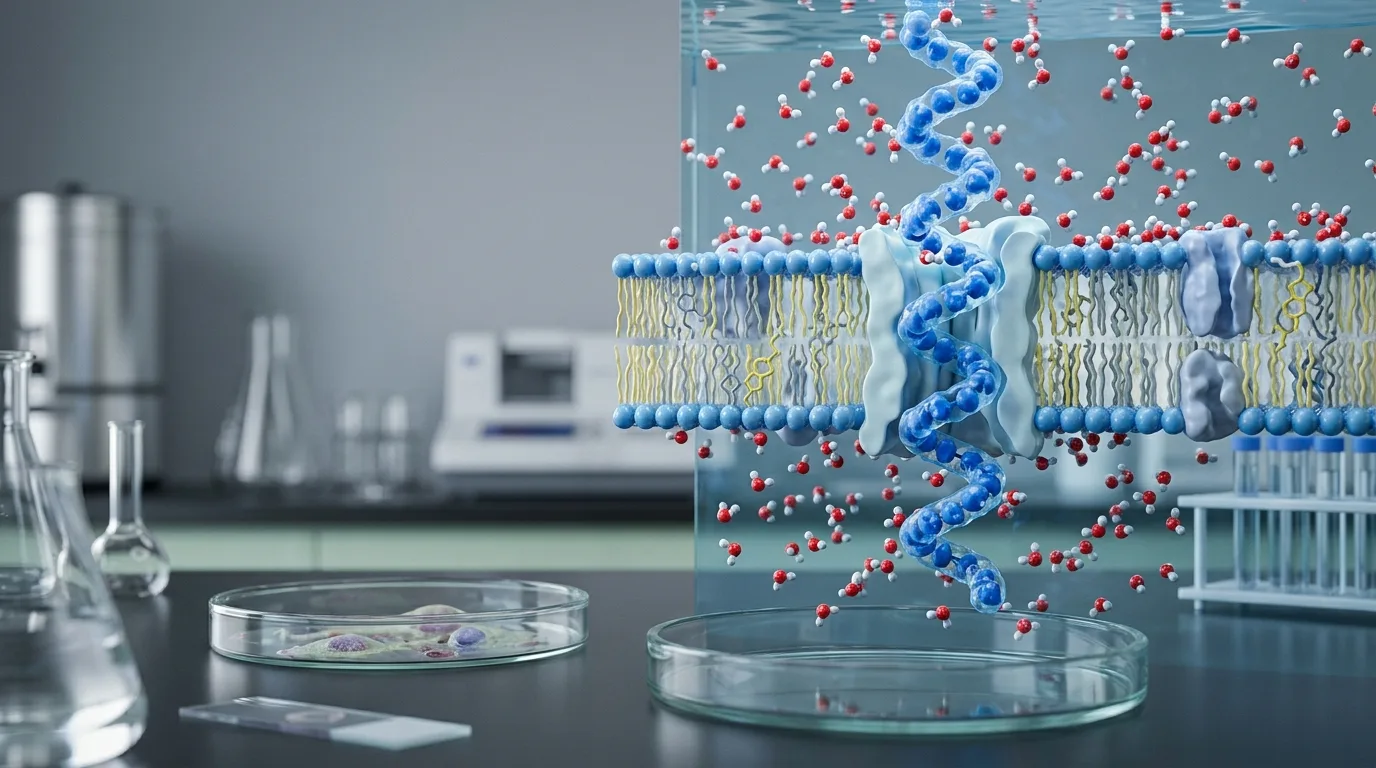
The HIV-1 TAT peptide has been studied in hundreds of laboratories across four decades. It crosses cell membranes with a facility that has made it a workhorse for drug delivery research. It also carries a negative GRAVY score, meaning the most widely used computational metric in peptide characterization classifies it as hydrophilic. By that metric's logic based on peptide hydrophobicity GRAVY score and cell membrane penetration predictions, TAT should not cross lipid bilayers efficiently. It does anyway.
That contradiction is not a minor footnote. It points to something fundamental about the gap between computational prediction and biological reality in peptide science. The GRAVY score, formally the Grand Average of Hydropathy, was developed by Jack Kyte and Russell Doolittle in 1982 for a specific and different purpose than the one researchers now routinely apply it to. Understanding what it measures, how it is calculated, and where it systematically fails is not merely an exercise in methodological caution. It is prerequisite knowledge for anyone working in peptide characterization.
What Hydrophobicity Actually Means for a Peptide
Hydrophobicity, at the molecular level, describes the tendency of nonpolar amino acid side chains to minimize contact with water molecules. In aqueous environments, nonpolar residues are effectively excluded from hydrogen-bonding networks, creating thermodynamic pressure for those residues to associate with each other or with similarly nonpolar environments. The interior of a lipid bilayer is one such environment.
The cell membrane presents a specific physical challenge. Two sheets of phospholipids are arranged with their hydrophilic phosphate heads facing outward, toward the aqueous cytoplasm and extracellular fluid, and their fatty acid tails facing inward, forming a hydrophobic core roughly 3 to 4 nanometers thick. A peptide moving by passive diffusion must partition into that nonpolar core and traverse it without the assistance of channels or receptors. Whether it can do so depends heavily on the character of its amino acid residues.
Not all residues contribute equally. The Kyte-Doolittle hydropathy scale assigns numerical values to each of the 20 standard amino acids based on their physical chemistry. Isoleucine sits at +4.5, the most hydrophobic position on the scale. Valine scores +4.2. Leucine, +3.8. At the opposite end, Arginine scores -4.5, reflecting its positive charge and strong interaction with water. Aspartate scores -3.5. Lysine, -3.9.
These numbers represent the raw material of GRAVY calculation. Before any prediction about membrane behavior can be attempted, each residue's contribution to the sequence's overall hydrophobic character must be accounted for. The breakdown illustrates how dramatically individual residues pull a sequence toward or away from membrane compatibility.
The Kyte-Doolittle Scale and How Peptide Hydrophobicity GRAVY Score Influences Cell Membrane Penetration
Kyte and Doolittle published their hydropathy analysis in the Journal of Molecular Biology in 1982. The paper's original aim was to identify transmembrane segments within folded proteins, not to characterize short synthetic peptides. Their approach assigned hydropathy values to each amino acid by synthesizing data from water-to-vapor transfer free energies, interior-to-surface distribution in solved protein structures, and other physical measurements. The resulting scale provided a way to scan protein sequences for stretches likely to span the lipid bilayer.
The GRAVY score extends this logic to entire sequences. The calculation is arithmetically simple: sum the hydropathy values assigned to each amino acid residue in the sequence, then divide by the total number of residues. The result is a single number representing the average hydrophobic character of the peptide.
Sign convention matters here. A positive GRAVY score indicates net hydrophobicity. A negative score indicates net hydrophilicity. A peptide composed entirely of leucine, isoleucine, and valine, the three most hydrophobic standard residues, would produce a strongly positive GRAVY score in the range of +4.0 to +4.5. A peptide built from arginine, lysine, and aspartate would produce a score below -3.5. Most biologically relevant peptides fall between these extremes.
The ExPASy ProtParam tool, maintained by the Swiss Institute of Bioinformatics, has standardized GRAVY calculation for the research community. A researcher can paste any sequence into ProtParam and receive a GRAVY value within seconds. That accessibility is part of why the metric has become a near-universal first-pass element in peptide characterization, even when applied to contexts Kyte and Doolittle never intended.
To make the scoring concrete: a repeating Leu-Ile-Val tripeptide would yield a GRAVY score near +4.3. The TAT peptide from HIV-1, rich in arginine and lysine, scores approximately -1.0. Insulin scores around -1.1. These numbers highlight the wide range across peptides with radically different biological behaviors.
GRAVY Score as a Predictor of Passive Membrane Diffusion
The foundational connection between a positive GRAVY score and passive membrane diffusion follows directly from the physical chemistry. A peptide with predominantly nonpolar residues will thermodynamically favor partitioning into the hydrophobic core of the lipid bilayer rather than remaining in aqueous solution. That partitioning is the first step in passive diffusion across the membrane.
This logic parallels Lipinski's Rule of Five, the framework developed in small-molecule drug design to predict oral bioavailability. Lipophilicity, typically measured as logP, is one of Lipinski's central parameters. A compound that is too hydrophilic will not cross intestinal epithelial membranes passively. Too hydrophobic, and it will not dissolve adequately in biological fluids. GRAVY plays an analogous role for peptides, providing a rapid sequence-level estimate of where a compound falls on the hydrophilic-to-hydrophobic spectrum.
In practice, a strongly positive GRAVY score flags a peptide as a plausible candidate for passive membrane diffusion. A strongly negative score suggests the peptide will require a receptor, transporter, or other facilitated mechanism to enter cells, or that it functions extracellularly. The score does not confirm either outcome. It generates a hypothesis worth testing.
Researchers use GRAVY early in sequence analysis, often alongside other computational parameters, to prioritize which peptides to advance to experimental assays. That is the appropriate scope of the tool. Its limitations become serious when it is treated as a verdict rather than a screen.
When GRAVY Fails: Cationic Peptides That Defy the Score
The TAT peptide, derived from the transactivator of transcription protein of HIV-1, contains a high concentration of arginine and lysine residues. Its sequence carries a strong net positive charge. Its GRAVY score is negative. By the metric's own logic, it should remain in aqueous environments and interact poorly with the hydrophobic membrane interior. Instead, TAT crosses cell membranes with a speed and efficiency that has made it one of the most studied cell-penetrating peptides in biochemistry.
The mechanism does not involve passive diffusion through the hydrophobic core. TAT exploits electrostatic attraction. The outer leaflet of most mammalian cell membranes carries a net negative charge, contributed in part by phosphatidylserine and heparan sulfate proteoglycans on the cell surface. Positively charged peptides such as TAT are drawn to this surface electrostatically. From there, entry proceeds through direct translocation or endocytosis, depending on experimental conditions, concentration, and cell type.
Ziegler's work, along with subsequent studies from multiple groups, has helped characterize cationic cell-penetrating peptides as a mechanistic class. What they share is not hydrophobicity but arginine-rich sequences that interact with membrane components through charge-based mechanisms. GRAVY, which averages hydropathy values without any representation of charge distribution or surface electrostatics, is structurally incapable of predicting this behavior.
The precise translocation mechanism for TAT and related peptides remains debated in the literature. Some studies support direct membrane penetration; others emphasize macropinocytosis. That unresolved question is itself informative: even with decades of experimental attention, the entry mechanism is not fully understood. A computational score derived in 1982 for a different purpose was never going to resolve it.
Receptor-Dependent Peptides and the Insulin Problem
Insulin presents a second category of GRAVY failure, distinct from the cationic peptide case. Insulin scores approximately -1.1 on the GRAVY scale, indicating net hydrophilicity. It does not passively cross cell membranes. Those two facts are consistent with the metric's predictions. What the score cannot reveal is why the negative value is biologically appropriate: insulin's function depends entirely on binding to the insulin receptor on the cell surface, triggering intracellular signaling cascades through receptor tyrosine kinase activity.
Insulin was not designed by evolution to enter cells. It was designed to bind a receptor from outside the cell and initiate a signal. Many physiologically critical peptides and protein hormones operate through this same principle. Glucagon, growth hormone-releasing hormone, and numerous neuropeptides function through extracellular receptor binding, not membrane crossing. For all of them, a negative GRAVY score is not a deficiency. It reflects a biology in which membrane penetration was never the relevant activity.
This exposes a categorical limitation of applying GRAVY to peptide function prediction. The score was developed to characterize transmembrane protein segments, not to evaluate the full range of strategies by which bioactive peptides interact with cellular architecture. A peptide with a strongly positive GRAVY score is a candidate for passive membrane crossing. A peptide with a negative score could be extracellular by design, receptor-dependent, cationic and charge-driven, or simply not membrane-active in any mode. The score alone cannot distinguish among these possibilities.
The Blood-Brain Barrier: Where GRAVY Becomes Especially Limited
The blood-brain barrier imposes a more complex set of constraints than a standard cell membrane. Tight junctions between cerebral endothelial cells eliminate the paracellular route available in peripheral tissues. The lipid environment is exceptionally restrictive. P-glycoprotein and other efflux transporters actively expel foreign molecules that enter endothelial cells from the luminal side.
Lipophilicity is necessary for passive BBB crossing. A peptide with a strongly negative GRAVY score is unlikely to partition into endothelial cell membranes at all. But lipophilicity alone is insufficient. Molecular weight, hydrogen bond donor and acceptor counts, and susceptibility to efflux all modulate actual transport across the BBB. None of these parameters appear in a GRAVY calculation.
William Pardridge's 2012 analysis in the Journal of Cerebral Blood Flow and Metabolism documented how many putative CNS drug candidates fail at the BBB despite adequate lipophilicity, precisely because they are substrates for efflux transporters or because their size prevents effective membrane partitioning. Some peptides cross the BBB not through passive diffusion but through receptor-mediated transcytosis, including pathways involving the transferrin receptor and the LDL receptor-related protein.
Researchers have also studied glycosylation and carrier-conjugation strategies to enable BBB penetration for peptides that lack intrinsic CNS access. These modifications alter a peptide's interaction with transport systems in ways that bear no relationship to the raw GRAVY value of the native sequence. A glycosylated peptide and its unmodified parent may have very different BBB transport profiles while sharing a nearly identical GRAVY score.
Experimental Validation: PAMPA and Cell-Based Assays
The Parallel Artificial Membrane Permeability Assay, known as PAMPA, was established as a high-throughput screening tool by Kansy and colleagues in a 1998 paper that formalized its application to early-stage drug discovery. The assay uses an artificial lipid membrane to separate donor and acceptor compartments. A peptide is added to the donor side, and its transfer rate to the acceptor side is measured over time, providing a direct experimental value for passive membrane permeability.
PAMPA captures passive diffusion only. It cannot detect active uptake, endocytosis, or receptor-mediated transport. For cationic cell-penetrating peptides like TAT, PAMPA results would likely underreport actual cellular uptake substantially, because the dominant entry mechanism involves electrostatic interactions and endocytic pathways that the artificial membrane system does not replicate.
Cell-based uptake assays using fluorescently labeled peptides address that gap. By tagging a peptide with a fluorophore and measuring its intracellular accumulation in living cells using confocal microscopy or flow cytometry, researchers can detect active and endocytic entry mechanisms that PAMPA cannot capture. The two methods are complementary, not redundant.
The critical point is the gap between what computation predicts and what experiment measures. Consider three peptide classes side by side: a strongly hydrophobic peptide with a GRAVY score above +3.0 shows high PAMPA permeability consistent with prediction; a cationic CPP with a GRAVY score near -1.0 shows low PAMPA permeability but high cell-based uptake; a receptor-dependent hormone with a similar negative score shows low permeability in both assays. GRAVY predicts one outcome; experimental data reveal three different biological realities. These numbers highlight the systematic divergence between computational screening and measured behavior, particularly for non-passive entry mechanisms.
The Structural Blind Spot: What GRAVY Cannot See
GRAVY treats a peptide as a linear string of hydropathy values. It sums those values and divides. Three-dimensional structure is entirely absent from the calculation. This creates a category of prediction error that is particularly significant for amphipathic peptides.
An amphipathic alpha-helix arranges hydrophobic and hydrophilic residues on opposite faces of the helical axis. When such a helix encounters a membrane, its hydrophobic face can insert into the lipid environment while its hydrophilic face remains oriented toward the aqueous phase. The result is a membrane interaction that the raw GRAVY score, averaged across the entire sequence, would not predict. A peptide with a mildly negative GRAVY score but strong helical amphipathicity may interact with membranes more effectively than a peptide with a modestly positive GRAVY score lacking secondary structure.
Henriksen and colleagues' 2014 analysis in Biochimica et Biophysica Acta examined computational prediction models for antimicrobial peptides, a class where amphipathicity rather than average hydrophobicity is frequently the dominant driver of membrane disruption. Their analysis identified structural parameters as more predictive than raw hydrophobicity scores for that class, underscoring the structural blind spot in sequence-only metrics.
Charge distribution presents a parallel problem. Two peptides with identical GRAVY scores but different clustering of charged residues will behave differently at a membrane surface. A peptide with its charged residues clustered at one terminus may orient differently at the membrane interface than one with charges distributed throughout the sequence. GRAVY cannot distinguish them.
Situated accurately, GRAVY is a fast, reproducible, sequence-level screen. It is useful at the start of analysis. It is insufficient at the end.
Where the Field Stands
The GRAVY score, developed by Kyte and Doolittle in 1982 for identifying transmembrane protein segments, has persisted in peptide characterization for over four decades because it is computationally trivial, reproducible, and grounded in measurable amino acid properties. Those qualities have real analytical value, particularly at the earliest stage of sequence screening when dozens or hundreds of candidates require rapid triage.
Its limitations are equally real and equally well-documented. It cannot account for three-dimensional structure, amphipathicity, charge distribution, endocytic mechanisms, receptor-mediated transport, efflux susceptibility, or molecular size. The TAT peptide and insulin, sitting at opposite ends of the biological spectrum, both expose the score's boundaries from different directions. One enters cells efficiently despite a negative GRAVY score through charge-based mechanisms. The other does not need to enter cells at all. The score predicts neither behavior correctly.
Experimental methods remain the only reliable confirmation of membrane behavior. PAMPA measures passive diffusion directly. Cell-based assays capture active and endocytic mechanisms. Neither is replaceable by sequence-level computation alone.
Better computational models are under active development. Approaches incorporating molecular dynamics simulations, amphipathicity indices, charge moment calculations, and machine learning trained on experimental permeability datasets are producing more nuanced predictions than GRAVY alone can generate. Several research groups have published predictive algorithms that outperform GRAVY on benchmark datasets of cell-penetrating peptides. Open questions remain about how well those models generalize across peptide classes and experimental conditions.
GRAVY persists in the literature not because it is the best available tool but because a flawed first-pass metric, applied with appropriate skepticism and followed by experimental validation, still has a legitimate place in the analytical workflow. That is the accurate characterization of its role, and the one researchers would do well to carry into practice.
Stay current with peptide chemistry research. Molecule Notes publishes in-depth analysis of peptide synthesis, computational methods, and biomedical research for readers who want rigorous coverage without the hype. Subscribe to the newsletter to receive new articles directly.
Sources
- nih.gov — pmc.ncbi.nlm.nih.gov
- nih.gov — pmc.ncbi.nlm.nih.gov
- mdpi.com — mdpi.com
- ias.ac.in — ias.ac.in
- nih.gov — pmc.ncbi.nlm.nih.gov
- biorxiv.org — biorxiv.org
- oup.com — academic.oup.com
- nih.gov — pmc.ncbi.nlm.nih.gov
- nih.gov — pubmed.ncbi.nlm.nih.gov
- acs.org — pubs.acs.org
- nih.gov — pmc.ncbi.nlm.nih.gov