
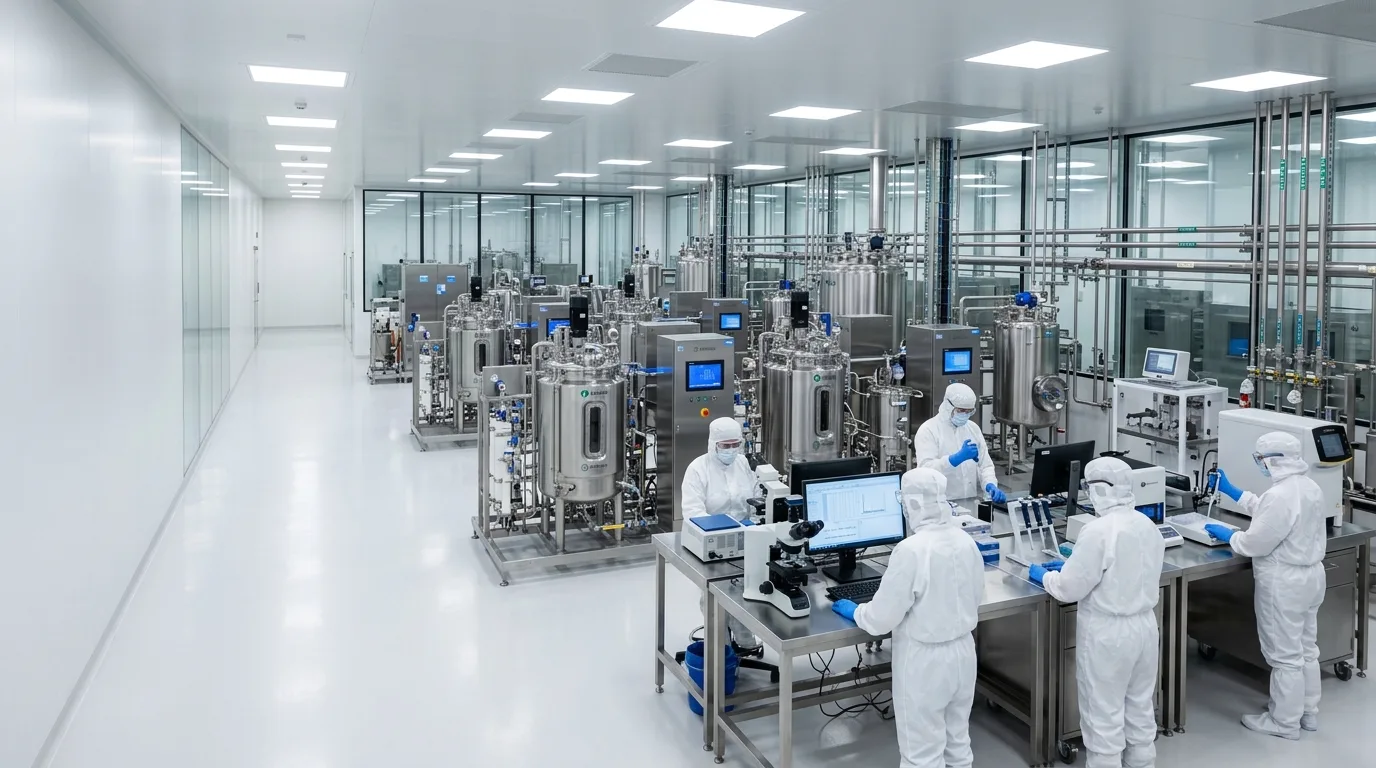
In November 2023, Novo Nordisk announced a $6 billion expansion of its fill-finish site in Kalundborg, Denmark, the small port town that has become the epicenter of global semaglutide production. The investment was not aimed at inventing a new drug or improving its efficacy. It was aimed at making more of a molecule the company had already perfected years earlier. Demand for semaglutide, sold as Ozempic and Wegovy, had outpaced Novo Nordisk's manufacturing capacity so severely that the compound spent much of 2023 on the FDA's drug shortage list, alongside its competitor tirzepatide.
The shortage exposed a counterintuitive fact about peptide chemistry: making a gram of a peptide in a university lab and making a metric ton of the same molecule for a global pharmaceutical market are, chemically speaking, almost unrelated problems. A synthesis route that works cleanly on a benchtop, with a chemist manually monitoring each reaction, can become a logistical and financial liability when scaled a millionfold.
This article walks through why scaling peptide synthesis from milligrams to metric tons is an industrial engineering problem as much as a chemistry one. It covers the two dominant manufacturing paths, chemical synthesis and recombinant fermentation, the hybrid model that produces semaglutide, and the bottlenecks in purification, raw materials, and regulatory compliance that turned a well-capitalized company's supply chain into a multi-year shortage.
Why Peptides Are Different From Small-Molecule Drugs
A peptide is a short chain of amino acids linked by peptide bonds, typically defined as containing fewer than roughly 50 residues. That threshold separates peptides from full proteins like insulin analogs or monoclonal antibodies, which involve far more complex folding and post-translational processing. Compared to a small-molecule drug like aspirin, which has a fixed, simple structure and can often be produced through a handful of straightforward chemical reactions, a peptide is a sequential construction project. Each amino acid must be added in a specific order, with a specific chemical linkage, and any error propagates through the rest of the chain.
This sequential nature is precisely why peptide manufacturing scale-up presents such a distinct engineering challenge within pharmaceutical production. Methods that work perfectly at milligram scale in a research lab, where a chemist can babysit a single reaction vessel, often fail or become prohibitively expensive once volumes reach kilogram or ton scale. The rest of this piece traces the two dominant manufacturing paths that have emerged to address that gap: chemical synthesis, built primarily around solid-phase and liquid-phase methods, and recombinant synthesis, which relies on engineered organisms.
Chemical and Fermentation Routes in Pharmaceutical Production Scale-Up
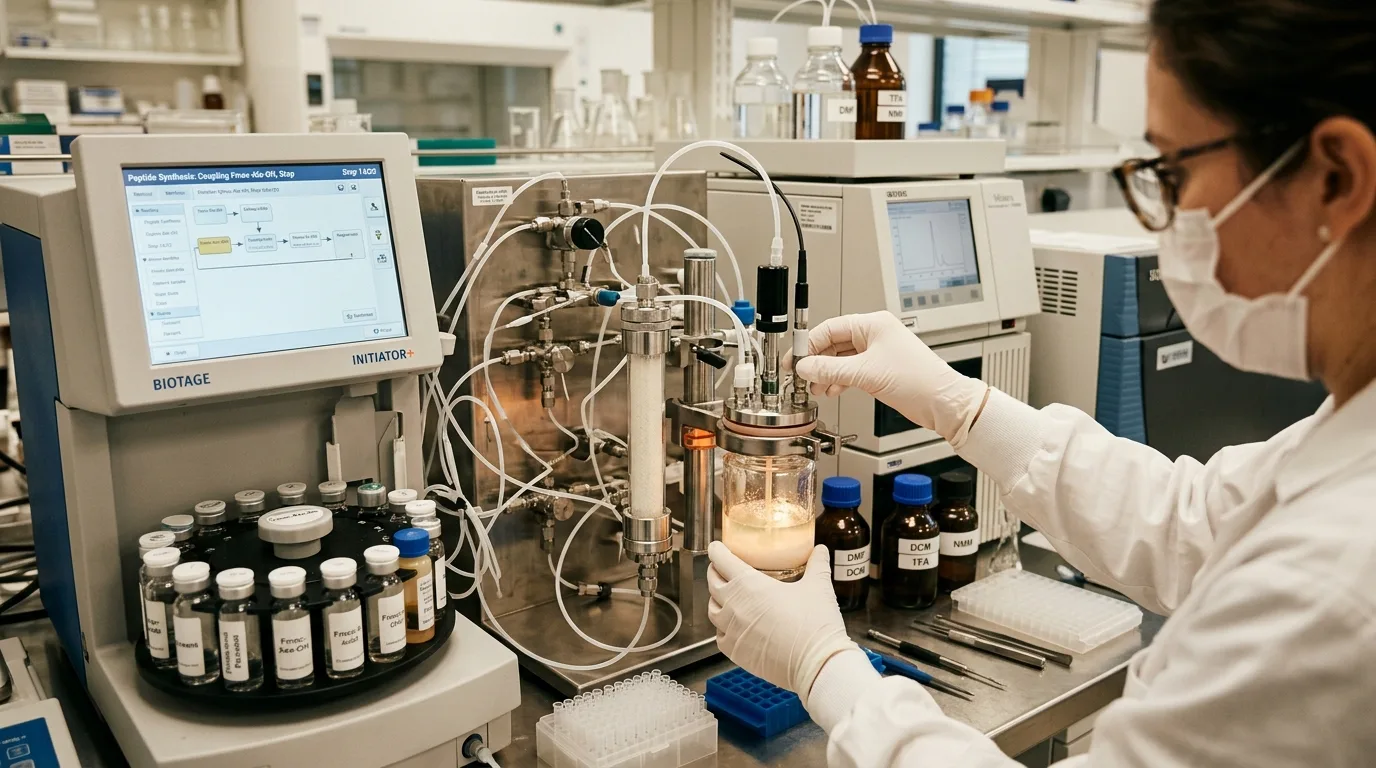
Solid-Phase Peptide Synthesis, or SPPS, has been the workhorse of peptide chemistry since Bruce Merrifield developed the technique in the 1960s at Rockefeller University, work that later earned him the 1984 Nobel Prize in Chemistry. The method builds a peptide chain one amino acid at a time, anchoring the growing chain to an insoluble resin bead and cycling through repeated steps of coupling and deprotection until the full sequence is assembled.
SPPS remains the default choice for shorter peptides, generally under 50 amino acids, according to sourcing from Bachem [1], one of the industry's largest custom peptide manufacturers. Its appeal at research scale is speed and reliability. Automated synthesizers can assemble a peptide sequence in hours, and the solid-phase format simplifies purification between steps since excess reagents simply wash away from the resin-bound chain.
That same design becomes a liability at industrial volumes. Each coupling and deprotection step requires excess reagent, often several-fold molar excess, to drive the reaction close to completion. At milligram scale, that excess is chemically trivial. At kilogram or ton scale, raw material consumption multiplies dramatically, and so does the volume of hazardous solvent waste. Dimethylformamide, or DMF, a solvent central to SPPS, is both an industrial bottleneck and an environmental liability at scale, generating waste streams that require costly handling and disposal under increasingly strict regulatory regimes.
A separate problem emerges as chains lengthen: aggregation. Longer peptide chains have a tendency to clump together during synthesis, a phenomenon tied to hydrophobic interactions between growing chains on the resin. According to chemistry coverage from the American Chemical Society [2], this aggregation lowers yields and complicates purification, since aggregated chains couple less efficiently and produce more truncated failure sequences that must later be separated from the target product.
Liquid-Phase Synthesis as a Scalable Alternative
Liquid-Phase Peptide Synthesis, or LPPS, is an older technique than SPPS but one that has regained industrial interest specifically because of its scalability advantages. Rather than anchoring the growing peptide chain to a solid resin, LPPS carries out coupling reactions with all components dissolved in solution.
According to reporting from Neuland Labs [3], LPPS reduces solvent waste relative to SPPS and can be more cost-effective for large-scale production of shorter peptide sequences. Because the chemistry does not depend on resin-bound intermediates, manufacturers can use larger reaction vessels and recover solvents more efficiently, which matters considerably once batch sizes move from grams to hundreds of kilograms.
The trade-off is flexibility. LPPS generally requires more process development and optimization per molecule, since each new sequence demands its own set of solubility and purification adjustments rather than relying on standardized resin protocols. That makes LPPS less attractive during early-stage discovery work, when a research team may need to synthesize dozens of candidate sequences quickly, but more attractive once a specific peptide is destined for commercial-scale manufacturing and the chemistry is locked in.
The relative economics tell the story. At lab scale, measured in grams, SPPS and LPPS often land close in cost-per-gram, with SPPS holding a slight speed advantage. As batch size climbs into the tens of kilograms and beyond, LPPS's solvent efficiency and equipment scalability tend to close, and eventually reverse, that cost gap, while SPPS's solvent consumption and waste-handling costs continue climbing roughly in proportion to output. The comparison illustrates why some companies re-engineer a peptide's synthesis route entirely once it clears clinical trials and moves toward commercial volume.
Recombinant Synthesis: Fermentation as a Green Alternative
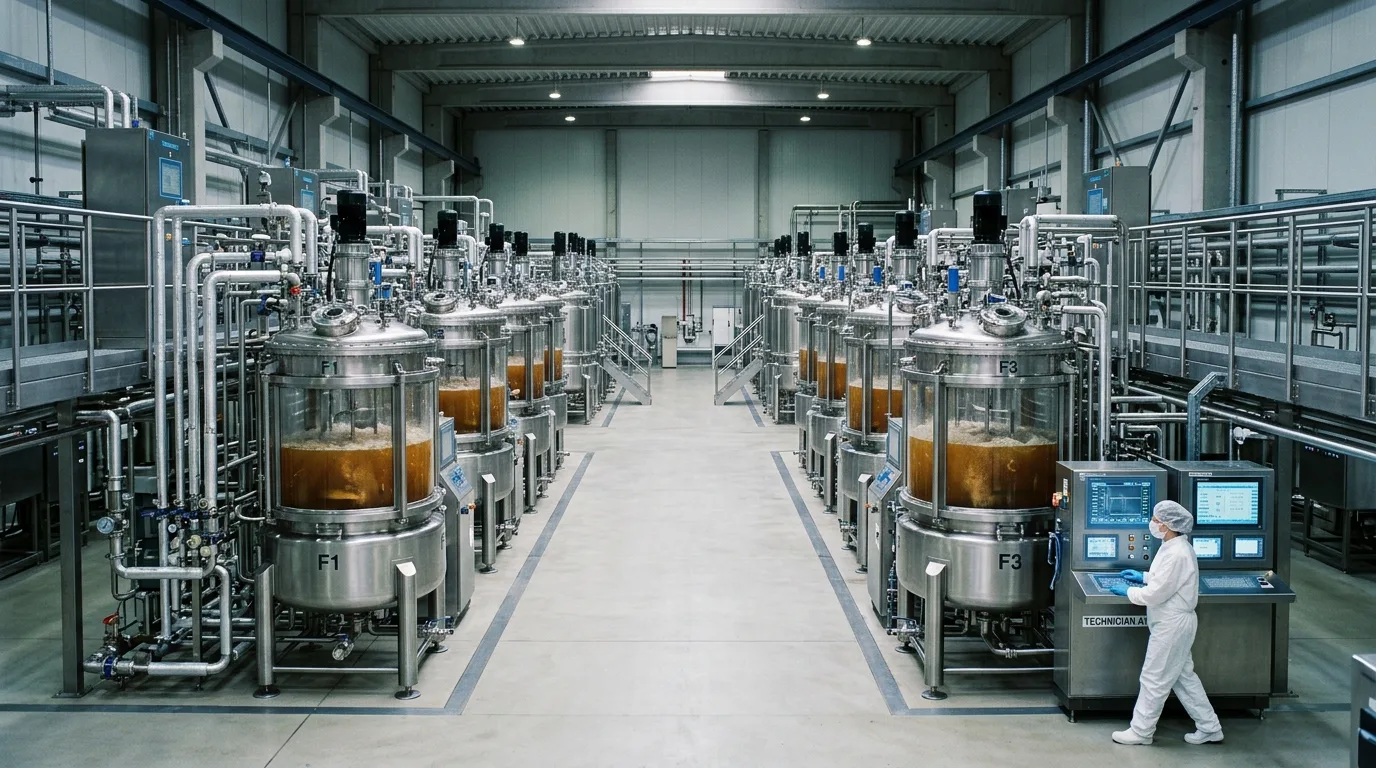
Recombinant synthesis takes a fundamentally different approach: rather than assembling a peptide chain through repeated chemical reactions, it engineers bacteria or yeast to produce the chain biologically, using the organism's own protein synthesis machinery. The concept is not new. Recombinant methods have been used to manufacture insulin since Genentech and Eli Lilly brought the first recombinant human insulin, Humulin, to market in 1982.
According to NUMAFERM [4], recombinant methods are considered cost-effective and more environmentally sustainable for long-chain peptides produced at large volumes, since fermentation avoids the solvent-heavy waste streams associated with chemical synthesis. Bacterial or yeast cultures can be scaled up in bioreactors using established fermentation infrastructure, and the marginal cost per gram tends to decrease more favorably as batch size grows, compared to the linear reagent scaling of chemical methods.
The trade-offs are substantial, however. Engineering and validating a production strain, whether E. coli, yeast, or another host organism, takes considerable development time, often a year or more before a stable, high-yield strain is ready for manufacturing use. Downstream purification adds its own complexity: the target peptide must be separated from host cell proteins, DNA fragments, and other biological debris, a process that is often more involved than purifying a chemically synthesized peptide from its byproducts.
These trade-offs shape where recombinant methods fit best. They tend to be better suited to longer peptides and small proteins, where the savings on raw materials and waste handling outweigh the strain development timeline. Chemical synthesis retains an edge for shorter, simpler sequences, where SPPS or LPPS can produce material faster and with fewer biological unknowns.
The Hybrid Model: How Semaglutide Gets Made
Semaglutide sits at the center of this article's case study precisely because it does not fit neatly into either category. Novo Nordisk uses a hybrid approach that combines recombinant fermentation with chemical modification, according to reporting from Pharma's Almanac [5].
The logic follows from semaglutide's structure. The peptide backbone, a 31-amino acid chain related to human GLP-1, is produced biologically through yeast fermentation, taking advantage of the cost and scalability benefits recombinant methods offer for longer chains. That precursor is then finished through chemical modification, most notably lipidation, the attachment of a fatty acid side chain that extends the drug's half-life in the body. Lipidation is difficult to achieve through fermentation alone, since it requires a precise, non-standard chemical linkage that biological synthesis machinery is not built to produce.
This hybrid process connects directly back to the Kalundborg expansion. Even a well-engineered manufacturing route that plays to the strengths of both fermentation and chemical synthesis can still hit capacity ceilings when global demand surges unexpectedly, as it did through 2023 and into 2024 for GLP-1 receptor agonists. It is worth acknowledging plainly that the full details of Novo Nordisk's proprietary manufacturing process are not entirely public, which limits outside verification of exactly where in the hybrid chain the tightest bottlenecks sit.
Purification: The Industry's Quiet Bottleneck
Regardless of which synthesis route produces the crude peptide, purification is frequently cited as the single most constraining step in the entire manufacturing chain. According to GenScript [6], reverse-phase chromatography, the dominant purification method for peptides, does not scale linearly with batch size.
A chromatography column sized for gram-scale purification cannot simply be run more times to purify a kilogram-scale batch; the equipment footprint, solvent volume, and processing time all grow disproportionately as batch size increases. Larger columns require proportionally larger solvent reservoirs, longer run times, and more rigorous quality control checks at each stage, all of which add cost and schedule risk.
This difficulty compounds directly with the chain aggregation problem raised earlier. Longer or more hydrophobic peptides are harder to separate from truncated failure sequences and other closely related impurities, since their chemical properties often overlap closely with the target molecule's. In a typical peptide production run, purification frequently consumes a disproportionate share of total processing time and cost relative to the synthesis steps that build the chain in the first place. The imbalance illustrates why purification, rather than synthesis chemistry itself, is often the true rate-limiting step in scaling a peptide from lab to market.
GMP Compliance and Regulatory Pressure
Every stage of pharmaceutical-grade peptide production, not just the final product, must comply with Current Good Manufacturing Practice regulations enforced by the FDA in the United States and equivalent bodies like the European Medicines Agency abroad. These regulations exist to ensure consistent quality and safety, according to FDA guidance [7], but they add substantial cost and time rel
Sources
- bachem.com -- bachem.com
- acs.org -- acs.org
- neulandlabs.com -- neulandlabs.com
- numaferm.com -- numaferm.com
- pharmasalmanac.com -- pharmasalmanac.com
- genscript.com -- genscript.com
- fda.gov -- fda.gov