
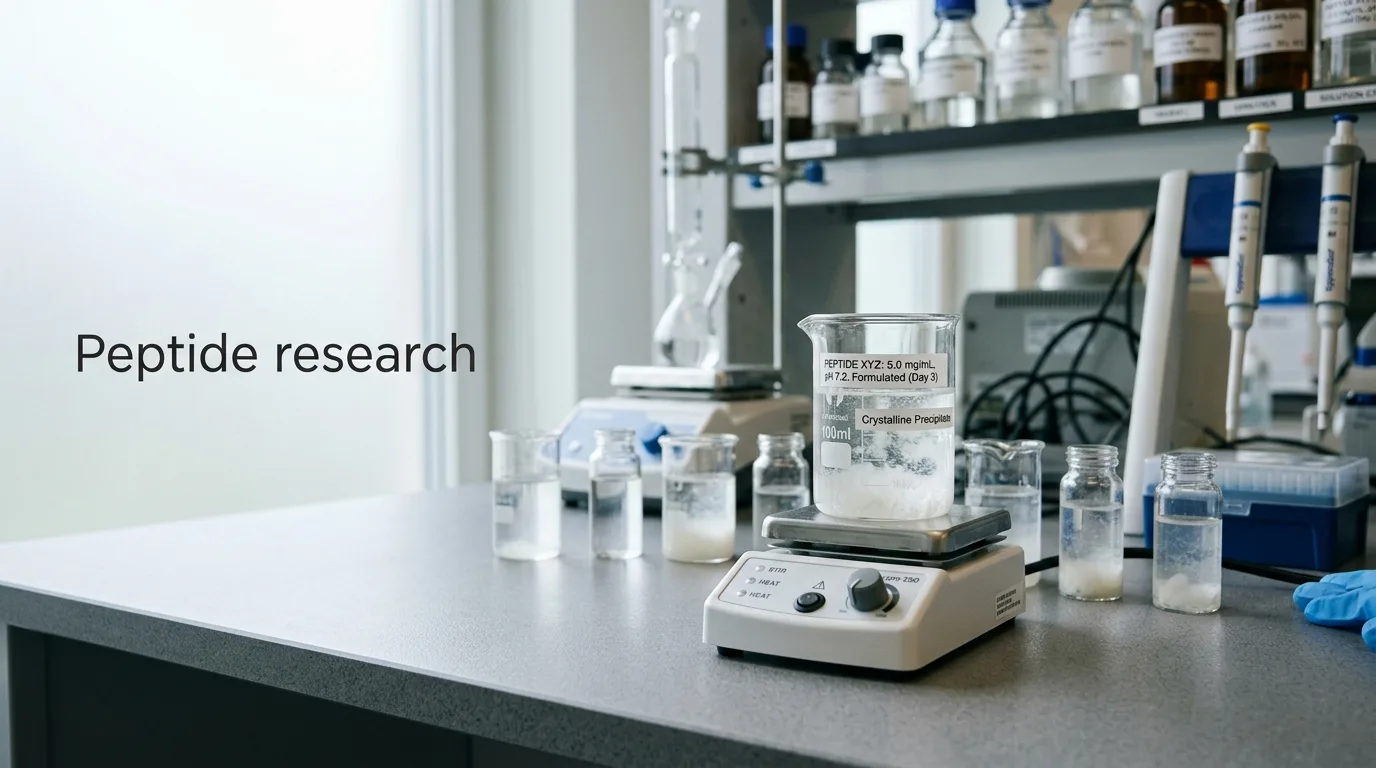
At a peptide chemistry core facility in the early 2000s, a formulation researcher reconstituted a batch that had worked cleanly the week before. Same vial type, same diluent, same technique. Instead of a clear solution, the liquid turned faintly cloudy within seconds, and by the ten-minute mark a fine haze of aggregated material had settled toward the bottom of the vial. The sequence was different this time, just a handful of amino acid substitutions from the prior peptide. Nothing else had changed.
That scenario, or something close to it, has played out in pharmaceutical formulation labs and university peptide cores for decades. It is often the first moment someone confronts a central fact about peptide chemistry: solubility problems are not glitches. Cloudiness, clumping, and precipitation are predictable outcomes of a peptide's own molecular structure, specifically its amino acid sequence, its isoelectric point, and the pH of the solution it meets. Understanding peptide solubility aggregation precipitation formulation buffering as a matter of chemistry, rather than manufacturing defect, changes how the problem gets solved. This piece walks through why some peptides resist dissolving, what pH and isoelectric point have to do with it, and what formulation scientists actually reach for, buffers, excipients, surfactants, when a sequence refuses to cooperate.
Why 'It Won't Dissolve' Is Rarely a Manufacturing Problem
A common assumption among people handling peptides for the first time is that a cloudy vial signals a bad batch, contamination, or a counterfeit product. In the vast majority of documented cases, that assumption is wrong.
Peptide solubility is a chemical property encoded in the sequence itself, not a downstream quality-control failure introduced during synthesis or shipping. Formulation scientists at pharmaceutical companies and academic labs have documented this across hundreds of sequences for more than thirty years, tracing poor dissolution back to the same handful of structural variables every time [1].
Two concepts explain most of what happens inside that vial: the hydrophobic-hydrophilic balance of the amino acids present, and the isoelectric point, the pH at which the peptide carries no net charge. Both are fixed properties of a given sequence. Neither is something a manufacturer introduces or removes after the fact. The remainder of this article unpacks each one, then turns to what formulation chemists actually do about them.
The Hydrophobic-Hydrophilic Balance Inside a Peptide
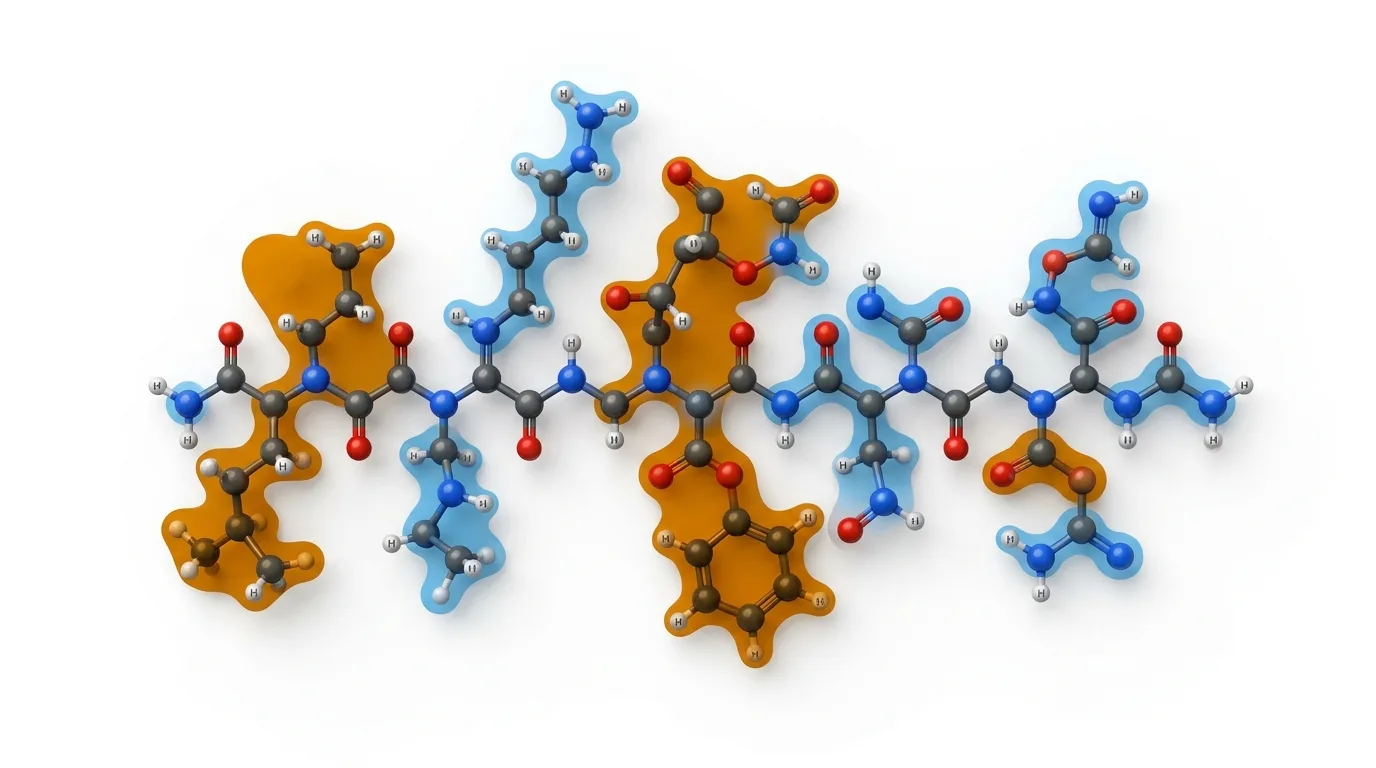
Every peptide is a chain of amino acids, and each amino acid interacts with water differently. Hydrophilic residues, such as serine, threonine, and lysine, form favorable interactions with water molecules and tend to sit at a peptide's surface in solution. Hydrophobic residues resist those interactions and behave more like oil dropped into water.
Leucine, valine, isoleucine, and phenylalanine are among the amino acids most associated with poor solubility when they appear in high concentration within a sequence [2]. A peptide loaded with these residues faces a structural problem: water molecules crowd around the hydrophobic side chains in an energetically unfavorable arrangement, and the system looks for a way to reduce that cost.
The resolution is aggregation. Hydrophobic residues from separate peptide molecules cluster together, minimizing their collective exposure to water, and the clusters grow until they are heavy enough to fall out of solution as visible precipitate [3]. This is not a defect in the peptide. It is thermodynamics working exactly as the sequence dictates, driven by the same hydrophobic effect that shapes protein folding throughout biology [4].
The Isoelectric Point: Where Peptides Dissolve Least
Every peptide has an isoelectric point, abbreviated pI, the specific pH at which its net electrical charge equals zero [5]. Below the pI, a peptide tends to carry a net positive charge. Above it, the charge shifts negative. Exactly at the pI, positive and negative charges on the molecule balance out entirely.
Charge matters because charged peptide molecules repel one another in solution, and that repulsion is what keeps them dispersed rather than clumped. At the pI, with no net charge to generate repulsion, peptide molecules have nothing pushing them apart. They drift together, aggregate, and often precipitate [1].
Consider a hypothetical peptide with a calculated pI of 6.0, sitting close to physiological pH. Dissolved in a solution at pH 6.0, that peptide will show markedly reduced solubility compared with the same peptide dissolved at pH 4.0 or pH 8.0. Solubility does not decline gradually as pH approaches the pI; it tends to drop sharply within a narrow band around that point, then rise again as pH moves away from it in either direction. The pattern shows up consistently enough in formulation data that predicting a rough solubility curve from a peptide's pI alone is standard practice in early-stage formulation work [6].
Why Freshly Reconstituted Peptides Sometimes Start Out Acidic
A lyophilized peptide, meaning one that has been freeze-dried into a powder for storage and shipping, is rarely pure peptide and nothing else. Purification methods like reverse-phase HPLC often leave behind residual trifluoroacetic acid or other acidic counterions from the mobile phase used during synthesis and purification [7].
When that lyophilized powder meets water or a diluent, the residual acid dissolves along with the peptide, and it can shift the initial solution pH downward, sometimes by a full pH unit or more. If that shift lands the solution close to the peptide's pI, the very act of reconstitution can push the peptide into its least soluble condition before any deliberate pH adjustment happens [8].
This is a downstream consequence of how the peptide was purified, not evidence of contamination or a poor-quality product. It is well documented in formulation literature, and it is addressable, typically by adjusting pH after reconstitution rather than assuming the reconstitution itself has failed [9].
Basic vs. Acidic Peptides: Opposite Rules for Opposite Charges
Once the pI is known or reasonably estimated, the direction of pH adjustment follows a fairly consistent rule, though the rule runs in opposite directions depending on the peptide's overall charge character.
Basic peptides, meaning those with a net positive charge from residues like lysine, arginine, or histidine, tend to dissolve more readily in acidic solutions, where the pH sits well below the pI. Acidic peptides, dominated by residues like aspartate and glutamate, tend to dissolve more readily in basic solutions, where the pH sits well above the pI [10].
The general guidance formulation scientists apply is to move the solution pH at least one to two full units away from the peptide's pI, in whichever direction suits the peptide's charge type [1]. A peptide with a pI of 9.0, for instance, is typically formulated closer to pH 6.5 or 7.0 rather than at neutral pH alone, while a peptide with a pI of 4.0 might be pushed toward pH 6.0 or higher. The specific target depends on the sequence, its intended use, and what other excipients are already present, so these ranges function as starting points rather than fixed rules.
Peptide Solubility, Aggregation, and Precipitation: Using Buffers in Formulation
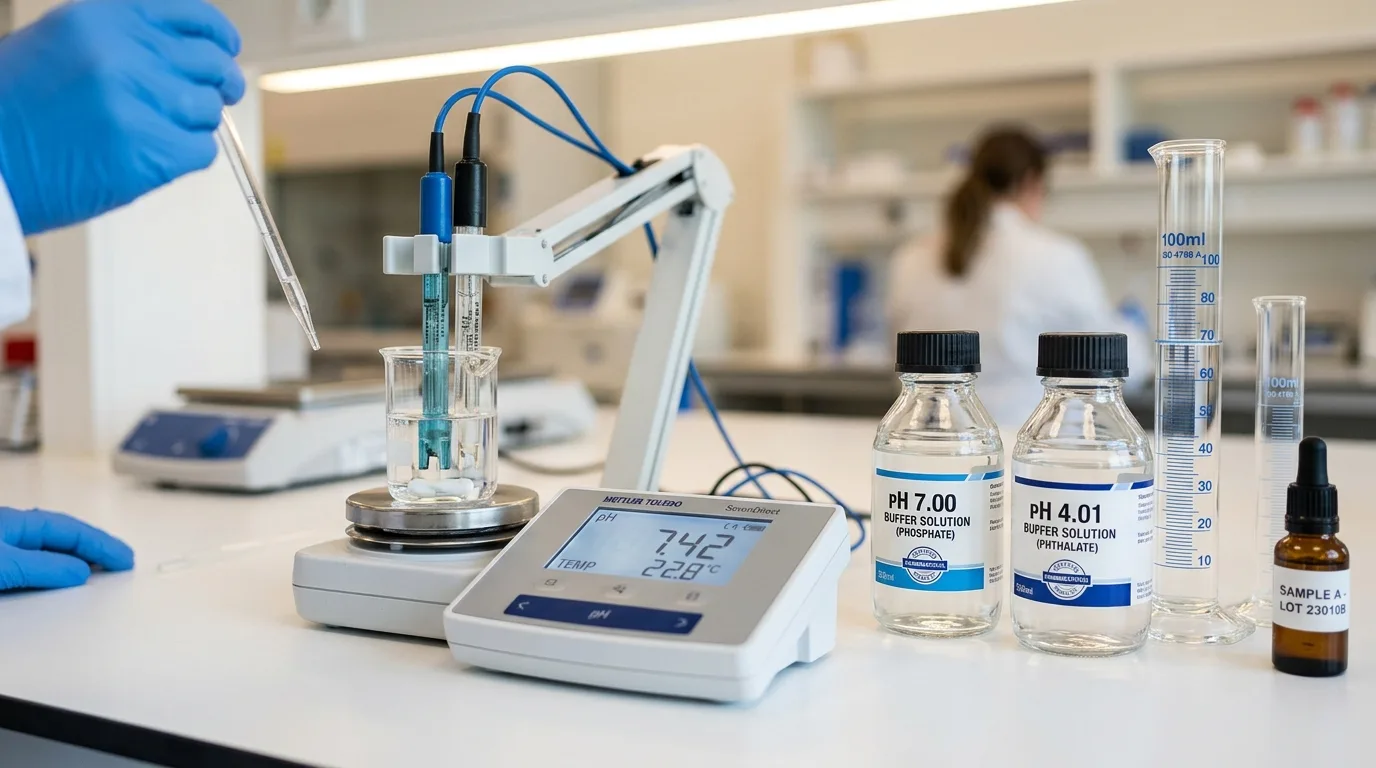
Finding a favorable pH is only half the task. Solutions drift. Exposure to air, temperature changes, and the peptide's own chemistry can all shift pH over time, and a peptide that dissolved cleanly at hour zero can begin to precipitate by hour twelve if the pH has crept back toward its pI.
A buffer resists that drift chemically, using a pair of chemical species that neutralize small additions of acid or base before they change the solution's pH substantially [11]. That stability matters not only for keeping the peptide dissolved initially but for its ongoing structural stability in solution, since prolonged exposure to unfavorable pH can accelerate degradation pathways independent of aggregation.
Acetate buffers, phosphate buffers, and citrate buffers are among the most common systems used in peptide formulation work, each effective across a different pH range [12]. Acetate tends to work well in mildly acidic ranges, phosphate spans a broad middle range near physiological pH, and citrate offers buffering capacity across a wider span with multiple ionizable groups. No single buffer suits every peptide; the choice depends on where the target pH sits relative to the peptide's specific pI, and on compatibility with the peptide's intended downstream use [13].
When pH Adjustment Isn't Enough: Excipients and Surfactants
Some sequences remain poorly soluble even after pH has been optimized away from the pI, particularly those dominated by long stretches of hydrophobic residues. For these, formulation chemists reach for tools beyond pH alone.
Organic co-solvents such as DMSO can dissolve highly hydrophobic peptides that water alone cannot touch, since DMSO interacts favorably with hydrophobic side chains in a way water does not [14]. This approach is generally reserved for research contexts rather than straightforward reconstitution, given DMSO's own handling considerations and its incompatibility with many downstream applications.
Surfactants, most notably Polysorbate 80, work differently. They position themselves at the interface between hydrophobic peptide surfaces and the surrounding water, effectively shielding those surfaces and reducing the molecular contact that drives aggregation [15]. Certain free amino acids serve a related purpose. Arginine, in particular, is documented in commercial peptide products as an aggregation suppressant, thought to interact directly with exposed hydrophobic and charged regions on the peptide surface and interfere with the clustering that leads to precipitation [16].
Why Some Peptides Stay Difficult Despite Decades of Research
Even with pH optimization, buffering, and excipients available, some sequences remain genuinely resistant to clean formulation. Certain peptides have an inherent structural propensity to form highly ordered, stable aggregates such as amyloid fibrils, structures that are thermodynamically favorable and difficult to disrupt with the standard formulation toolkit [17].
Chemical instability compounds the problem. Oxidation of susceptible residues like methionine and cysteine, along with hydrolysis of the peptide backbone, can occur alongside aggregation, degrading the peptide even when it appears to be staying in solution [18]. A formulation that solves the solubility problem does not necessarily solve the stability problem, and the two are often intertwined.
Formulation science has not solved every difficult sequence, and pharmaceutical and academic labs continue publishing on unresolved cases where standard approaches fall short [4]. That ongoing body of work, spread across companies and universities rather than concentrated in one place, suggests the problem is understood in outline but not yet solved in every specific case.
Reframing the Cloudy Vial
Poor peptide solubility is best understood as a predictable expression of a sequence's chemistry, its balance of hydrophobic and hydrophilic residues, its isoelectric point, and the pH environment it encounters, rather than a sign of a flawed product. The cloudy vial at the bench is not lying about the batch. It is reporting on the sequence.
The practical toolkit formulation scientists reach for tends to follow a rough order: adjust pH away from the pI first, stabilize that pH with an appropriate buffer, and turn to excipients like surfactants or specific amino acids such as arginine when hydrophobic character alone defeats pH adjustment. Each step addresses a different piece of the same underlying chem
Sources
- nih.gov - pmc.ncbi.nlm.nih.gov
- creative-proteomics.com - creative-proteomics.com
- encyclopedia.pub - encyclopedia.pub
- acs.org - pubs.acs.org
- wikipedia.org - wikipedia.org
- pepdraw.com - pepdraw.com
- conceptlifesciences.com - conceptlifesciences.com
- biopharmaspec.com - biopharmaspec.com
- quotientsciences.com - quotientsciences.com
- creative-peptides.com - creative-peptides.com
- mblintl.com - blog.mblintl.com
- creative-peptides.com - creative-peptides.com
- coriolis-pharma.com - coriolis-pharma.com
- medchemexpress.com - medchemexpress.com
- abcam.com - abcam.com
- nih.gov - pmc.ncbi.nlm.nih.gov
- nih.gov - pmc.ncbi.nlm.nih.gov
- nih.gov - pmc.ncbi.nlm.nih.gov