
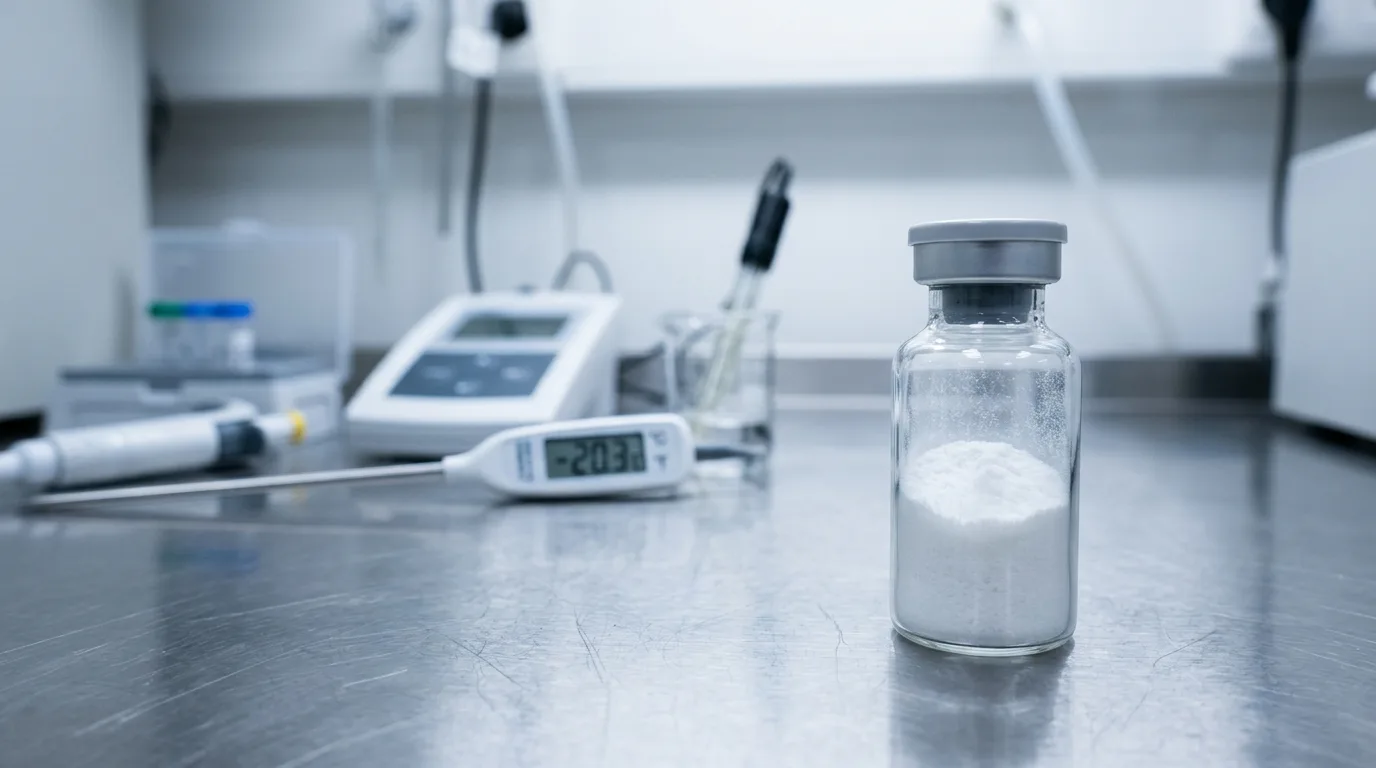
A vial left on a kitchen counter overnight looks the same as one that spent the night in a freezer. Chemically, it is not. A stability survey circulated among biochemistry labs in 2021 found that a majority of peptide samples showed measurable degradation within weeks when handled outside strict cold-chain conditions, a pattern that shows up just as reliably on a refrigerator door as it does in a laboratory freezer left ajar. The finding echoes older work cited in the Journal of Pharmaceutical Sciences on lyophilized peptide degradation, which traced most instability back to a small number of chemical reactions rather than generic "spoilage" [1].
One amino acid comes up again and again in that literature: asparagine. Its side chain is unusually reactive, and it sits at the center of two of the three major degradation pathways described below. One temperature threshold also recurs constantly in formulation guidance: -20°C, the point below which most hydrolysis and oxidation reactions slow to a near standstill for lyophilized powder [2].
None of this is really about warnings. It is about mechanism. Peptides fail through identifiable chemical pathways, and nearly every storage rule that circulates among researchers and patients alike traces back to one of those pathways specifically.
Why Peptides Are Chemically Fragile
Peptides are short chains of amino acids linked by peptide bonds, and that structure makes them considerably more reactive than the small-molecule drugs most people are used to thinking about. A peptide bond is a specific chemical linkage, and the side chains hanging off each amino acid carry their own reactive chemistry, capable of reacting with water, oxygen, or each other under the wrong conditions [3].
Degradation is not random decay in the way food spoilage is often imagined. It follows specific, well-characterized chemical reactions that researchers have studied for decades, using analytical tools like high-performance liquid chromatography and mass spectrometry to track exactly which bonds break and which side chains react first [4].
A 2019 review in the Journal of Pharmaceutical Sciences catalogued three pathways as the dominant failure modes across marketed peptide formulations: hydrolysis, oxidation, and aggregation [1]. Each has a distinct chemistry, a distinct set of vulnerable amino acids, and a distinct storage rule built around preventing it.
Hydrolysis: The Water Problem
Hydrolysis is the breakdown of peptide bonds by water molecules, a reaction that chemically cleaves the chain into smaller fragments. Water does not need to be present in large quantities to cause damage; even trace moisture in a supposedly dry powder can drive the reaction forward over time [5].
Asparagine and aspartate residues are especially vulnerable because their side chains can cyclize and react with the peptide backbone, a process that water accelerates considerably [3][6]. This single reaction is the primary reason lyophilized, or freeze-dried, powder is dramatically more stable than the same peptide in liquid solution. Removing water removes the medium the reaction depends on.
It is also the chemistry behind a rule that seems almost superstitious until explained: warming a vial to room temperature before opening it. A cold vial opened in room-temperature air will condense atmospheric moisture on its interior surfaces, introducing exactly the water that hydrolysis needs [2][7].
How Temperature, pH, and Light Drive Oxidation and Deamidation
Oxidation is a reaction between a peptide's side chains and oxygen, and it accelerates sharply with exposure to light and heat. Four amino acids carry most of the risk: methionine, cysteine, tryptophan, and tyrosine, each of which has side-chain chemistry that reacts readily with reactive oxygen species [8][9].
Deamidation is a related but separate reaction, affecting asparagine and glutamine specifically, and it is highly dependent on both pH and temperature rather than oxygen exposure. The reaction worsens considerably as pH moves from acidic toward neutral or basic conditions [3][10].
Published degradation-rate data illustrates the pH dependence clearly: peptides held in acidic buffer conditions typically show the slowest deamidation rates, neutral pH conditions show a marked acceleration, and basic pH conditions show the fastest degradation of all, sometimes several times the rate observed under acidic storage [3][11]. The breakdown illustrates why buffer selection during reconstitution is not a minor technical detail but a determinant of how long a peptide remains intact.
Aggregation: When Peptides Clump Together
Aggregation is what happens when peptide molecules clump together into larger, often insoluble masses that no longer behave like the original compound. Unlike hydrolysis or oxidation, aggregation is a physical process layered on top of chemical instability, and it tends to be triggered by temperature swings, physical agitation such as shaking or vigorous mixing, and pH conditions that push the peptide away from its most soluble state [12][13].
Aggregation is often visually detectable, a fact that becomes useful later when identifying a peptide that has begun to deteriorate. Cloudiness, visible particles, or a change in how a solution catches light can all indicate that aggregation has begun.
Aggregation can also be irreversible, which sets it apart from some milder forms of chemical stress a peptide might tolerate briefly without lasting harm. Once a substantial fraction of a peptide sample has aggregated, that material is generally not recoverable [14][15].
Lyophilization vs Freezing: Why Form Matters
Lyophilization, commonly called freeze-drying, removes water from a peptide sample under vacuum, and that removal dramatically slows hydrolysis specifically because the reaction has no water left to draw on. Stored at -20°C or -80°C in a tightly sealed, light-protected vial, a lyophilized peptide can remain stable for years [2][16].
Reconstituted liquid peptide is a different chemical situation entirely. Once water is reintroduced, the peptide becomes far more reactive, and its stability window shrinks from years to weeks.
A rough comparison illustrates the gap: lyophilized powder at -20°C can remain stable for roughly one to two years, reconstituted solution refrigerated at 2°C to 8°C typically holds for a few weeks, and reconstituted solution subjected to repeated freeze-thaw cycling can lose meaningful activity within days [17][18]. These numbers highlight why the physical form of a peptide matters as much as its temperature.
Light exposure compounds the risk further, since photons can directly drive oxidation reactions in susceptible side chains like tryptophan and tyrosine, which is why amber vials and dark storage are standard recommendations rather than cosmetic packaging choices [8][19].
The Reconstitution Window: What Happens After Mixing
Once a lyophilized peptide is mixed with a diluent, it should move to refrigeration at 2°C to 8°C rather than back into a freezer or onto a countertop. Freezing a reconstituted solution introduces the freeze-thaw damage described below, while room temperature storage accelerates every pathway already discussed [20].
Typical shelf life after reconstitution runs a matter of weeks, not months, a timeline far shorter than the dry powder form specifically because mixing with water reactivates hydrolysis while simultaneously creating conditions favorable to aggregation and oxidation at the same time [7][21].
Solvent choice during reconstitution and gentle handling also matter. Vigorous shaking introduces mechanical stress that promotes aggregation, so most formulation guidance calls for slow, gentle mixing rather than agitation [12][13].
Freeze-Thaw Cycles and the Case for Aliquoting
Freeze-thaw damage has a distinct mechanism from the pathways above: ice crystal formation. As a solution freezes, ice crystals form and physically disrupt peptide structure, concentrating dissolved peptide into smaller unfrozen pockets where molecules are pushed into closer contact and aggregate [14].
Published estimates suggest each freeze-thaw cycle can cause a loss of activity in the range of 20 percent to 50 percent, an effect that compounds with every additional cycle a vial undergoes [17]. A vial thawed and refrozen five times could plausibly retain only a small fraction of its original activity, though exact figures vary by peptide sequence and formulation.
The practical fix is straightforward: dividing a reconstituted solution into single-use aliquots before freezing, so that only one small portion is ever thawed at a time. This single practice addresses three degradation pathways simultaneously, limiting hydrolysis exposure, reducing aggregation from repeated freezing, and cutting down oxidation driven by repeated air exposure each time a vial is opened [15][16].
Visual Red Flags: Signs a Peptide Has Degraded
Discoloration, particularly a yellowing of powder or solution, is a visual marker often linked to oxidation reactions in progress. It is not proof of a specific reaction, but it is a signal worth taking seriously [9][19].
Changes in powder texture, such as clumping or a gel-like appearance, often indicate that moisture has intruded into what should be a dry sample, a red flag for hydrolysis risk even before reconstitution occurs [2][5].
Cloudiness or visible particles after reconstitution generally point to aggregation or the formation of insoluble degradation products. A solution that was clear at mixing and turns hazy over days or weeks is showing a physical sign of a chemical process already underway [13][14].
These observations function as diagnostic clues rather than definitive proof. Some degradation, particularly early-stage deamidation or low-level oxidation, produces no visible change at all and can only be confirmed through analytical testing [1][6].
Open Questions in Peptide Stability Research
Stability data varies considerably by specific peptide sequence, and the storage rules described here function as reasonable approximations rather than guarantees for every compound. A peptide rich in methionine will behave differently under light exposure than one that contains none, and a sequence with no asparagine or glutamine residues will face a much lower deamidation risk than one that does [3][11].
Published stability studies are also typically conducted under controlled laboratory conditions, with calibrated temperature chambers and analytical monitoring that rarely reflect home refrigerators, shipping containers, or field handling far from a lab bench [4][7].
Researchers continue to study stabilizing excipients and formulation strategies, including buffer systems, cryoprotectants, and alternative lyophilization techniques, aimed at extending shelf life further. This remains an active area of pharmaceutical research, and the literature does not yet offer settled answers for every peptide sequence in circulation [1][20].
Peptide degradation during storage follows traceable chemistry rather than arbitrary decay. Hydrolysis breaks peptide bonds through exposure to water, oxidation and deamidation damage specific side chains under the influence of light, heat, and pH, and aggregation clumps peptide molecules into inactive masses under thermal or mechanical stress. Each widely repeated storage rule, freezing lyophilized powder, warming a vial before opening, refrigerating after reconstitution, and aliquoting before freezing, exists because of a specific reaction it is designed to slow or prevent.
Visual signs like discoloration, clumping, or cloudiness offer useful clues but not certain proof.
Sources
- verifiedpeptides.com — verifiedpeptides.com
- nih.gov — pmc.ncbi.nlm.nih.gov
- sigmaaldrich.com — sigmaaldrich.com
- nih.gov — pmc.ncbi.nlm.nih.gov
- encyclopedia.pub — encyclopedia.pub