
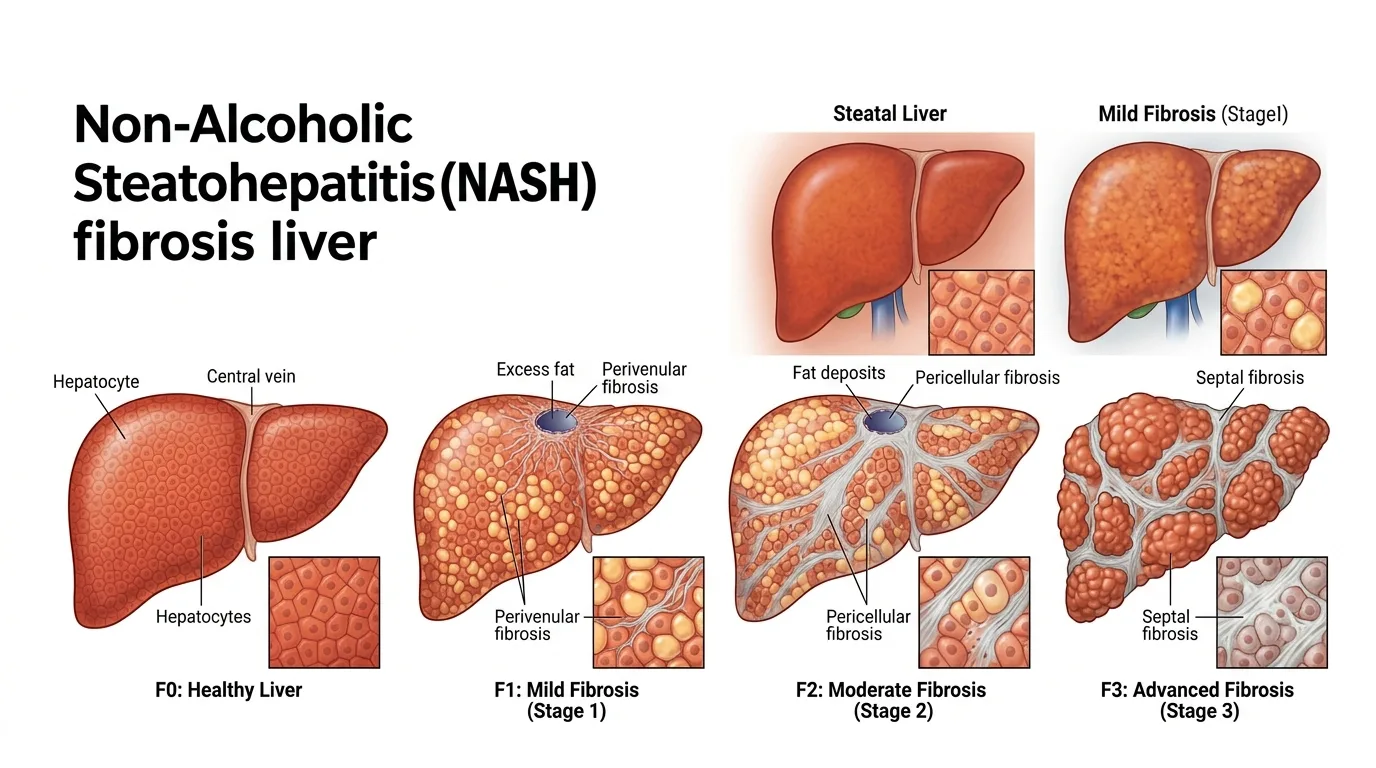
In March 2024, the FDA approved resmetirom, the first drug ever cleared specifically for NASH, closing out a stretch of nearly two decades in which every prior candidate had failed at Phase 3. The STELLAR trials, run to test selonsertib in advanced fibrosis, ended without meeting their primary endpoints. Gilead's obeticholic acid program collapsed under safety concerns after years of regulatory back-and-forth. Boston-based liver imaging consortiums have since built out MRI and elastography protocols specifically to grade fibrosis non-invasively, an effort that reflects just how hard this disease has been to treat and to measure.
Against that backdrop, the rise of GLP-1, GIP/GLP-1, and triple-agonist peptides in NASH research has generated something closer to cautious optimism than declared victory. These compounds, originally built for type 2 diabetes and obesity, are now producing liver biopsy and imaging data that researchers are still working to interpret. The central question is not whether these drugs move the needle. It is what "fibrosis improvement" in a trial readout actually means. Does it mean scarring is reversing, or does it mean disease progression has slowed enough that imaging looks better without the underlying scar tissue actually resolving? This piece attempts to separate those two claims using the data on semaglutide, tirzepatide, and retatrutide as case studies in NASH fibrosis progression peptide therapy reversal research.
What NASH Actually Does to the Liver
Nonalcoholic steatohepatitis, or NASH, is not the same as simple fatty liver. Simple steatosis involves fat accumulation in hepatocytes with little else going on. NASH adds two more layers: inflammation and direct cellular damage, or hepatocyte injury, on top of that fat deposit
. That combination is what makes NASH dangerous in a way plain fatty liver typically is not.
Left unaddressed, NASH can progress along a fairly well-characterized pathway. Steatosis leads to steatohepatitis, which leads to fibrosis, and fibrosis, if it accumulates enough, leads to cirrhosis. Clinicians stage that fibrosis on a five-point scale running from F0, no scarring, to F4, cirrhosis
. Each stage represents a meaningful jump in disease severity and, eventually, in mortality risk.
Recent literature has also renamed the disease. NASH is increasingly referred to as MASH, or metabolic dysfunction-associated steatohepatitis, a shift meant to tie the condition more explicitly to metabolic syndrome rather than to an "alcohol exclusion" framing
. That renaming matters for anyone reading trial data going forward, since newer papers and press releases increasingly use MASH terminology interchangeably with NASH. Estimates of prevalence vary, but the disease is understood to affect a substantial share of adults with obesity and type 2 diabetes, which is precisely the population overlapping with the peptide trials discussed below
.
Fibrosis Progression and Reversal as Trial Endpoints in Liver Disease
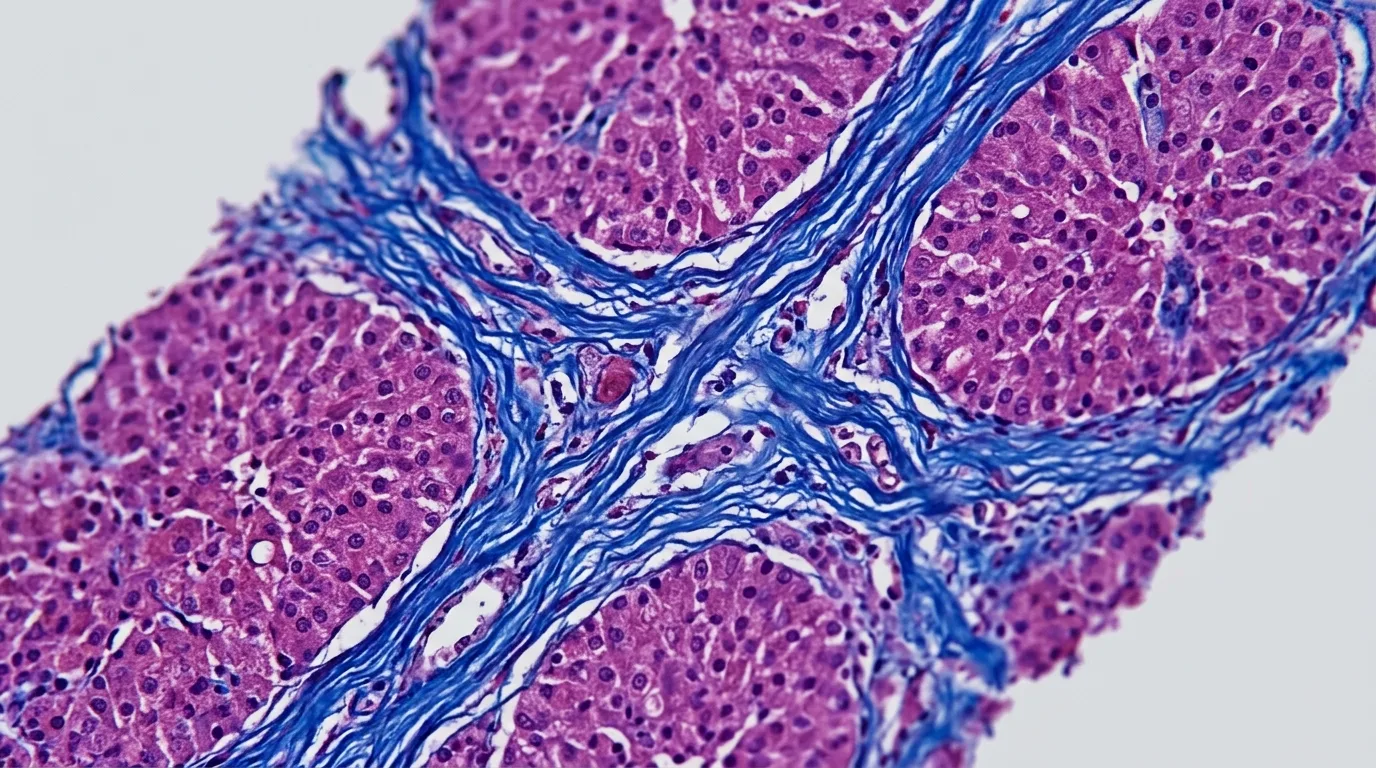
Fibrosis is not inflamed tissue. It is scar tissue, made mostly of collagen, laid down by hepatic stellate cells that become activated in response to chronic liver injury
. Once that collagen matrix is established, it does not disappear simply because the initial insult, whether fat or inflammation, has been addressed.
Biopsy remains the reference standard for staging fibrosis, despite being invasive, costly, and prone to sampling error, particularly in trials that only span months rather than years
. A needle biopsy captures a tiny fragment of an organ that can have uneven scarring distributed across its lobes, which means two biopsies taken from the same liver on the same day can occasionally produce different stage readings.
Pivotal NASH trials have settled on two separate endpoints, and it is worth stating them exactly as regulators and trial sponsors define them: "MASH resolution without worsening of fibrosis," and "fibrosis improvement of at least one stage without worsening of MASH"
. These are not two ways of describing the same outcome. A drug can resolve the inflammatory component of NASH while leaving fibrosis stage unchanged, and a drug can improve fibrosis by one stage while some inflammatory activity persists. Semaglutide's own trial history, discussed below, is the clearest illustration of just how disconnected those two outcomes can be.
How Metabolic Peptides Are Thought to Act on the Liver
GLP-1, GIP/GLP-1, and GLP-1/GIP/glucagon triple agonists were not designed with the liver as the primary target. They were developed for glycemic control and weight loss in type 2 diabetes and obesity, and their liver effects were discovered, in large part, as a downstream consequence of those original indications
.
The leading hypothesis is straightforward: substantial weight loss reduces the metabolic load moving through the liver. Less circulating fat means less fat delivered to hepatocytes, which in turn means less lipotoxic stress and less of the downstream inflammatory cascade that drives NASH forward
. Under that model, liver improvement is essentially a secondary effect of systemic metabolic improvement, not a liver-specific action of the peptide itself.
A second, less-established hypothesis runs in parallel. Some researchers have proposed that GLP-1 and related peptides exert direct anti-inflammatory or cytokine-modulating effects on hepatic tissue, independent of weight change
. This NASH inflammation cytokine peptide mechanism has support in preclinical models, but the extent to which it operates in humans, separate from weight loss, is not fully understood. Investigators at academic centers studying these compounds have generally been careful to frame this second mechanism as a hypothesis under active investigation rather than a settled finding.
Semaglutide: Resolution Without Fibrosis Improvement
Semaglutide's NASH data offers the sharpest illustration of the resolution-versus-fibrosis gap discussed above. In its Phase 2 trial, semaglutide produced NASH resolution in 59 percent of treated patients, a striking figure by the standards of the field. Yet that same trial failed to meet its co-primary endpoint for fibrosis improvement
.
That result alone would have suggested a drug that clears inflammation but leaves scarring untouched. The picture shifted with longer follow-up. A later Phase 3 trial, run over a longer duration and with a larger cohort, found a statistically significant one-stage improvement in fibrosis in 36.6 percent of patients
.
Phase 2 showed 59 percent NASH resolution but no significant fibrosis improvement. Phase 3, conducted over a longer observation window, showed 36.6 percent of patients achieving at least one-stage fibrosis improvement. The breakdown illustrates how trial duration and cohort size can change which endpoints a drug appears capable of meeting, and it should caution against reading any single trial phase as a final verdict.
The discrepancy between these two readouts is instructive. It suggests that inflammatory resolution can happen relatively quickly, within the timeframe of a Phase 2 study, while measurable fibrosis change requires more time, a larger sample, or both. It also underscores that "the drug works" is not a single binary outcome in NASH research; it is a question with at least two separate answers depending on which endpoint is being asked about.
Tirzepatide and the GIP/GLP-1 Dual Agonist Data
Tirzepatide, a dual GIP/GLP-1 agonist originally developed for type 2 diabetes and obesity, has produced some of the more encouraging fibrosis figures in this class of drugs. In Phase 2 trial data, 51 to 55 percent of participants receiving tirzepatide achieved at least a one-stage improvement in fibrosis, compared with 30 percent of those on placebo
.
Tirzepatide's fibrosis-improvement rate reached 51 to 55 percent versus a 30 percent placebo response, for a placebo-adjusted effect of roughly 20 to 25 percentage points. Semaglutide's Phase 3 fibrosis-improvement rate, by comparison, sat at 36.6 percent. These numbers highlight the different magnitude of effect across drug classes, even though direct cross-trial comparisons carry real limitations given differing patient populations and trial designs.
A 20 to 25 percentage point placebo-adjusted effect is statistically meaningful, but it is worth being precise about what that means clinically. It indicates that roughly one in five to one in four patients experienced a fibrosis improvement attributable to the drug beyond what placebo alone produced, largely through diet counseling and monitoring built into trial protocols. That is a real effect, but it also means a majority of patients in the same cohort did not meet that one-stage improvement threshold within the trial window.
Researchers studying tirzepatide have proposed that its dual GIP/GLP-1 activity may add a mechanism beyond weight loss alone, potentially touching on lipid handling or insulin sensitivity pathways specific to GIP receptor activity
. That hypothesis remains under investigation, and the evidence distinguishing a GIP-specific liver effect from weight-loss-driven improvement is still limited.
Retatrutide: Liver Fat Reduction Ahead of Fibrosis Proof
Retatrutide, a triple agonist acting on GLP-1, GIP, and glucagon receptors simultaneously, has produced the most dramatic liver fat numbers reported so far in this drug class. In a Phase 2a trial, retatrutide produced a mean liver fat reduction exceeding 80 percent, as measured by MRI
.
That figure deserves a precise reading. It is a fat measurement, obtained through magnetic resonance imaging, not a biopsy-confirmed fibrosis outcome. MRI can quantify the volume of fat within liver tissue with good accuracy, but it does not directly visualize collagen deposition or stage scar tissue the way a biopsy does.
Comprehensive biopsy data on retatrutide's effect on fibrosis is still pending, expected from ongoing Phase 3 trials
. Until that data arrives, the 80 percent liver fat reduction figure should be understood as a surrogate marker, a strong signal that the metabolic environment inside the liver is improving, rather than as proof that existing scar tissue is regressing.
Retatrutide is, in that sense, the clearest case study for the distinction this article is trying to draw. Fat clearance, inflammation resolution, and fibrosis reversal are three separate biological events, and a drug's success at the first does not guarantee success at the third. Retatrutide's imaging data is genuinely impressive on its own terms; whether it translates into biopsy-confirmed fibrosis regression is a question the field cannot yet answer.
Improvement Versus Reversal: What the Biopsy Data Actually Shows
It is worth restating plainly what a "one-stage fibrosis improvement" represents on the F0 through F4 scale. It is a partial regression, a single step backward on a discrete five-point scale, not an elimination of scarring
. A patient who moves from F3 to F2 still has meaningful fibrosis present; the disease has not been reversed to a healthy baseline.
This distinction matters most in patients with advanced fibrosis. A one-stage shift from F3 to F2, or even F4 to F3 in principle