
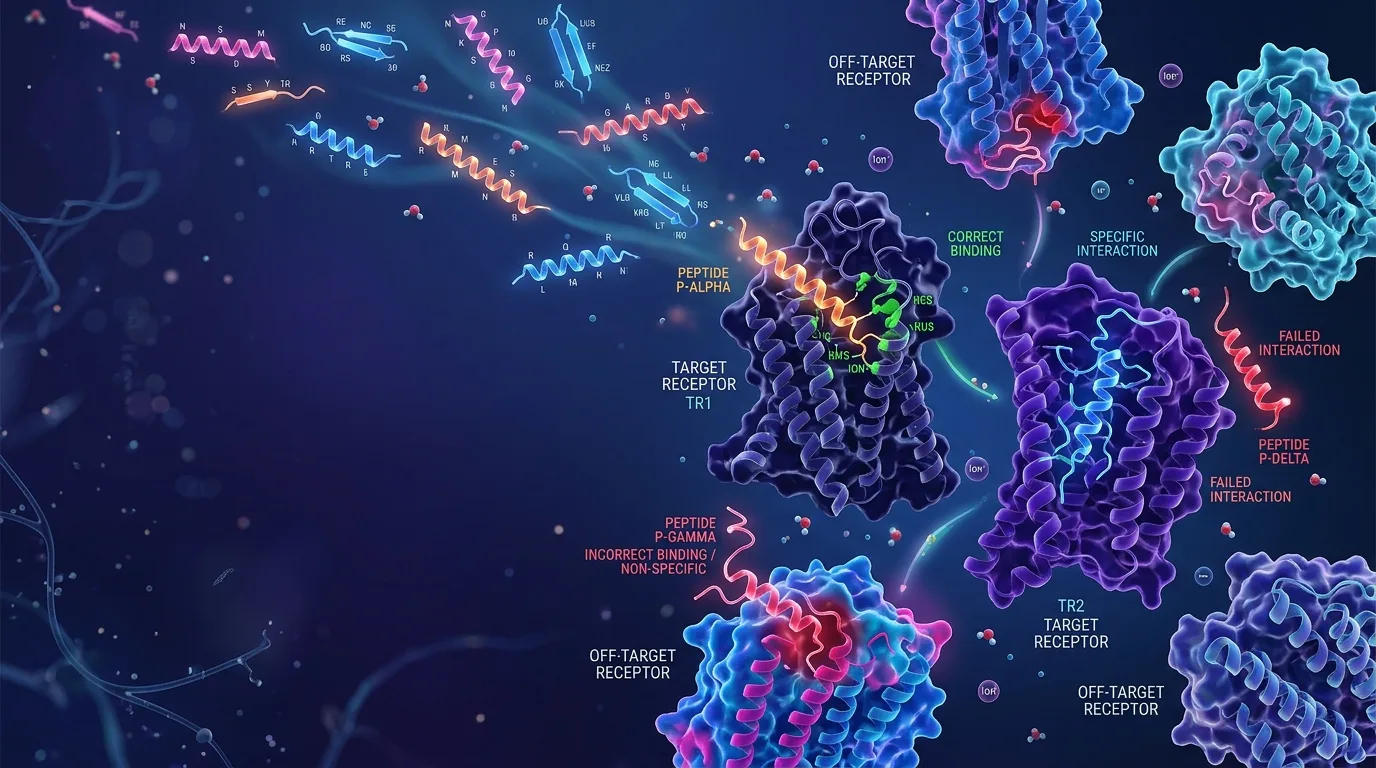
In May 2022, the FDA approved tirzepatide, a molecule that Eli Lilly had spent nearly a decade refining. The drug did something unusual for a peptide therapy: it was built, on purpose, to bind two different receptors at once. That design choice sat on top of a question that had followed incretin research since the early 2000s. Why does a peptide engineered to fit one receptor so often end up activating another one nearby?
The answer has little to do with sloppy chemistry. It has to do with evolution. The glucagon receptor family, a group of Class B G-protein coupled receptors that includes the GLP-1, GIP, and glucagon receptors, shares enough structural ancestry that a peptide shaped for one member frequently fits the others too. Researchers at Eli Lilly, building on decades of incretin biology first mapped by academic labs studying gut hormone signaling, didn't fight that overlap in tirzepatide's case. They used it.
This article walks through why that overlap exists in the first place, using the glucagon receptor family as the case study, and then examines the opposite problem: how medicinal chemists try to strip that overlap away when selectivity, not dual action, is the goal. Both approaches are active in labs right now, and neither is fully solved.
Cross Reactivity, Off-Target Binding, and Unintended Effects in Peptide Pharmacology
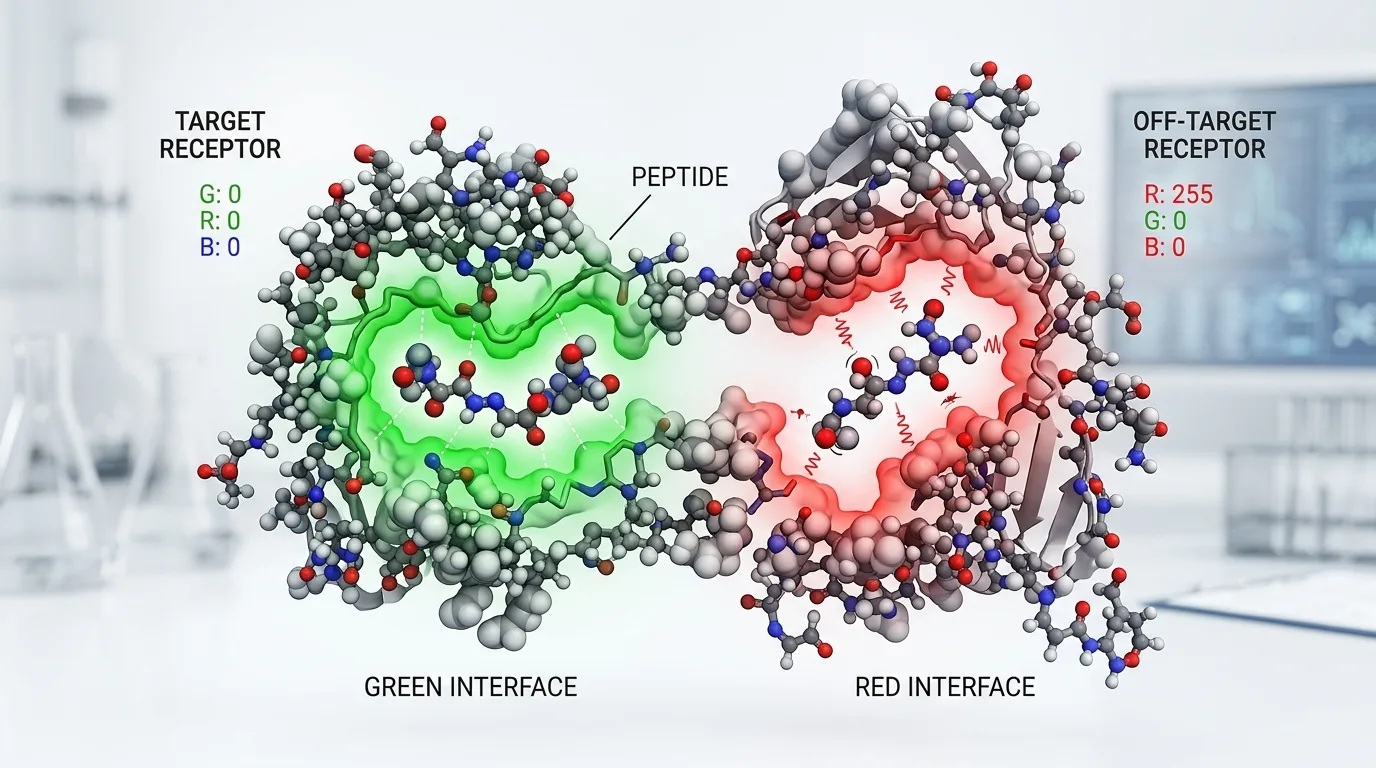
Peptide cross reactivity off target binding unintended effects describes a specific, well-documented phenomenon: a peptide synthesized to bind one receptor also binds one or more structurally related receptors, triggering signaling that wasn't the original design target [1]. This isn't framed here as a claim about human benefit or harm. It's a pharmacological event, observable in receptor-binding assays and cell models, that shapes how a compound behaves once it leaves the test tube.
The concept most people reach for is lock and key. A receptor is the lock, a peptide is the key, and a correctly cut key opens only its intended lock. That analogy holds up reasonably well at the level of a single interaction. It breaks down, however, once locks start resembling each other.
Two technical ideas sit underneath this discussion. Peptide specificity refers to how selectively a molecule binds its intended target versus related ones. Receptor selectivity describes the same relationship from the receptor's side, how well it distinguishes one peptide ligand from its structural cousins. Both concepts are necessary to understand why cross-reactivity happens, and why eliminating it entirely has proven difficult across multiple receptor families, not just the glucagon-related ones discussed here.
The Lock-and-Key Model and Why It Breaks Down
Receptors don't exist as isolated, uniquely shaped locks scattered across the genome. Many of them belong to families, groups of receptors descended from a shared ancestral gene that duplicated and diverged over millions of years. The result is a set of locks that look different enough to serve different purposes but similar enough to still respond to some of the same keys.
This shared ancestry produces what researchers call structural homology, meaning stretches of amino acid sequence and three-dimensional shape that remain conserved across related receptors [2]. Homology isn't identity. Two receptors in the same family can differ substantially in their overall sequence while still sharing the specific binding pocket architecture that determines which peptides can dock there.
A peptide "key" cut precisely enough to trigger one receptor in the family often retains just enough complementary shape to partially engage a neighboring receptor as well. Peptide structural similarity cross-reactivity is not a manufacturing defect or a sign of poor synthesis. It is closer to a structural inevitability, a byproduct of the same evolutionary process that gave rise to the receptor family in the first place. That inevitability becomes concrete in one family in particular.
A Family of Similar Locks: The Glucagon Receptor Class
The glucagon receptor family belongs to Class B GPCRs, a subgroup distinct from the far larger Class A family that includes receptors for dopamine and serotonin. Within Class B sit the GLP-1 receptor, the GIP receptor, and the glucagon receptor itself, three separate proteins that each respond to a different gut or pancreatic hormone under normal physiology [3].
What makes this family structurally distinctive is a shared two-domain architecture. Each receptor carries a large extracellular N-terminal domain that functions like a hook, catching the tail end of an incoming peptide hormone [4]. That initial capture positions the peptide's head region against the receptor's transmembrane domain, the portion embedded in the cell membrane that actually triggers the conformational change leading to activation.
Because GLP-1, GIP, and glucagon are themselves structurally related peptide hormones, sharing overlapping sequence stretches from a common evolutionary origin, the receptors built to recognize them inherited a matching family resemblance [5]. A hook shaped to catch one hormone's tail often catches a related hormone's tail reasonably well too, even if the resulting activation of the transmembrane domain is weaker or less precise. Receptor homology peptide drug design in this family isn't an edge case; it's close to the default condition. The similarity is pronounced enough that researchers routinely compare sequence homology percentages across the three receptors when mapping which regions drive selective binding versus shared cross-reactivity. The breakdown illustrates why this particular receptor family became such a fertile testing ground for both accidental cross-reactivity and, eventually, deliberate multi-receptor drug design.
Turning a Problem Into a Strategy: Tirzepatide and Dual Agonists
For years, cross-reactivity within the glucagon receptor family was treated mainly as a liability, something to engineer away. Tirzepatide inverted that framing. Eli Lilly researchers built the molecule specifically to activate both the GIP and GLP-1 receptors, using the family's known structural overlap as a starting point rather than an obstacle [6].
The logic depended on the same shared hook-and-transmembrane architecture described above. Because the two receptors' extracellular domains recognize overlapping tail sequences, a single engineered peptide could be shaped to engage both hooks effectively, then trigger both transmembrane activation events, producing combined signaling that neither receptor alone would generate. This is dual-agonist design: one molecule, two intended targets, deliberately chosen rather than stumbled into.
That approach hasn't stopped at two receptors. Several pharmaceutical groups are now developing triple agonists intended to engage GIP, GLP-1, and glucagon receptors simultaneously, an active area of development rather than a finished product category [7]. The scope of targeting has moved in stages: single-agonist peptides engage one receptor, dual agonists like tirzepatide engage two, and triple agonists under investigation aim for three within the same receptor family. Each additional target changes the molecule's overall pharmacological profile, and each step has required its own structural adjustments to keep the added activity from destabilizing the rest of the design.
Engineering Selectivity: How Chemists Fine-Tune a Peptide's Fit

Not every peptide program wants cross-reactivity. When a single, clean target is the goal, medicinal chemists turn to structure-activity relationship studies, usually shortened to SAR, a systematic method for identifying which parts of a peptide's structure actually matter for binding and which are structurally incidental [8].
Alanine scanning is one of the most common SAR techniques. Researchers replace individual amino acids in the peptide sequence, one at a time, with alanine, a small, chemically inert amino acid with minimal side-chain bulk. If swapping out a given residue collapses binding activity, that position is likely critical to receptor engagement. If activity barely changes, the original amino acid at that position was probably not doing much structural work [9].
Truncation studies approach the same question from a different angle, progressively shortening the peptide from one or both ends to find the minimum fragment still capable of activating the receptor. This identifies the essential structural core and strips away regions that add length without adding function [10].
Once the critical residues are mapped, chemists move to amino acid substitution, swapping specific residues for chemically similar alternatives that might improve fit at the intended receptor while worsening fit at related ones [11]. Conformational constraint, often achieved through cyclization, locks the peptide into a fixed three-dimensional shape rather than letting it flex freely in solution. A rigid, correctly shaped peptide is less able to awkwardly accommodate a neighboring receptor's slightly different binding pocket, which is often the point.
The Trade-Offs of Chasing Selectivity
Selectivity doesn't come free. Locking a peptide into a narrower, more precise fit for one receptor can reduce its overall potency at that same receptor, sometimes requiring larger amounts of the compound to achieve equivalent activation compared to a less selective version [12]. Precision and strength aren't always aligned; a peptide can become more discriminating and less powerful at the same time.
Structural modifications built for selectivity, particularly cyclization and non-standard amino acid substitutions, also tend to increase manufacturing complexity. Each additional synthetic step adds cost and introduces more opportunities for batch inconsistency, a practical concern for any program moving toward larger-scale production [13].
Selectivity also has to coexist with other pharmacological properties that matter just as much: how long the peptide remains stable in circulation before being broken down, and how long its activity persists once it reaches the receptor. A highly selective peptide that degrades within minutes solves one problem while creating another. None of this is a solved equation. It's an ongoing negotiation among competing design priorities, and researchers working on different receptor families still disagree about which trade-offs are worth making for a given therapeutic goal.
Why Receptor Homology Still Shapes Modern Drug Design
Receptor homology isn't a quirk confined to the glucagon receptor family. It's a consideration built into early-stage design work across many peptide-receptor systems, anywhere a family of related receptors shares evolutionary ancestry [14]. The GLP-1/GIP/glucagon case is well documented largely because incretin biology has drawn sustained pharmaceutical investment, not because the underlying structural logic is unique to it.
Computational modeling of receptor structures has become an increasingly common tool for predicting cross-reactivity before a peptide is ever synthesized, allowing researchers to flag likely off-target binding early in the design process [15]. These models are improving, but they remain imperfect. Off-target activity is still sometimes discovered only after a compound has advanced well into later-stage testing, when structural predictions made years earlier turn out to have missed something.
An Unresolved Design Question
Cross-reactivity, in the end, is neither a flaw to be apologized for nor a guarantee of therapeutic success. It's a structural consequence of receptors that share a common evolutionary lineage, and medicinal chemists have learned to treat that consequence in two opposite ways depending on what a given program needs. Tirzepatide's dual-agonist design, and the triple agonists now moving through development, show cross-reactivity being deliberately exploited. SAR-driven selectivity work, built on alanine scanning, truncation, substitution, and cyclization, shows the opposite instinct very much alive in parallel.
How the field eventually balances selectivity, potency, and manufacturability as more receptor families get mapped in this kind of structural detail remains an open question, one that different labs are answering differently depending on the receptor system in front of them.
Stay current on peptide chemistry research as it develops. Subscribe to the Molecule Notes newsletter for rigorously sourced analys
Sources
- receptor.ai — receptor.ai
- nih.gov — pubmed.ncbi.nlm.nih.gov
- infinixbio.com — infinixbio.com
- nih.gov — pmc.ncbi.nlm.nih.gov
- nih.gov — pmc.ncbi.nlm.nih.gov
- creative-peptides.com — creative-peptides.com
- creative-proteomics.com — creative-proteomics.com
- acs.org — pubs.acs.org
- nih.gov — pubmed.ncbi.nlm.nih.gov
- acs.org — pubs.acs.org
- nih.gov — pubmed.ncbi.nlm.nih.gov
- nih.gov — pmc.ncbi.nlm.nih.gov
- rsc.org — pubs.rsc.org
- ucdavis.edu — zhu.physics.ucdavis.edu
- nih.gov — pubmed.ncbi.nlm.nih.gov