
In 2004, researchers running chronic exposure experiments on cultured cells found something that should have alarmed anyone betting on GLP-1 receptor agonists as durable therapeutics: the receptor desensitized within hours. Continuous exposure to the agonist blunted the cell's response fast, in the kind of timeframe that would suggest any drug built on this mechanism was destined to stop working almost as soon as it started. Yet when the same compounds were tested in live animal models, glucose control held. The desensitization observed in a dish did not translate to a loss of efficacy in a functioning body [1].
That gap, between what happens to a receptor in isolation and what happens to an organism as a whole, sits at the center of nearly every claim about peptide tolerance circulating today. A 2025 systematic review and meta-analysis pooling 55 trials found that GLP-1 receptor agonists sustain their effect for at least two years, with only a slight attenuation appearing after the 104-week mark [2]. That is a substantial, regulator-grade evidence base. Growth hormone secretagogues like Sermorelin and CJC-1295 have nothing comparable. This article looks at what the literature actually documents about peptide tachyphylaxis, receptor tolerance, and long-term treatment resistance, and where the conversation has drifted into territory the data does not yet support.
Tachyphylaxis, Tolerance, and Desensitization: Three Different Words
Precision matters here because these three terms describe different timescales and different mechanisms, even though casual peptide discussion often treats them as synonyms.
Tachyphylaxis is a rapid, acute drop in drug response that can appear after a single dose. It is not resolved by raising the dose, a detail that matters clinically because the instinct to push more compound at a fading effect is often exactly the wrong move [3]. Tolerance, by contrast, unfolds more slowly, over days to months, and typically requires a higher dose to reproduce the original effect. Unlike tachyphylaxis, tolerance is frequently reversible once the drug is stopped [4].
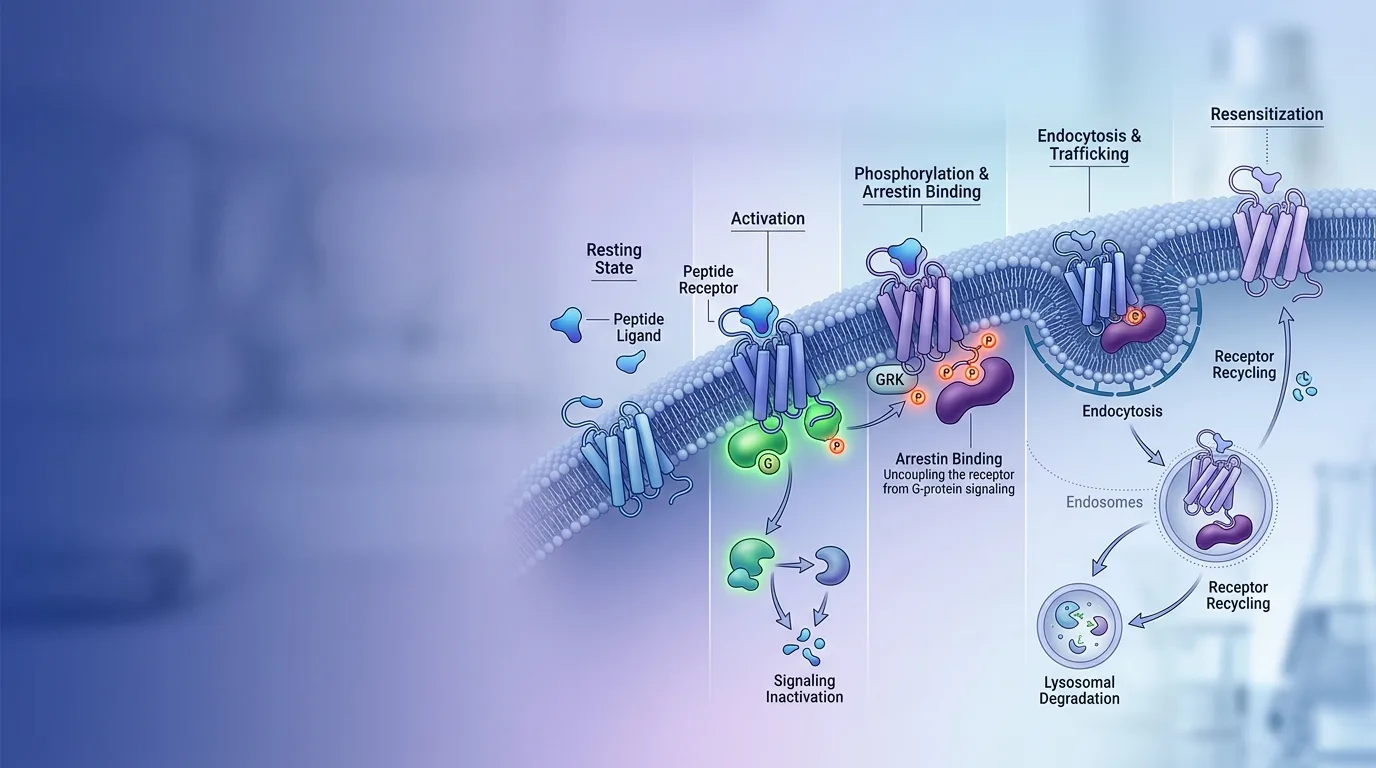
Receptor desensitization and receptor downregulation are related but distinct mechanisms underneath both phenomena. Desensitization is a functional modification of the receptor, usually temporary. Downregulation is a physical reduction in the number of receptors available on the cell surface, achieved through internalization [5]. A desensitized receptor is still there, just less responsive. A downregulated one has been pulled inside the cell and is, for the moment, gone. Collapsing these three concepts into a single word, "tolerance," makes it nearly impossible to interpret anecdotal reports about a peptide "stopping working."
Peptide Tachyphylaxis, Receptor Tolerance, and Treatment Resistance at the Molecular Level
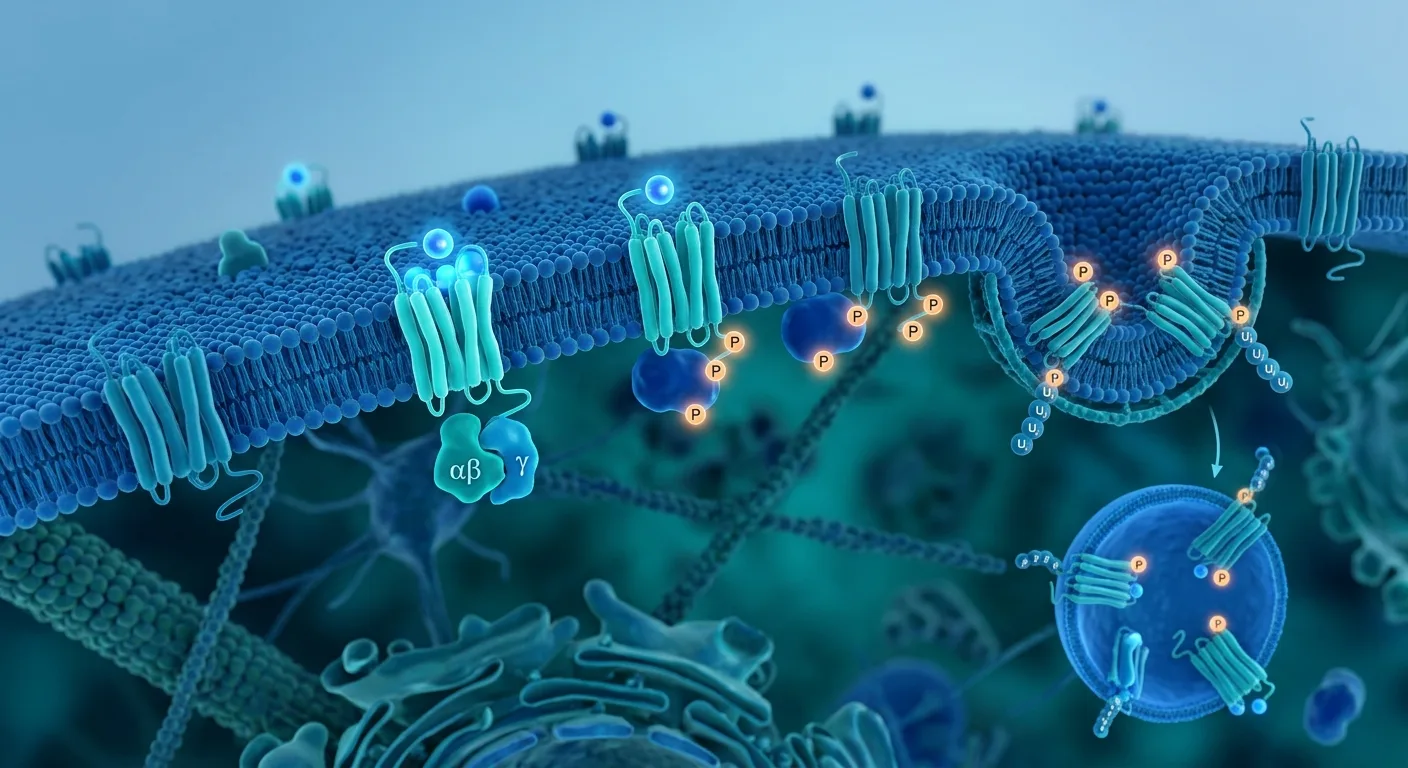
Most peptides relevant to this discussion act on G-protein coupled receptors, or GPCRs, a large family of cell-surface proteins that translate an external chemical signal into an internal cellular response.
The desensitization sequence is fairly well characterized mechanistically. Sustained agonist exposure triggers phosphorylation of the receptor, which recruits a protein called beta-arrestin. Beta-arrestin binding both uncouples the receptor from its normal signaling pathway and marks it for internalization, pulling it away from the cell surface [5]. Repeated exposure over time can reduce the density of receptors available at the surface, which is the structural basis for downregulation. None of this, however, guarantees a corresponding loss of effect in a whole organism. Cell culture systems lack the redundancy, compensatory signaling, and receptor reserve that living systems often have. The 2004 finding of rapid GLP-1 receptor desensitization in vitro is the clearest illustration of that gap [1]. What happens in a petri dish is a starting hypothesis, not a forecast.
GLP-1 Receptor Agonists: What the Long-Term Data Actually Shows
GLP-1 receptor agonists are, by a wide margin, the best-documented peptide class when it comes to long-term human efficacy data, largely because FDA approval pathways demanded years of controlled trials before these drugs reached pharmacies.
The 2025 systematic review and meta-analysis of 55 trials is the most comprehensive answer available to the question of whether GLP-1 drugs lose potency over time. Its conclusion is direct: efficacy is sustained for at least 104 weeks, or two years, with only a slight attenuation appearing after that point [2]. That is a meaningfully different picture than the rapid desensitization described in the 2004 cell-culture work. The breakdown illustrates just how far apart the in-vitro and in-vivo timelines are, one measured in hours, the other holding steady across years.
Researchers have proposed a few explanations for the discrepancy. One is receptor reserve, the idea that tissues often have more receptors than strictly necessary for a maximal response, so some degree of desensitization can occur without any detectable drop in the physiological output. Another is compensatory signaling through parallel pathways that pick up slack when one receptor population underperforms. Neither explanation is fully settled, and the mechanism connecting molecular-level desensitization to whole-body glycemic control is not fully understood. What is clear is that the scale of FDA-mandated trial data behind GLP-1 drugs makes this one of the few peptide tolerance narratives grounded in something more than case reports.
Growth Hormone Secretagogues: A Thinner Evidence Base
The contrast with growth hormone secretagogues is stark. Compounds like Sermorelin and CJC-1295 have a comparatively sparse, non-rigorous long-term human data set, according to charlestonhealthspan.com [6]. There is no equivalent to the 55-trial GLP-1 review for this class of peptides.
What does exist is more mechanistic than clinical. PMC-documented research on growth hormone-releasing peptides, or GHRPs, found that the method of administration matters: continuous infusion produced desensitization more readily than intermittent or pulsatile dosing [7]. That finding lines up with basic endocrine physiology. Endogenous GHRH and ghrelin signaling occurs in pulses, not steady streams, and receptor systems that evolved around pulsatile input may simply be less prepared for constant occupancy. That is a reasonable hypothesis, but it is still an inference built from administration-pattern studies, not a direct measurement of long-term human treatment resistance. The honest accounting is that mechanistic rationale for GH secretagogue tolerance is stronger than the clinical evidence for it. Anecdotal reports of GH secretagogues "stopping working" circulate widely in casual peptide discussion, but none of that carries the weight of a controlled, multi-year trial.
Comparing the Evidence: FDA-Approved Peptides vs Research Peptides
The disparity between these two peptide classes is not really about biology. It is about which compounds went through a regulatory gauntlet that generates long-term efficacy data and which did not.
GLP-1 receptor agonists moved through FDA Phase I, II, and III trials, each stage adding sample size, duration, and oversight before approval. That process is expensive and slow, but it is precisely what produced the 55-trial evidence base and the 104-week efficacy figure. Sermorelin and CJC-1295 have not traveled that same regulatory road, so no comparably sized, comparably monitored trial data set exists for them. Funding contraction after 2008 compounded the problem across the peptide field generally. Several programs that had advanced into later-stage trials simply stopped, and the number of peptide compounds reaching Phase III narrowed considerably in the years that followed. That funding history helps explain why some peptide classes have thin long-term data even decades after their initial characterization. None of this means growth hormone secretagogues are ineffective or unsafe. Absence of large-scale trial evidence is not evidence of absence of effect. It does mean that claims about their long-term tolerance profile, in either direction, rest on a much smaller and less rigorous foundation than claims made about GLP-1 drugs.
Is Tolerance Reversible?
The reversibility question splits cleanly along the tachyphylaxis-versus-tolerance line established earlier.
Tachyphylaxis, being an acute and rapid phenomenon, tends to resolve within hours to days once the drug is discontinued. Tolerance, developing more gradually, generally requires a longer discontinuation window to reverse. The "drug holiday" concept, a defined period of stopping treatment to allow a receptor system to reset and regain sensitivity, is the most commonly cited approach to reversing tolerance-type responses [8]. What remains genuinely unresolved is how long that reset actually takes for different receptor systems and different peptides. There is no standardized human trial data measuring reset timelines directly, comparing, for instance, a two-week discontinuation period against a six-week one across a defined population. Clinical practice around drug holidays for peptides currently draws more on general pharmacological principle than on peptide-specific controlled trials. That is a genuine open question in the field, not a settled protocol.
How Clinicians and Researchers Monitor for Diminished Response
Monitoring for a fading response generally runs on two parallel tracks: what a patient reports feeling and what laboratory testing shows. Subjective tracking covers changes in energy, sleep quality, and mood, self-reported measures that are useful but inherently noisy [6]. Objective biomarker testing is the more reliable track, and the specific marker depends on the peptide class.
For GH secretagogues, the primary biomarker is Insulin-like Growth Factor 1, or IGF-1, with testing recommended roughly every three to six months to confirm levels sit within an expected range [9]. That interval reflects the pace at which meaningful physiological change would plausibly show up, not an arbitrary calendar habit. For GLP-1 drugs, the equivalent monitoring centers on HbA1c, fasting glucose, and weight trends tracked across similarly spaced multi-month windows. The clinically important point is what happens after a decline shows up. Because tachyphylaxis is not resolved by increasing the dose, a documented drop in response should prompt investigation into cause, not an automatic escalation. Raising the dose in response to apparent tachyphylaxis is, per the underlying pharmacology, unlikely to restore the original effect and may simply compound the exposure without benefit.
Strategies Proposed to Prevent or Delay Diminished Response

Several strategies circulate in both clinical and casual peptide use aimed at preventing or delaying diminished response, though the strength of evidence behind them varies considerably.
Pulsatile dosing, structuring administration to mimic the body's natural, intermittent hormone release patterns rather than maintaining constant exposure, is one such approach [10]. The logic follows directly from the GHRP administration-pattern findings discussed earlier: continuous infusion desensitizes receptors more readily than intermittent exposure, so replicating a pulse-like pattern is thought to reduce that risk. Using the lowest effective dose is another commonly cited principle, aimed at minimizing unnecessary receptor overstimulation. Peptide "cycling," alternating defined periods of use with periods of non-use, is perhaps the most widely discussed strategy in casual peptide circles, framed as a way to preserve receptor sensitivity over time. But evidence-based cycling protocols, validated through rigorous clinical trials, are not well established for many newer peptides [6]. These strategies are grounded in mechanistic plausibility, reasoning from how GPCRs are known to behave, rather than in controlled human trial outcomes demonstrating that cycling or pulsatile dosing actually
Sources
- nih.gov - pubmed.ncbi.nlm.nih.gov
- nih.gov - pubmed.ncbi.nlm.nih.gov
- derangedphysiology.com - derangedphysiology.com
- litfl.com - partone.litfl.com
- mdpi.com - mdpi.com
- charlestonhealthspan.com - charlestonhealthspan.com
- nih.gov - pmc.ncbi.nlm.nih.gov
- towsenclinic.com - towsenclinic.com
- formblends.com - formblends.com
- newtropin.com - newtropin.com