
In January 1921, in a small laboratory at the University of Toronto, Frederick Banting and his team faced a problem that had nothing to do with discovering insulin and everything to do with keeping it working. The hormone, extracted from canine pancreas tissue, degraded so quickly once injected that diabetic patients needed multiple doses a day just to keep their blood sugar from swinging out of control. The insulin worked. It simply didn't last.
Nearly a century later, the FDA approved semaglutide in 2017, a peptide drug for type 2 diabetes that requires an injection roughly once a week. Same broad therapeutic territory, blood sugar regulation through a peptide hormone. Wildly different dosing schedule.
What changed, chemically, in the span between Toronto in 1921 and the FDA's approval decision in 2017, is the real story here. It has little to do with discovering better hormones and everything to do with learning how to protect the ones already known. That story runs through peptide post translational modifications, phosphorylation, glycosylation, and a handful of synthetic tricks that chemists borrowed, adapted, and eventually industrialized.
The Problem With Unmodified Peptides
A peptide fresh off a synthesis line, or freshly extracted from tissue the way Banting's insulin was, is a fragile thing. It is a short chain of amino acids with no armor. The kidneys filter it out of the bloodstream within minutes, since peptides below a certain size pass through the glomerulus almost as easily as water. Meanwhile, proteases, the enzymes that chew proteins apart, are circulating in blood and tissue specifically to break down loose peptide chains.
The result is a molecule that might be biologically active for seconds and clinically irrelevant within minutes. Unmodified peptides are often cleared from circulation before a clinician could reasonably expect them to reach their target receptor in sufficient concentration. Modified peptides, by contrast, can persist for hours or, in some cases, days. That gap, minutes versus days, is not a matter of degree. It is the difference between a molecule that can be a drug and one that cannot.
This is where post-translational modifications, or PTMs, become central to the story. PTMs are the chemistry that determines whether a peptide functions as a durable therapeutic or a fleeting biological signal. Some of these modifications occur naturally inside cells, part of the machinery organisms already use to regulate their own proteins. Others are added synthetically, after a peptide has already been built, specifically to solve the clearance and degradation problems that plague raw peptide chains. The rest of this piece walks through both categories, and what each one is actually doing at the molecular level.
Natural Post-Translational Modifications: Phosphorylation, Glycosylation, and the Body's Own Toolkit
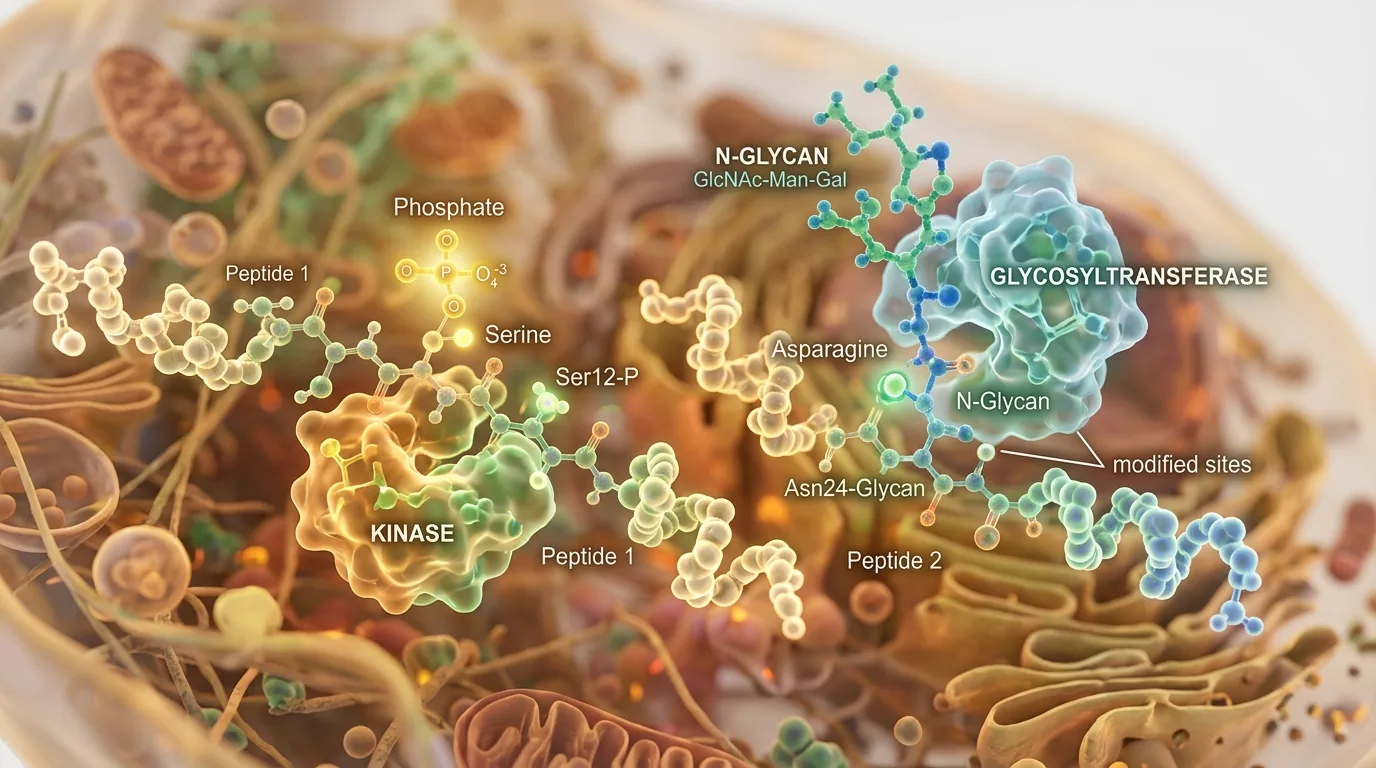
Post-translational modifications, defined precisely, are chemical alterations made to a peptide or protein after it has already been assembled from amino acids. They are distinct from the amino acid sequence itself. Two peptides can have identical sequences and behave completely differently depending on what has been chemically attached to them afterward.
Phosphorylation is one of the most studied examples. It involves adding a phosphate group to a serine, threonine, or tyrosine residue on the peptide chain. Enzymes called kinases carry out this reaction, and the effect is often described as a cellular on/off switch. Phosphorylation can activate or deactivate enzyme function, and it governs a large share of the protein-protein interactions that keep a cell's internal signaling running. It is fast, reversible, and constantly being added and removed as conditions change.
Glycosylation works differently. It involves attaching carbohydrate chains, known as glycans, to specific sites on a peptide or protein. Glycosylation plays a role in proper protein folding, in overall structural stability, and in how cells recognize one protein from another. Critically for drug design, glycans can also physically shield a peptide from the enzymes that would otherwise degrade it, and they appear to reduce immunogenicity, meaning the likelihood that a patient's immune system will recognize the drug as foreign and mount a response against it.
Pharmaceutical chemists did not invent these mechanisms. They studied them, in cellular systems where phosphorylation and glycosylation had already been doing this work for millions of years, and then asked whether the same chemistry could be borrowed or mimicked in a therapeutic peptide built in a lab.
Phosphorylation and Glycosylation in Therapeutic Design
Glycosylation has proven far easier to exploit commercially than phosphorylation. Several biologic drugs, including certain erythropoiesis-stimulating agents used to treat anemia, are deliberately engineered with additional glycan attachments. The added bulk from the glycan chains slows clearance and physically blocks some of the enzymatic cleavage sites that proteases would otherwise target. The peptide backbone is unchanged. What has changed is the shielding around it.
Phosphorylation is a harder modification to build a drug around, largely because it is designed by biology to be transient. Kinases add phosphate groups, and phosphatases remove them, often within seconds, as part of a constantly shifting signaling state. That reversibility makes phosphorylation an excellent research tool for understanding cell signaling, but a poor candidate for a fixed, stable modification that a formulation chemist could rely on to extend a drug's half-life. Researchers tend to study phosphorylation to understand a target's biology rather than to engineer it directly into the final drug molecule.
How much a specific glycan structure actually contributes to reduced immunogenicity remains an open question. Evidence varies considerably depending on the peptide in question and the patient population studied, and formulation chemists are still working out which glycan patterns matter most for which drug classes.
PEGylation: A Stealth Shield Against Clearance
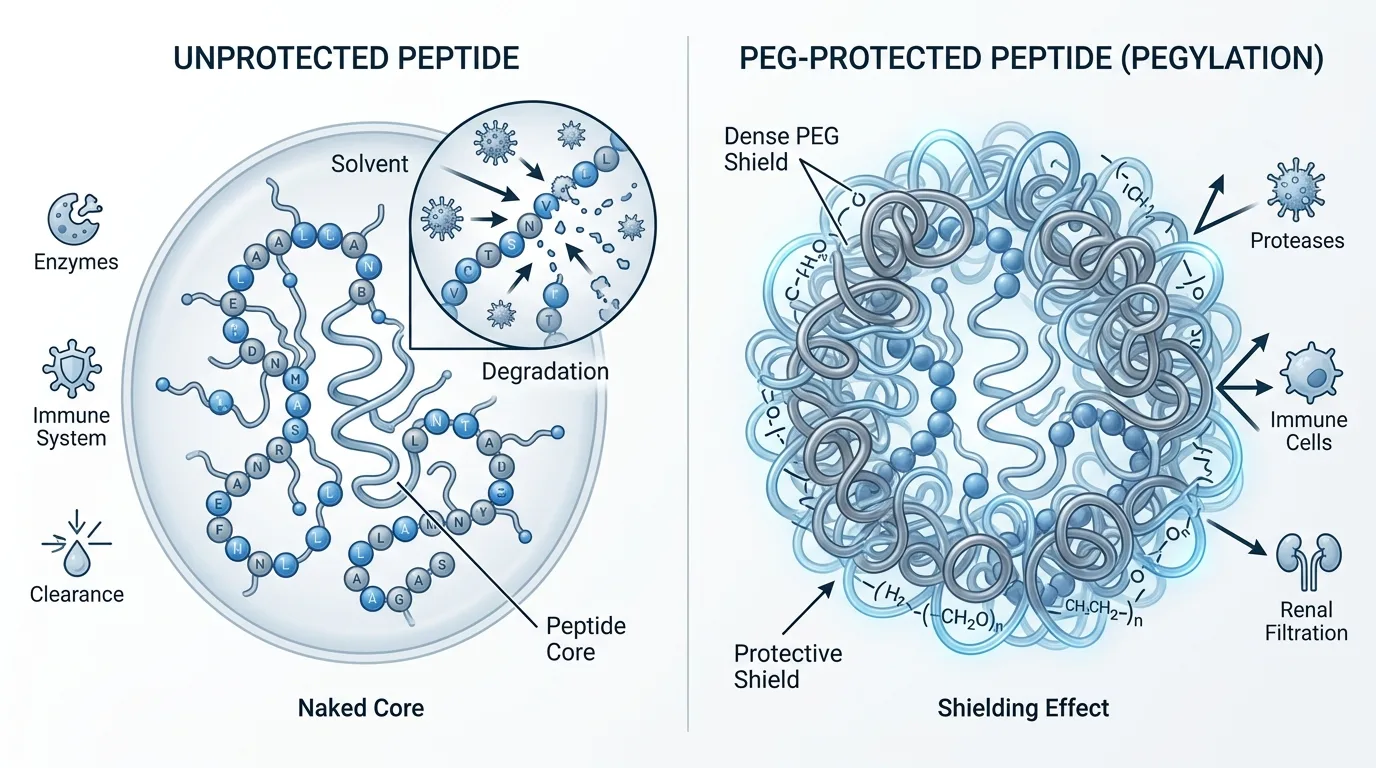
The kidney filtration problem is mechanical, not biological. The glomerulus, the filtering unit inside the kidney, passes small molecules out of the bloodstream based largely on size. Unmodified peptides sit well under the threshold where filtration slows down, which means they are flushed out of circulation quickly regardless of how biologically potent they might be.
PEGylation addresses this directly. Chemists attach chains of polyethylene glycol, a synthetic polymer, to the peptide. The PEG chains dramatically increase the molecule's effective hydrodynamic size, the size it appears to be as it moves through fluid, which slows glomerular filtration and extends how long the drug stays in circulation. Researchers sometimes describe this as a stealth shield, since the PEG coating can also reduce recognition by the immune system. The phrase is an analogy, not a mechanism. The actual chemistry is straightforward: bigger molecules filter out more slowly, and a PEG-coated peptide behaves, hydrodynamically, as something much larger than it actually is.
Pegfilgrastim, marketed as Neulasta, is a concrete example. It is a PEGylated version of filgrastim, a peptide used to stimulate white blood cell production in patients undergoing chemotherapy. The unmodified version required near-daily injections. The PEGylated version is typically dosed once per chemotherapy cycle. Same active peptide, radically different dosing burden, entirely because of a polymer chain attached after the fact.
Lipidation: Building a Slow-Release Reservoir
PEGylation solves the filtration problem by making a peptide look bigger. Lipidation solves a related but distinct problem: how to keep a peptide circulating and being released gradually, rather than clearing all at once or requiring repeated injections throughout the day.
The chemistry involves attaching a fatty acid chain to the peptide. That fatty acid tail allows the peptide to bind, reversibly, to albumin, the most abundant protein in blood plasma. Albumin acts as a carrier. The lipidated peptide binds to it, circulates attached to it, and gets released slowly over time as the binding equilibrium shifts. Effectively, the modification builds a small circulating reservoir out of the patient's own blood chemistry.
Semaglutide and liraglutide, both GLP-1 receptor agonists used in diabetes and weight management, illustrate this well. Liraglutide, which carries one fatty acid modification, requires daily dosing. Semaglutide, with a more extensively engineered fatty acid and linker chemistry, achieves weekly dosing. The comparison across these two drugs, and against a hypothetical unmodified GLP-1 peptide that would need to be dosed multiple times a day, maps a clear line from unmodified to lipidated to more heavily engineered lipidated versions.
Lipidation is not without tradeoffs. Attaching a fatty acid chain can alter how the peptide sits in its receptor binding pocket, which means formulation chemists have to balance albumin affinity against retained potency. Push albumin binding too far and the peptide may become so tightly sequestered that too little free peptide is available to activate its receptor. This balance is an area of ongoing optimization, not a solved engineering problem.
Acetylation and Other Chemical Guards Against Degradation
N-terminal acetylation targets a narrower vulnerability. Peptides have an exposed end, the N-terminus, that exopeptidases, enzymes that degrade peptide chains starting from the terminus and working inward, use as an entry point. Adding an acetyl group to that end blocks the enzyme's ability to grab hold, protecting the peptide from that specific mode of degradation.
Where PEGylation offers broad, size-based shielding across the entire molecule, acetylation is a targeted fix for one particular vulnerability. The two approaches solve overlapping problems, both extending a peptide's functional lifespan, but through different mechanisms and at different points on the molecule.
Methylation, the addition of a methyl group, and ubiquitination, the tagging of a protein with a small ubiquitin protein that typically marks it for cellular degradation, round out the major PTM categories. Both are far more relevant to how cells regulate their own proteins than to current pharmaceutical design. Ubiquitination in particular is difficult to harness therapeutically, since its natural role is to flag a protein for destruction rather than to protect it. Engineering these modifications into synthetic drug candidates remains a much harder chemistry problem than PEGylation or lipidation, and neither has produced an approved peptide drug built primarily around that mechanism.
Combining modifications, such as pairing acetylation with lipidation on the same peptide backbone, is an active area of formulation research. Whether these combinations reliably outperform single modifications in clinical settings is still being worked out on a case-by-case basis, rather than established as a general rule.
Synthetic vs Natural Modifications: A Side-by-Side Comparison
The distinction between synthetic peptide vs natural peptide modifications comes down to where the chemistry happens. Natural PTMs, phosphorylation, glycosylation, ubiquitination, arise inside living cells through enzymatic machinery that the organism already possesses. Synthetic modifications, PEGylation, lipidation, acetylation, are added in a laboratory, after the peptide has already been synthesized, specifically to engineer pharmacokinetic properties that the natural sequence lacks.
Measured against half-life extension, synthetic modifications currently dominate clinical use: PEGylation and lipidation both produce well-documented, multi-day extensions in approved drugs, while natural PTMs like phosphorylation are too transient to rely on directly. Measured against immunogenicity reduction, glycosylation and PEGylation both show meaningful effects, though the degree varies by peptide and patient population. Measured against manufacturing complexity, natural PTMs like glycosylation are more complex to control than synthetic modifications.