
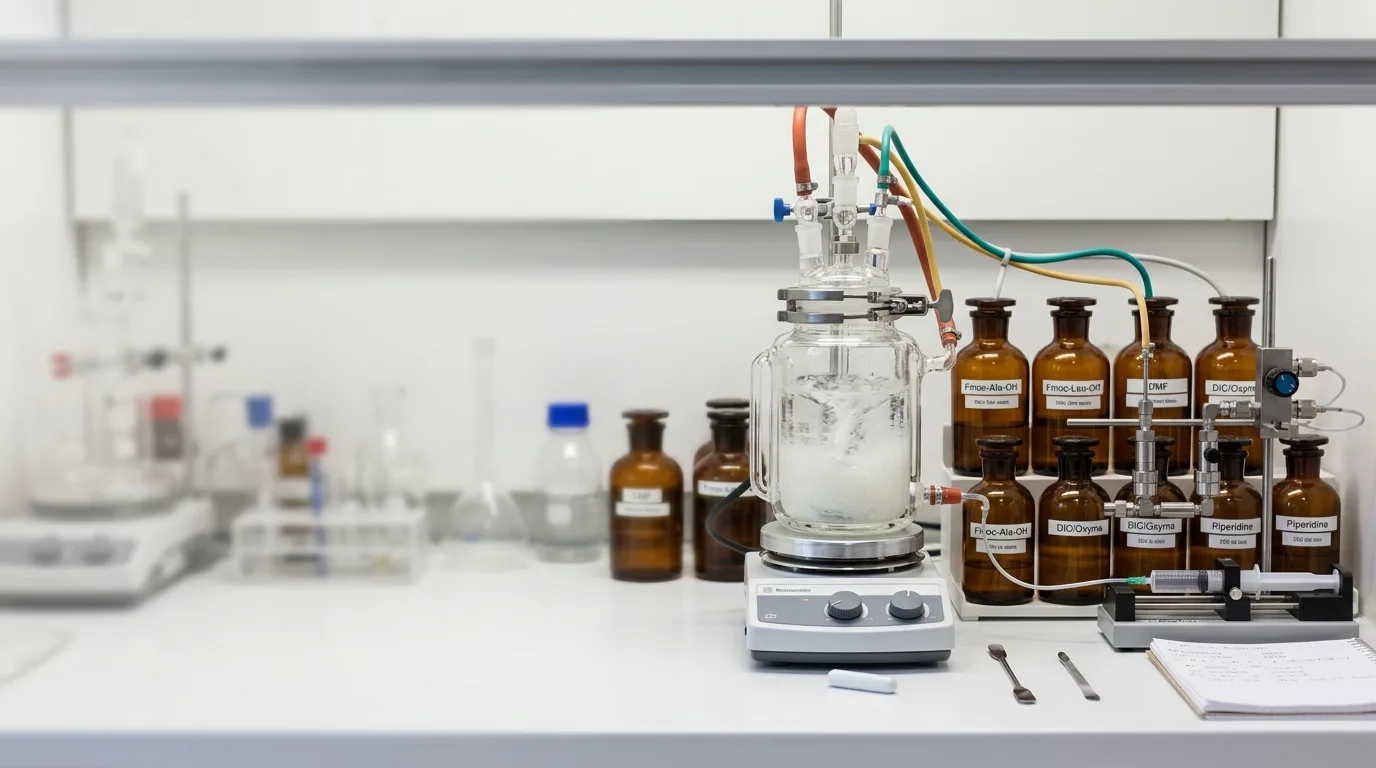
Tesamorelin presents one of the more demanding targets in therapeutic peptide synthesis. At 44 amino acids with a non-standard trans-3-hexenoic acid modification at the N-terminus, it sits at the intersection of long-chain Fmoc solid-phase peptide synthesis and precision bioconjugation chemistry. The tesamorelin synthesis Fmoc solid phase protocol must address three distinct failure points simultaneously: racemization at His-1, aspartimide formation at Asp-containing sequences, and aggregation-driven coupling failures along the hydrophobic mid-chain. Getting any one of these wrong produces material that fails pharmaceutical-grade release criteria, regardless of how well the rest of the synthesis proceeds.
The FDA approved tesamorelin (Egrifta) on November 10, 2010, for HIV-associated lipodystrophy, making it the first GHRH analogue approved for a metabolic indication in the United States. That regulatory context matters for synthesis planning: pharmaceutical-grade material requires final HPLC purity of ≥98%, confirmed isotope envelope by ESI-MS, and D-Tyr content below 1%. These are not aspirational targets. They are release criteria that define whether a batch is usable.
This guide is structured as a practical protocol reference for graduate researchers who already understand Fmoc SPPS fundamentals and need actionable chemistry for this specific 44-mer. It covers resin selection, protecting group strategy, chain elongation parameters, and the specific chemical interventions required at each critical failure point, followed by trans-3-hexenoic acid conjugation, global deprotection, and HPLC purification. Pharmacology is addressed only where it directly informs synthesis decisions.
What Is Tesamorelin and Why Is Fmoc SPPS the Synthesis Method of Choice
Tesamorelin is identical in primary sequence to endogenous human GHRH(1-44), modified by conjugation of a trans-3-hexenoic acid group to the alpha-amine of Tyr-1 at the N-terminus. The molecular weight is approximately 5,135.9 Da (monoisotopic mass). The modification is not decorative. Native GHRH carries a plasma half-life of roughly 6 to 7 minutes, limited by rapid DPP-IV cleavage at the His-Ala N-terminal dipeptide. The trans-3-hexenoic acid group sterically occludes that cleavage site, extending the half-life to approximately 26 to 38 minutes and enabling the approved once-daily 2 mg subcutaneous dosing regimen.
From a receptor-binding standpoint, the N-terminal residues 1 through 3 are critical for activation of the GHRH-R, a class B secretin-like GPCR. The C-terminal portion (residues 15 to 44) drives high-affinity binding, but activation requires the intact N-terminal geometry. The trans-3-hexenoic modification must preserve that binding geometry at His-1 despite adding a six-carbon unsaturated acyl chain. This imposes a strict constraint on conjugation chemistry: any modification that alters the alpha-amine configuration at His-1 destroys biological activity, which is precisely why His-1 racemization is a critical quality attribute.
Fmoc SPPS is the preferred synthetic route over Boc SPPS for several converging reasons. Fmoc deprotection uses mild base (piperidine) rather than the repeated strong acid (HF or TFA) cycles required by Boc chemistry, which would be incompatible with acid-sensitive side chains present across this 44-mer. Fmoc chemistry also offers a much broader selection of commercially available pseudoproline dipeptide building blocks and backbone-protecting group strategies, both of which are essential for managing the aggregation and aspartimide problems described below. Finally, Fmoc SPPS scales more cleanly in automated synthesizer platforms, which matters when producing material for analytical method development or formulation studies.
Resin and Protecting Group Strategy in Tesamorelin Synthesis Fmoc Solid Phase Protocol
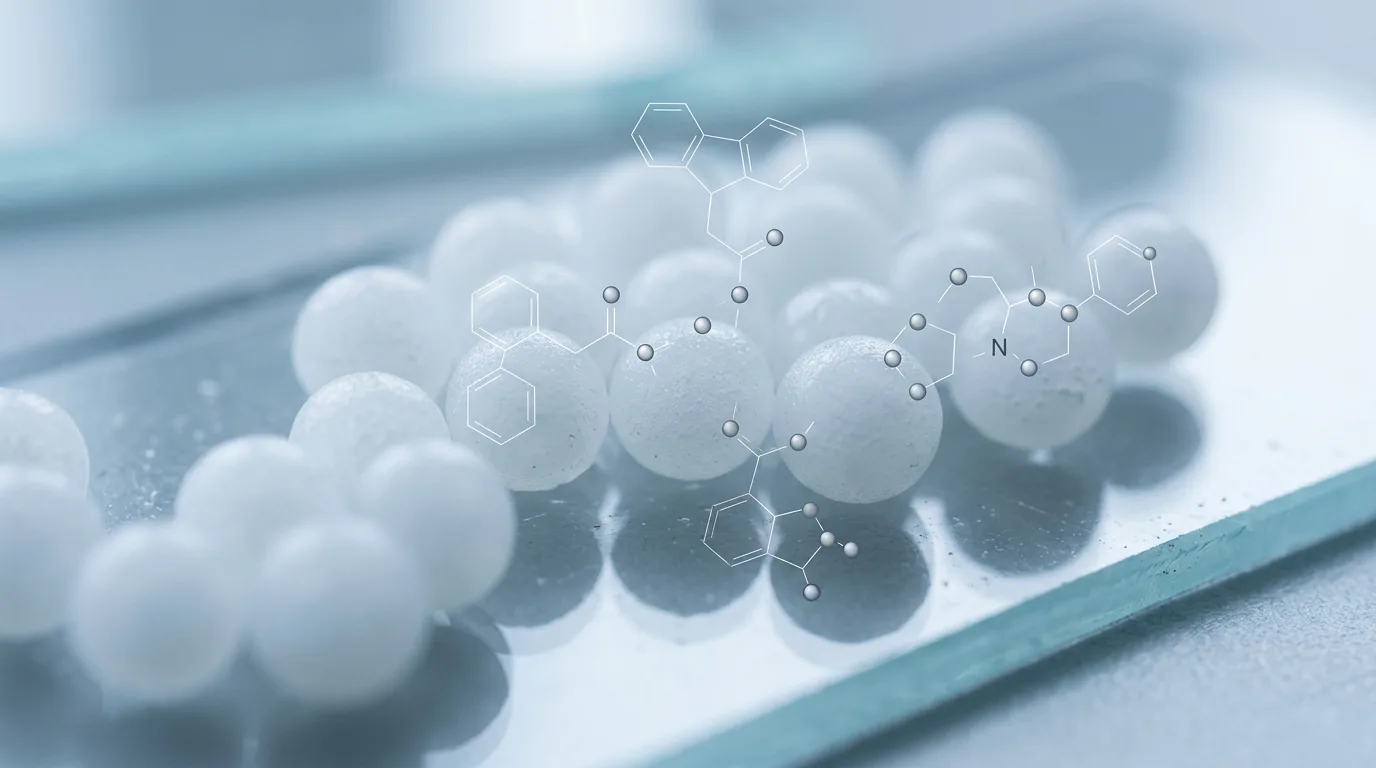
The C-terminus of tesamorelin is an amide, matching the native GHRH(1-44)-NH2 terminus. Rink amide MBHA resin is the standard choice, providing the required amide functionality upon TFA cleavage. Resin loading is a critical parameter for a 44-mer. A loading of 0.3 to 0.5 mmol/g is recommended. Higher-loaded resins (above 0.7 mmol/g) introduce steric crowding that compounds aggregation problems at the chain-elongation stage and reduces coupling efficiency in the mid-chain region. Verify actual loading by Fmoc quantification UV assay at 301 nm after resin conditioning; typical values for a 0.4 mmol/g target resin fall in the range of 0.38 to 0.43 mmol/g, confirming acceptable batch-to-batch consistency before committing to a full synthesis run.
Resin conditioning follows a standard sequence. Swell in DCM for 30 minutes, then exchange to DMF with two washes. Confirm swelling visually and proceed to Fmoc removal test before beginning the synthesis cycle. This solvent conditioning step is frequently skipped in time-pressured settings, but with a 44-mer it is not optional. Incomplete swelling restricts solvent penetration into the resin matrix and directly increases aggregation-related coupling failures in early chain-building steps.
The side-chain protecting group scheme for the full 44-mer follows standard Fmoc SPPS practice with a few positions requiring specific attention. tBu protects Ser, Thr, Tyr, Asp, and Glu. Pbf protects Arg. Trt protects His, Asn, Gln, and Cys. Boc protects Lys. For Asp residues specifically, the OtBu ester is used on the side chain, but this alone does not fully prevent aspartimide. The additional interventions required at Asp positions are addressed in the dedicated section below. The protecting group assignments here are summarized as a foundation; they interact directly with the aspartimide and racemization strategies that follow.
To compare resin loading ranges and their practical effects, consider that a 0.3 mmol/g resin loading typically yields lower steric density but requires larger resin bed volumes, while 0.5 mmol/g maximizes mass efficiency but increases aggregation risk. The 0.4 mmol/g midpoint represents the practical optimum for this chain length. These numbers highlight the trade-off between synthetic efficiency and coupling access that researchers must account for when planning scale.
Chain Elongation: Coupling and Deprotection Cycles
Standard Fmoc deprotection uses 20% piperidine in DMF applied in two cycles, such as 3 minutes followed by 7 minutes. This two-step protocol is important: the first treatment removes Fmoc and the second washes away the dibenzofulvene-piperidine adduct that would otherwise compete in subsequent coupling steps. Kaiser test or chloranil test (the latter preferred for secondary amines such as Pro) should be performed at each cycle to confirm complete deprotection before proceeding.
Coupling employs HATU/DIPEA or DIC/Oxyma in DMF with 4 to 10 equivalents of the incoming amino acid building block. A 30 to 60 minute coupling window is standard. The choice between HATU and DIC/Oxyma is not arbitrary; HATU provides faster activation but carries greater racemization risk at sensitive positions, while DIC/Oxyma is slightly slower but significantly gentler. The coupling reagent selection at Tyr-1 and at sterically hindered positions should default to DIC/Oxyma for this reason.
Cumulative coupling efficiency across a 44-mer synthesis is a practical concern that can be quantified clearly. At 99% per-step efficiency, the theoretical cumulative yield across 44 steps is approximately 64%. At 98% per-step efficiency, that drops to approximately 41%. At 97%, it falls to roughly 26%. These figures illustrate why even a 1% reduction in per-step efficiency has a pronounced effect on crude purity and HPLC purification burden. The breakdown illustrates why double-coupling protocols at difficult positions are not optional overhead but direct investments in final yield.
Double coupling is mandatory at sterically hindered positions including beta-branched residues (Val, Ile) and any position adjacent to N-substituted or conformationally constrained residues. If microwave-assisted SPPS is available, elevated temperature operation between 50 and 70°C significantly improves coupling kinetics in aggregation-prone mid-chain segments (roughly residues 14 to 30), reducing incomplete coupling and truncation sequences. NMP as a co-solvent in place of or alongside DMF also improves solvation of hydrophobic peptide-resin intermediates during the elongation of difficult segments.
Solving His-1 Racemization: The N-Terminal Challenge
His-1 racemization is a mechanistically distinct problem from the other two critical failure points in this synthesis. The alpha-carbon of histidine is particularly susceptible to epimerization under standard Fmoc coupling conditions because the imidazole side chain participates in base-catalyzed enolization. Under conditions involving strong activation with HATU and elevated temperature, or with prolonged reaction times, the alpha-carbon of His can equilibrate between L and D configurations. Even a small fraction of D-His-1 incorporation destroys the biological activity of the resulting peptide and will fail the <1% D-His release criterion by chiral HPLC.
The specific solution for the His-1 coupling step combines three parameters. First, use Fmoc-His(Trt)-OH as the building block. The Trt group on the imidazole nitrogen reduces the electron-withdrawing capacity of the side chain, which in turn lowers the tendency for alpha-carbon activation and epimerization. Boc and Mmt alternatives are less effective in this regard. Second, perform the activation step at 0 to 4°C rather than room temperature. The lower temperature slows the racemization pathway more than it slows the coupling reaction. Third, couple with DIC/Oxyma rather than HATU at this position specifically. Oxyma-based activation is gentler and does not generate the highly activated HOBt-OBt ester intermediates that increase racemization risk.
Coupling time at His-1 should be shortened relative to standard positions. A 20 to 30 minute coupling at 0 to 4°C with DIC/Oxyma typically gives complete reaction by Kaiser test without the extended activation exposure that promotes racemization. Confirm with a negative Kaiser test before proceeding. Do not extend the coupling time as a precaution against incomplete reaction; instead, perform a second coupling under the same conditions if the first Kaiser test is weakly positive.
After synthesis and cleavage, chiral HPLC analysis of the His-1 position is a mandatory QC checkpoint. Diastereomeric separation of the D-His and L-His-containing sequences should confirm D-Tyr content below 1%. This is a non-negotiable release criterion for pharmaceutical-grade material. Batches that pass MS confirmation but fail the chiral HPLC check at His-1 are not salvageable by further purification and must be discarded.
Preventing Aspartimide Formation at Asp Sequences
Aspartimide formation is a cyclization side reaction where the Asp side-chain carboxyl attacks the backbone amide nitrogen of the following residue, forming a succinimide ring and eliminating the side-chain protecting group. Under repeated piperidine exposure across 44 deprotection cycles, even low per-cycle rates of aspartimide formation accumulate into significant byproduct levels. The sequences most susceptible are Asp-Gly, Asp-Ser, and Asp-Asn. The tesamorelin chain contains Asp-3 adjacent to the His-Ala N-terminal region and additional Asp-Xxx sequences that must be evaluated against this criteria during retrosynthetic planning.
The primary chemical solution is backbone amide protection using pseudoproline dipeptide building blocks at Ser and Thr residues adjacent to or near Asp positions. Fmoc-Ser(tBu)-Ser(tBu)-ψ[Pro]-OH and Fmoc-Asp(OtBu)-Ser(tBu)-ψ[Pro]-OH dipeptide units introduce an oxazolidine ring that conformationally disrupts the backbone geometry required for the aspartimide cyclization. Specific pseudoproline pairs applicable to the tesamorelin sequence should be identified during sequence mapping before synthesis begins, with attention to all Asp-Ser and Asp-Thr adjacencies across the 44-residue chain.
A secondary chemical intervention is the incorporation of 0.1 M HOBt into the piperidine deprotection solution. HOBt acts as a nucleophilic competitor, intercepting the activated aspartimide intermediate before ring closure can occur. This is a low-cost addition that measurably reduces aspartimide byproduct levels. An alternative deprotection protocol that reduces base exposure is the 2% DBU plus 2% piperidine cocktail applied for a shortened time (2 times 2 minutes rather than 2 times 5 minutes). DBU is a stronger, non-nucleophilic base that completes Fmoc removal faster, reducing cumulative piperidine exposure across the full synthesis cycle.
For aspartimide-prone positions where pseudoproline incorporation is not structurally compatible, backbone amide protection with Hmb (2-hydroxy-4-methoxybenzyl) groups on the amide nitrogen provides an alternative. Hmb-protected building blocks are incorporated during coupling and are removed under standard TFA cleavage conditions. Comparative data from the literature illustrate the effectiveness of these interventions. Aspartimide byproduct levels in unprotected Asp-Gly sequences under standard 20% piperidine/DMF deprotection typically reach 5 to 15% of total crude peptide. Incorporation of 0.1 M HOBt in the deprotection solution reduces this to approximately 2 to 4%. Pseudoproline incorporation at adjacent Ser positions reduces aspartimide to below 1% in well-controlled syntheses. These numbers highlight why a layered strategy combining both pseudoprolines and HOBt additive is preferable to either intervention alone.
Managing 44-Mer Chain Aggregation During Elongation
Chain aggregation in long-mer SPPS is qualitatively different from the other two failure modes because it is not a discrete chemical side reaction at a single position. It is a progressive structural problem that emerges as the growing peptide chain adopts intermolecular beta-sheet-like hydrogen bonding patterns on the resin surface. For tesamorelin, the mid-chain hydrophobic segment spanning approximately residues 14 to 30 is the primary aggregation locus. Once aggregated, the resin-bound chain resists solvent penetration, and subsequent coupling steps show dramatically reduced efficiency or fail entirely, generating deletion sequences that are difficult to separate from the target during HPLC purification.
Pseudoproline dipeptide incorporation addresses aggregation through the same structural mechanism that prevents aspartimide: the oxazolidine ring introduces a conformational break that prevents the regular hydrogen-bonding pattern required for beta-sheet formation. Recommended insertion points for pseudoproline units targeting aggregation in the tesamorelin mid-chain region include Ser and Thr residues within the 14 to 30 segment. A useful guideline is to place pseudoproline units at intervals of no more than 8 to 10 residues within a hydrophobic stretch. The oxazolidine ring is cleaved under the standard TFA global deprotection conditions used at the end of synthesis, regenerating the native Ser or Thr residue without requiring separate removal steps.
Chaotropic additives in the coupling and washing solvents provide a complementary approach. Addition of 1 to 2 M LiCl or LiBr in DMF disrupts inter-chain hydrogen bonding by competing for the carbonyl and amide hydrogen-bonding partners that stabilize aggregated structures. This intervention is particularly useful in segments where pseudoproline incorporation is not chemically compatible due to the absence of nearby Ser or Thr residues. TBTU (0.1 M) as a coupling reagent complement has also been used to improve solvation of aggregated resin intermediates, though it should not replace the primary coupling reagent.
The backbone amide linker (BAL) strategy represents a more aggressive option for extremely difficult segments. BAL handles allow the peptide to be anchored through a backbone nitrogen rather than the C-terminal carboxyl, fundamentally changing the steric environment of chain elongation. The trade-offs are significant: BAL synthesis is more complex to set up, requires specialized building blocks, and is typically reserved for segments where pseudoproline and chaotropic additive strategies have both failed. For most tesamorelin synthesis campaigns, the pseudoproline-plus-LiCl approach is sufficient when applied systematically to the aggregation-prone region.
Trans-3-Hexenoic Acid N-Terminal Conjugation
The trans-3-hexenoic acid conjugation step is performed after full 44-residue chain elongation and final Fmoc removal, while the peptide remains anchored to the resin. On-resin conjugation is strongly preferred over solution-phase modification because the resin-bound environment minimizes the conformational freedom that would increase racemization or hydrolysis risk in solution. At this stage, the N-terminal alpha-amine of His-1 is free (after final Fmoc deprotection) and available for acylation.
The coupling protocol activates trans-3-hexenoic acid using HATU or DIC/Oxyma (3 to 5 equivalents relative to the resin-bound amine) with DIPEA in DMF. A 2-hour coupling time at room temperature is standard. Confirm completion by Kaiser test; a negative result (colorless beads) confirms full acylation of the alpha-amine. A positive Kaiser test at this step requires extended coupling or a fresh activation cycle before proceeding to cleavage.
Reagent quality is a non-negotiable variable at this step. Trans-3-hexenoic acid must be ≥98% pure, with the cis isomer content specifically characterized. Cis/trans isomer contamination is monitored by UV absorbance at 210 nm (the conjugated double bond absorbs here) and by HPLC retention time comparison against a reference standard. Even small percentages of the cis isomer incorporated at the N-terminus produce a regioisomeric product that co-elutes closely with tesamorelin on preparative HPLC and is difficult to remove cleanly.
Before committing to full-scale resin cleavage, perform an analytical mini-cleavage. Remove a small portion of resin (approximately 10 to 20 mg), cleave with TFA/TIS/water, precipitate with cold ether, and analyze by LC-MS. Confirm the correct monoisotopic mass of approximately 5,135.9 Da and the absence of the des-hexenoyl deletion product (which would appear at approximately 5,051 Da, corresponding to the unconjugated 44-mer). This checkpoint prevents committing the full resin-bound batch to cleavage conditions when the conjugation has not gone to completion.
Global Deprotection, Cleavage, and HPLC Purification
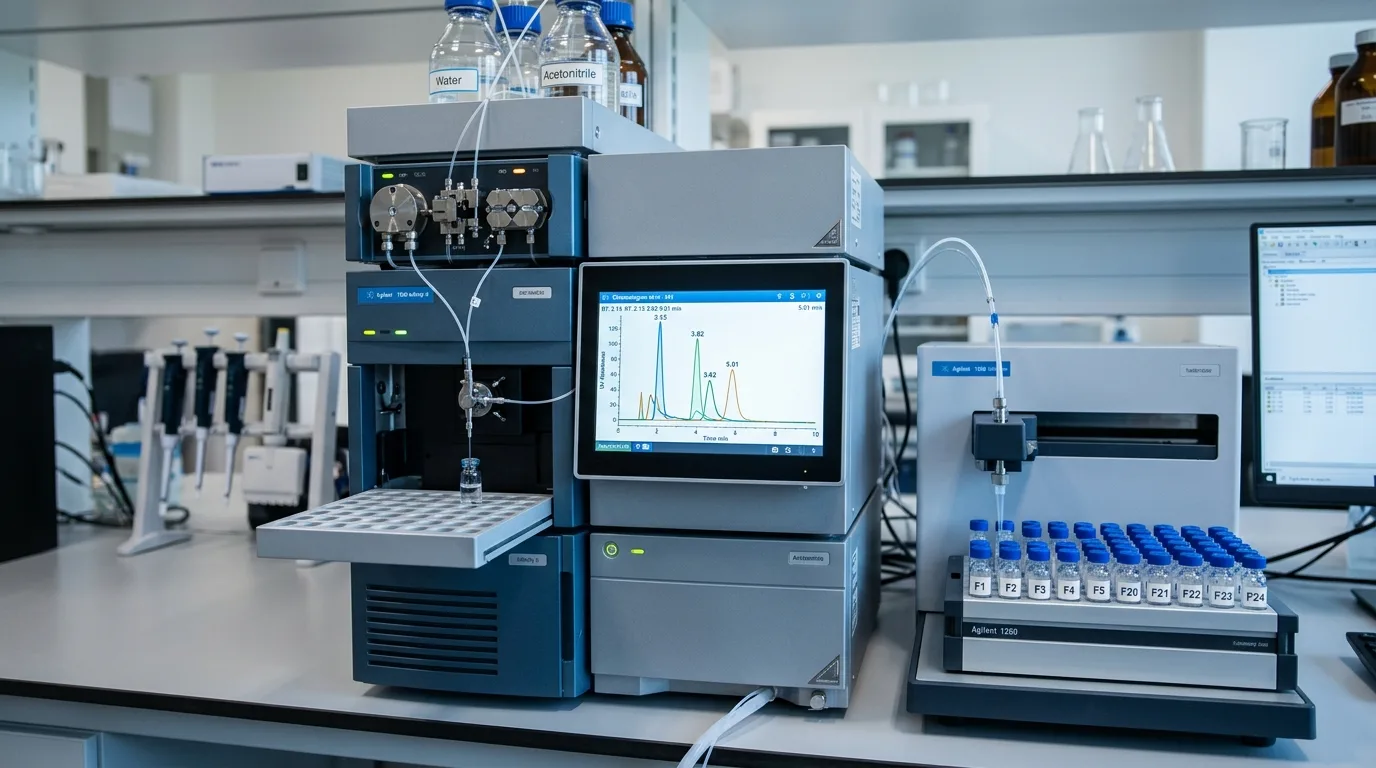
Global deprotection and resin cleavage use a TFA-based cocktail. The recommended formulation is TFA/TIS/water/DODT at a volume ratio of 92.5:2.5:2.5:2.5. DODT (3,6-dioxa-1,8-octanedithiol) is included specifically as a scavenger for the carbocation intermediates generated during Cys and Met side-chain deprotection. Without an effective thiol scavenger, alkylation of Cys and Met side chains is a significant competing reaction that produces difficult-to-separate adducts. TIS and water handle scavenging of tBu and Trt cations, respectively. The reaction is conducted at room temperature for 2 to 3 hours under nitrogen or argon.
After filtration to remove the resin, the crude peptide is precipitated by addition of cold diethyl ether (approximately 10 volumes, pre-chilled to minus 20°C). Repeat trituration three times, centrifuging between each wash to pellet the precipitate. The crude solid is then dissolved in water/acetonitrile (70:30 with 0.1% TFA) and lyophilized to give the crude peptide as a white to off-white powder.
Crude purity expectations for a well-executed tesamorelin synthesis follow a predictable range. A synthesis with careful double-coupling, pseudoproline incorporation, and optimized His-1 coupling typically yields crude material at 40 to 60% purity by analytical HPLC. Poorly managed syntheses (no pseudoprolines, standard His coupling conditions, no aspartimide suppression) routinely yield crude material below 25%, which dramatically increases HPLC purification burden and reduces final isolated yield. These numbers highlight the direct economic and practical impact of the protocol interventions described throughout this guide.
Reversed-phase HPLC purification uses a C18 column with 300 Angstrom pore size, appropriate for peptides in the 5,000 Da range where standard 100 Angstrom columns provide inadequate resolution of the target from closely related deletion sequences and modification byproducts. Gradient elution from 10 to 60% acetonitrile in 0.1% TFA over 60 minutes provides sufficient resolution for pharmaceutical-grade isolation. Pool fractions testing at ≥98% purity by analytical HPLC, confirmed by co-injection with reference standard. Target yield after purification from well-executed crude material in the 40 to 60% crude purity range is typically 15 to 30% of theoretical based on resin loading.
Mass spectrometric QC uses ESI-MS targeting the multiply charged ion series from [M+5H]5+ to [M+8H]8+, which are the dominant charge states observed for a 44-mer at approximately 5,100 Da. Confirm the correct isotope envelope and calculate the average mass to within ±0.5 Da of the theoretical value. The formal QC release criteria for pharmaceutical-grade tesamorelin are as follows. HPLC purity must be ≥98%. Molecular weight must match theoretical within ±0.5 Da by ESI-MS. D-His-1 content must be below 1% by chiral HPLC. Endotoxin must test below 1 EU/mg by LAL assay. Water content must be characterized by Karl Fischer titration if the lyophilized material will be weighed for dosing. All four criteria must be met before a batch is classified as pharmaceutical-grade material.
Synthesis Workflow Summary and Forward Outlook
The complete tesamorelin synthesis Fmoc solid phase protocol follows a sequential decision architecture. Begin with Rink amide MBHA resin at 0.3 to 0.5 mmol/g loading, verify loading by UV assay, and condition with DCM then DMF. Assemble the protecting group scheme with OtBu for Asp side chains, Trt for His, and standard tBu/Pbf/Boc elsewhere. Incorporate pseudoproline dipeptide building blocks at aggregation-prone mid-chain positions and at Asp-adjacent Ser or Thr residues before beginning elongation. Apply DIC/Oxyma at 0 to 4°C for the His-1 coupling step specifically. Use 0.1 M HOBt in the piperidine deprotection solution throughout, or switch to 2% DBU plus 2% piperidine for reduced base exposure at Asp-Xxx sequences. Couple trans-3-hexenoic acid on-resin after final Fmoc removal. Perform analytical mini-cleavage and LC-MS verification before full-scale cleavage with TFA/TIS/water/DODT. Purify by C18 reversed-phase HPLC to ≥98% purity. Confirm by ESI-MS, chiral HPLC for D-His, and endotoxin testing before release.
Each of the three critical failure points described in this guide, namely His-1 racemization, aspartimide formation at Asp sequences, and mid-chain aggregation, has a well-characterized chemical solution. None of them requires exotic reagents or equipment beyond what is standard in a peptide synthesis laboratory. The difference between pharmaceutical-grade tesamorelin and crude research-grade material is adherence to protocol checkpoints at each of these positions, not access to fundamentally different chemistry.
The trajectory of the field is toward reduced barriers to high-quality long-mer production. Microwave-assisted SPPS platforms operating at optimized temperature profiles for aggregation-prone 44-mers are making 24-hour synthesis cycles practical for chains that previously required 48 to 72 hours with elevated truncation rates. Automated synthesizers with in-line UV monitoring for real-time coupling verification are reducing the reliance on manual Kaiser test spot-checks, improving consistency across synthesis runs. These advances are directly applicable to tesamorelin and to the broader class of GHRH analogues that share similar sequence challenges.
For researchers building on this protocol, Molecule Notes maintains additional resources on GHRH analogue chemistry, analytical characterization methods for 44-mer peptides, and comparative HPLC method development for therapeutic peptide QC. The intersection of synthetic precision and analytical rigor is where pharmaceutical-grade peptide research happens, and the tesamorelin synthesis Fmoc solid phase protocol described here is a practical foundation for both.
Sources
- wikipedia.org — en.wikipedia.org
- flexpeptides.co.uk — flexpeptides.co.uk
- google.com — patents.google.com
- chemicalbook.com — chemicalbook.com
- peptideforge.com — peptideforge.com
- creative-peptides.com — creative-peptides.com
- moleculenotes.com — moleculenotes.com
- uci.edu — chem.uci.edu
- nih.gov — pmc.ncbi.nlm.nih.gov
- americanpeptidesociety.org — americanpeptidesociety.org
- google.com — patents.google.com
- google.com — patents.google.com
- google.com — patents.google.com
- sigmaaldrich.com — sigmaaldrich.com
- fda.gov — accessdata.fda.gov